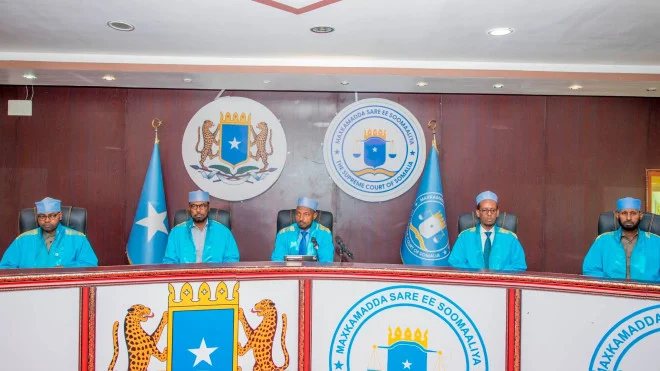
Mogadishu (AX) — Somalia’s Supreme Court on Thursday declared null and void President Hassan Sheikh Mohamud’s decision to dismiss Chief Justice Baashe Yusuf Ahmed, stating that the president lacks the constitutional authority to make such a decision unilaterally. The court accused the presidency of attempting to obstruct a politically sensitive constitutional case.
The Supreme Court’s forceful decision could trigger a direct confrontation between Somalia’s executive and judicial branches, one day after Mohamud dismissed Baashe and reappointed former Supreme Court Chief Justice Ibrahim Idle Suleiman to the position.
- Advertisement -
The Supreme Court said the dismissal statement issued by the presidency had no “legal basis” and clearly violated the separation of state powers, the independence of judicial institutions and the rule of law.
“The purpose of this dismissal was to interfere in a constitutional case that was already before the court, concerning amendments to Somalia’s Constitution and questions related to the terms of office of the president, the government and the federal parliament.”
“The document concerning the dismissal of the Chief Justice of the Supreme Court, published on the Presidency’s Facebook page, has no legal basis,” the court said in a statement issued on Thursday.
The court said the case before it directly addresses the process used to review the constitution, as well as the terms of office of federal-level institutions.
Former President Sharif Sheikh Ahmed filed the case on October 11, seeking to annul the constitutional amendments and the decisions arising from them. The Supreme Court registered the case the following day.
The federal government, for its part, had been preparing a legal defense related to the case. Last month, the State Attorney General’s Office asked both houses of parliament and the Ministry of Justice to submit all records documenting the process through which the constitutional amendments were approved.
In Thursday’s statement, the Supreme Court cited provisions of the 2012 Provisional Constitution and the revised 2026 Constitution, arguing that the president does not have the authority to dismiss the chief justice unilaterally.
The court noted that under Article 138 of the revised Constitution, the dismissal of the chief justice must be proposed by the Judicial Service Commission and then approved by a simple majority of both houses of parliament sitting jointly.
It also cited Article 135, which stipulates that the appointment of the chief justice must first originate with the Judicial Service Commission, receive parliamentary approval and then be formally made by the president.
The statement issued by the presidency on Wednesday did not clarify whether the Judicial Service Commission had proposed Baashe’s dismissal. It also did not state whether parliament had approved his removal or Suleiman’s appointment.
The Supreme Court formally issued two decisions: that Baashe’s dismissal was unlawful and that the president must uphold the constitution, judicial independence and the rule of law.
The presidency announced on Wednesday that Mohamud had dismissed Baashe following complaints from judges, judicial staff and legal scholars, who called for a transparent and impartial judicial system. It also said Mohamud’s plan was to carry out broad reforms of the justice institutions.
The presidency did not identify any specific allegations against Baashe, nor did it say that disciplinary measures had been taken. His dismissal was also never linked to the constitutional case before the court.
The Supreme Court categorically rejected the presidency’s claim that complaints were grounds for dismissal. It described the allegations against the judges as baseless and defended Baashe’s record of safeguarding judicial integrity, combating corruption and pursuing institutional reform.
The serious dispute emerged less than three months after the Supreme Court, led by Baashe, annulled the results of the Galmudug parliamentary and local council elections held on July 30 and ordered that the vote be repeated.
That decision forced the National Independent Electoral and Boundaries Commission to rerun the election on September 30. The court later approved the new results after determining that no valid legal challenge had been filed within the period prescribed by law.
The case led by Sharif is far broader. He is challenging the constitutional amendments underpinning the federal government’s electoral system and the 2027 election timetable. Sharif argues that the amendments were approved without following the required constitutional process and has warned that proceeding without an inclusive political agreement could lead to parallel elections.
Some Somali media outlets had previously linked Baashe’s dismissal to the case before the court, citing unnamed sources, but the presidency did not mention such a connection.
Suleiman previously led the Supreme Court before handing over the position to Baashe during the administration of former President Mohamed Abdullahi Farmaajo.