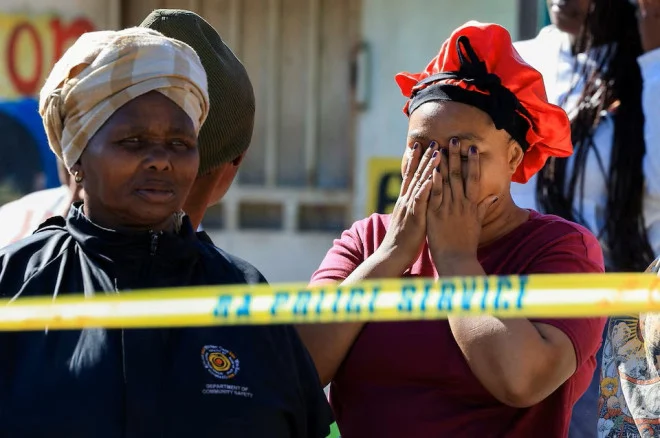
A person reacts at the scene of a shooting in Lwandle in South Africa’s Western Cape on September 27, 2026. REUTERS/Esa Alexander Purchase Licensing Rights
South African police were searching on Sunday for suspects linked to two separate shootings that left 27 people dead within hours, underscoring the country’s persistent struggle with gun violence.
- Advertisement -
The motives behind the attacks near Johannesburg and Cape Town remained unclear. Gang violence and organised crime are widespread in South Africa, despite government efforts to address one of the world’s highest murder rates per capita.
In Wedela township, roughly 80 km (50 miles) from Johannesburg, gunmen armed with AK-47 rifles opened fire at a tavern at about 9:30 p.m. (1930 GMT) on Saturday, killing 17 people and injuring 15, police said.
Residents were largely unwilling to discuss the attack. One resident said illegal miners, known locally as zama zamas — an isiZulu term meaning “taking a chance” — live in the gold-mining area, which experts identify as a hotspot for gun crime.
NO ARRESTS YET
Soldiers from the national army and police pathologists were deployed to the township, where two burned-out vehicles were visible. The tavern where the shooting took place displayed a sign below its trading hours stating: “No weapons allowed.”
In Lwandle, on Cape Town’s outskirts, crowds watched from behind police lines but declined to speak to journalists, citing fears for their safety. There, gunmen attacked a venue selling grilled meat at around 2:00 a.m. on Sunday, killing 10 people and wounding 11 others.
Police said in statements that no arrests had been made and detectives were working to identify and locate the attackers.
“South Africa has a serious illegal firearms problem, and firearms are frequently used by organised criminal groups as well as in gang-related and other violent crimes,” crime expert Yusuf Abramjee said.
THREAT TO DEMOCRACY
“Every mass shooting should therefore trigger more than an investigation into the immediate perpetrators,” he told Reuters. “Authorities need to look at the wider networks behind the violence.”
Crime is expected to rank among the leading concerns for voters in municipal elections in November, as the African National Congress confronts further losses in public support.
President Cyril Ramaphosa said earlier this year that organised crime had emerged as the greatest threat to South Africa’s democracy. He has also deployed the army to assist police in some areas.
A separate shooting at a house party near Durban on Tuesday night killed 11 people. Meanwhile, the discovery of women’s bodies near Johannesburg since July has intensified fear and anger over the country’s high rate of femicide.
Additional reporting by Nellie Peyton in Johannesburg and Shivani Tanna in Bengaluru; Writing by Nellie Peyton and Alexander Winning; Editing by Elaine Hardcastle and David Holmes