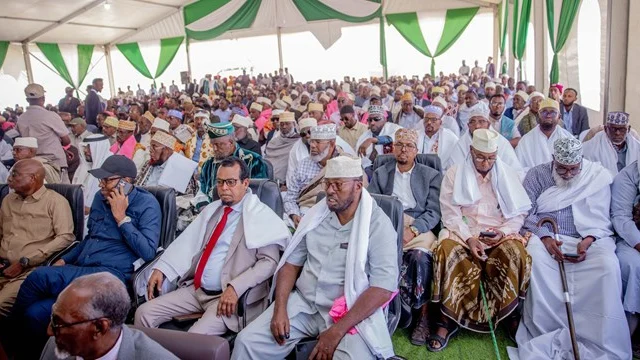

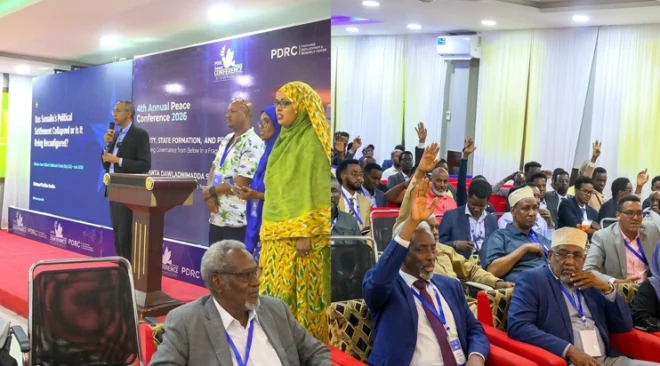
I attended the 4th PDRC Annual Peace Conference in Garowe, Somalia, from 21 to 23 September 2026, where I presented a paper titled: “Has Somalia’s Political Settlement Collapsed or Is It Being Reconfigured?”
The question was intentionally provocative. Somalia’s current political moment is increasingly being interpreted through two sharply contrasting lenses. One view holds that the country’s political settlement has collapsed. The other argues that constitutional amendments have been completed, the rules have changed and Somalia has therefore entered a fully reconfigured political order.I believe neither position adequately captures the reality.
- Advertisement -
Before presenting the paper, I asked participants to choose among three interpretations of Somalia’s political trajectory: Had the political settlement collapsed? Was it under severe strain? Or was Somalia entering a new political order?
I repeated the question after the presentation.
The shift in opinion was the most revealing result. Many participants who had initially concluded that the political settlement had completely collapsed moved toward the middle position after considering the evidence and discussion. Their revised view was that Somalia’s political settlement remains in place, but is under severe strain and undergoing reconfiguration.That distinction matters.
The first extreme: “The political settlement has collapsed”
There are compelling reasons why some observers have reached that conclusion.
Somalia has faced profound disputes over constitutional authority, electoral arrangements, federal–state relations, presidential and parliamentary mandates, and the rules of political competition. Relations between the Federal Government and some Federal Member States have worsened. Opposition figures have questioned the legitimacy of the constitutional process and the extension of institutional mandates. The traditional channels through which political elites negotiated the distribution of power are under significant pressure.These are not peripheral disputes; they concern the foundations of political authority.
Even so, the evidence does not support the conclusion that Somalia’s political settlement has completely disappeared.
A political settlement is more than a written constitutional agreement. It includes formal institutions, informal bargains, political expectations and the mechanisms powerful actors use to negotiate and manage competition. Federalism, clan-based inclusion, parliamentary institutions and negotiated forms of political competition have all shaped Somalia’s post-2012 political order.Important parts of that order remain intact.
Federalism has not vanished. Political actors continue to dispute how it should operate, where authority should reside and how powers should be exercised. But disagreement over the practice of federalism is not equivalent to rejecting federalism altogether.
Nor has political bargaining ended. Somali political actors continue to negotiate over mandates, institutions, elections, representation and political authority. The bargaining has become more difficult and increasingly focuses on the rules themselves, but it remains central to the political landscape.
State institutions also continue to function. Parliament, ministries, Federal Member State institutions and other bodies carry out their daily responsibilities. Political disputes have not produced a wholesale collapse of the institutional system.
Clan-based political inclusion remains significant. Although Somalia is moving toward direct elections, political actors continue to weigh representation, inclusion and political balance through familiar forms of negotiation.
Critically, Somalia has not entered sustained, nationwide political conflict between rival political elites. Serious confrontations have occurred, but they have not produced the kind of comprehensive institutional breakdown that would offer stronger evidence of a total settlement collapse.
On balance, the evidence more strongly supports the view that the settlement is under severe strain than the claim that it has ceased to exist.
The second extreme: “The new political order is already complete”
The opposing argument is no more convincing.
Somalia has undertaken substantial constitutional and institutional changes. The amendments altered important formal rules governing political authority, including the move toward a five-year institutional cycle and the transition to direct elections. The country has also begun holding local elections, putting parts of the emerging electoral architecture to the test. These are major developments. Yet institutional change alone does not amount to a completed political settlement.
A constitution may be amended, Parliament may approve new rules, institutions may adopt new procedures and elections may be held.But a political settlement becomes durable only when the principal political actors accept, accommodate or at least sufficiently recognize the rules that govern political competition.
That is where the difference between legal validity and political legitimacy becomes crucial.
A reform can be legally adopted through procedures recognized by state institutions while remaining politically contested by important actors. Likewise, political opposition to a reform does not automatically make it legally invalid. From the perspective of a political settlement, the central question is whether the new rules have gained enough political acceptance to regulate competition over time.That acceptance has not yet been demonstrated.
The constitutional amendments remain contested. Disputes continue over mandates, electoral timing, federal authority, relations between the Federal Government and Federal Member States, and the institutional arrangements governing the transition.The same is true of direct elections.
There has been significant institutional movement toward direct elections, but the debate has moved beyond the simple question of whether Somalia should adopt one-person, one-vote elections. Increasingly, the argument concerns how the elections will be administered, when they will occur, who will control the process, how federal and state elections will interact, and which institutions possess legitimate authority during the transition.That indicates an ongoing political reconfiguration, not a completed one.
The space between the two extremes
This is where the most useful analysis lies. Somalia’s political settlement has neither collapsed nor produced a consolidated new political order. The country is instead experiencing what is best described as a contested reconfiguration.
Existing arrangements are under pressure. Some formal rules are changing, new institutions and electoral mechanisms are taking shape, and political actors are challenging established distributions of authority. But the emerging configuration has not secured enough political acceptance to become a settled order. Somalia is therefore passing through a critical middle phase.
Old bargains are weakening while new bargains remain unconsolidated. This helps explain the apparent contradiction of contemporary Somalia: institutions can continue operating even as political legitimacy remains disputed.
That situation is not necessarily proof of political-settlement collapse. At the same time, functioning institutions do not prove that a new settlement has already been achieved. Institutional change can outpace political agreement. Indeed, that gap may define Somalia’s current political moment.
Why the distinction matters
Describing Somalia as having completely collapsed risks obscuring the institutions and political mechanisms that remain active and through which a new accommodation could still be negotiated. Declaring that the country has already completed its political transition, meanwhile, risks minimizing unresolved disagreements that could weaken the durability of the emerging rules.
Both interpretations therefore miss a central reality. The key question is not simply whether Somalia has a new constitution. It is whether the country has developed a new political bargain around that constitution. The distinction is fundamental.
Redesigning formal constitutional rules does not, by itself, create a new political settlement. That requires the principal political actors to accept the rules governing political competition.
Constitutional, electoral and federal disputes should therefore not be treated as separate crises. They are connected elements of a wider struggle over who has the authority to define the rules of political competition.
What happens next matters more than what we call it
Somalia’s prospects for a more consolidated political order will depend less on the existence of new constitutional language than on whether political actors can reach sufficient accommodation around the rules of competition.The question, therefore, should not be:
“Has Somalia changed its Constitution?”
The more important questions are: Do the principal political actors accept the new rules? Can disputes between the Federal Government and Federal Member States be handled through predictable mechanisms?
Can the transition to direct elections be agreed upon in terms of sequencing, administration, representation and dispute resolution? Can political inclusion be preserved as the country moves away from negotiated indirect elections? And perhaps most importantly:
Can Somalia restore a shared understanding of the rules governing political competition? The answers will determine whether the current reconfiguration ultimately develops into a durable political settlement.
The lesson from Garowe
The conversation at the PDRC conference reinforced the importance of avoiding simple conclusions in political analysis.Somalia is clearly undergoing profound political transformation. But transformation should not automatically be equated with collapse, just as constitutional change should not automatically be mistaken for consolidation.
The evidence points to a more complicated—and potentially more consequential—reality.
Somalia is in a critical middle phase: old political bargains are eroding, new institutional arrangements are emerging, and the political accommodation needed to make those arrangements durable remains incomplete.
The central takeaway is simple:
Institutional redesign cannot produce stability without political accommodation.
Somalia’s political settlement has neither collapsed nor consolidated a new order. It is undergoing a contested reconfiguration.The task now is not merely to defend the old order or proclaim the new one complete. It is to rebuild shared rules of political competition that Somalia’s principal political actors—and ultimately its citizens—can regard as sufficiently legitimate, inclusive and durable.
______________________________________________
Mohamed Mukhtar Ibrahim[email protected]