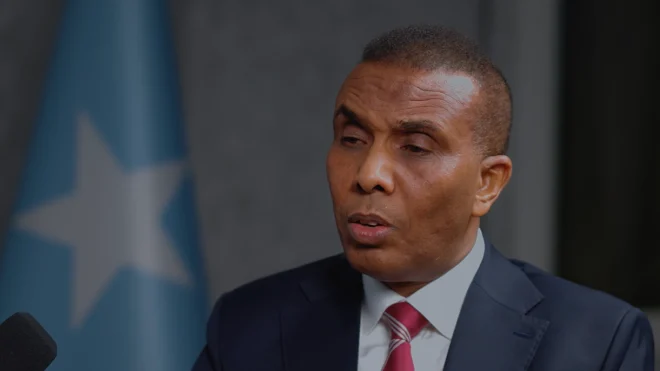
Mogadishu (AX) — Somalia’s federal government plans to proceed with elections in parts of Jubaland where voting can be conducted, while relying on alternative arrangements in districts blocked by insecurity or other obstacles, Prime Minister Hamza Abdi Barre said Saturday.
In an interview, Barre said Mogadishu wanted Jubaland to take part in the electoral process despite its unresolved political confrontation with the regional administration.
- Advertisement -
“The election will take place, and it will be held wherever it is possible,” Barre said.
He described Jubaland as a particularly difficult case, noting that the federal government does not recognize the region’s current administration and that several districts are either beyond government control or hard to reach.
Barre named Jilib, Bu’aale, Hagar, Jamaame and Badhaadhe among the areas where security and logistical problems could prevent or disrupt voting.
According to the prime minister, Somalia’s proposed “single constituency” electoral system includes mechanisms for districts where polling cannot be held.
He referred to elections in Iraq and Afghanistan, where insecurity prevented voting in some locations but authorities continued the broader electoral process through measures tailored to those conditions.
Barre did not explain how representatives from districts unable to vote would be selected, nor did he outline the specific form the alternative procedures would take.
His comments come as the federal government advances a one-person, one-vote system, a central element of President Hassan Sheikh Mohamud’s constitutional and political reform agenda. Officials have repeatedly pledged to replace Somalia’s long-running indirect electoral system with direct elections.
Jubaland and Puntland State remain among the most forceful critics of Mogadishu’s current electoral framework. Both regional administrations say significant changes must follow negotiations involving the federal government, federal member states and opposition groups. Proposals backed by opposition figures have also supported a transitional arrangement combining direct elections with aspects of Somalia’s existing clan-based power-sharing structure.
Barre separately addressed Puntland State, saying its circumstances were not the same as those in Jubaland.
He said voter registration and local government elections would start in Puntland State, while the region’s sitting leadership and parliament would be permitted to serve out their current terms.
The prime minister did not say how the plan could proceed without an agreement with Puntland State’s administration, which has remained outside the federal electoral process.
Puntland State and Jubaland have repeatedly opposed electoral measures they say Mogadishu adopted without consultation. The federal government, for its part, argues that direct elections are essential to ensure Somali citizens can choose their representatives.
Negotiations between the federal government and opposition groups have frequently broken down over the proposed electoral model. The disputes include how direct voting would be organized, how constituencies would be drawn and whether parts of Somalia’s 4.5 clan-based power-sharing formula should remain during a transition.
Barre’s statements suggest Mogadishu will continue pursuing elections even if nationwide voting proves impossible, using different arrangements for constituencies affected by insecurity, limited access or political disputes.