Mogadishu (AX) — The Federal Government of Somalia on Thursday ordered the ambassador of the United Arab Emirates to leave the country within 72 hours, while also urgently recalling its ambassador stationed in Abu Dhabi for consultations.
These sensitive decisions were announced following the weekly Cabinet meeting chaired in Mogadishu by Prime Minister Hamza Abdi Barre, where the Cabinet reviewed a report submitted by the Ministry of Foreign Affairs detailing what the government described as direct threats to Somalia’s sovereignty, independence and national security.
Information Minister Abdulfatah Qasim Mohamud, speaking to the media, announced the measures, confirming that the Cabinet had instructed the Ministry of Foreign Affairs to notify the UAE ambassador of the order to leave the country.
The ministry was also instructed to recall Somalia’s ambassador to the UAE to Mogadishu for in-depth consultations with the federal government.
The Cabinet further said that the Ministry of Foreign Affairs had been directed to formally inform the international community about what Mogadishu described as Abu Dhabi’s continued interference in Somalia’s internal affairs.
The government stressed that it would take all lawful measures to counter anything deemed a violation of the country’s sovereignty and territorial integrity.
The Information Minister also issued a stern warning to individuals and groups involved in activities that the government said were intended to undermine Somalia’s independence and national unity.
The government’s move on Thursday follows a diplomatic dispute that has rapidly intensified between Mogadishu and Abu Dhabi in recent days.
In a televised address on Tuesday, President Hassan Sheikh Mohamud accused the UAE of providing financial, political and security support to armed groups and regional administrations opposed to the federal government.
He also accused Abu Dhabi of establishing military bases and supporting security structures outside the control of Somalia’s constitutional institutions.
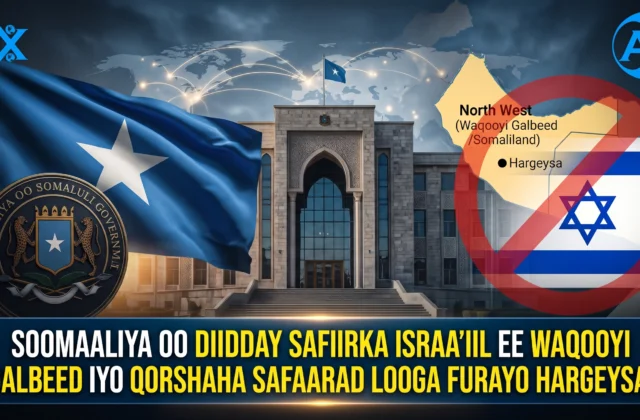
Hassan Sheikh criticized agreements between the UAE and the North Western State of Somalia, Puntland and Jubaland concerning the strategic ports of Berbera, Bosaso and Kismayo, stressing that negotiations and decisions on such agreements must be conducted through the federal government.
The president said the agreements undermine Somalia’s sovereignty and obstruct efforts to establish a unified national security system.
For its part, the UAE government has categorically rejected the allegations of interference.
On Wednesday, Anwar Gargash, diplomatic adviser to UAE President Sheikh Mohamed bin Zayed Al Nahyan, condemned Hassan Sheikh’s remarks, accusing Somalia’s leader of using relations between the two countries to serve personal political interests.
Gargash defended the UAE’s longstanding and extensive support for Somalia, warning against allowing Somalia’s internal political rivalry to become entangled with the broader competition unfolding in the region.
Somalia’s Ministry of Foreign Affairs said in a statement issued on Wednesday that it was deeply concerned about what it called the United Arab Emirates’ continued interference.
The ministry made clear that the federal government is the only legally responsible authority for Somalia’s foreign relations, categorically rejecting security or other agreements with foreign parties concluded without formal approval from the central government.
It called on the UAE to conduct all diplomatic, economic and security cooperation with Somalia through federal institutions, in accordance with international law.
The diplomatic dispute has escalated since January, when Somalia’s Cabinet annulled security, defense and economic cooperation agreements signed with the UAE, including arrangements concerning ports in the country’s regions.
Mogadishu said the decision was aimed at safeguarding Somalia’s sovereignty and territorial integrity.
The UAE continues to maintain longstanding economic and security ties with several Somali regional administrations, while the federal government has consistently rejected any action taken without an agreement and approval from the national leadership.