
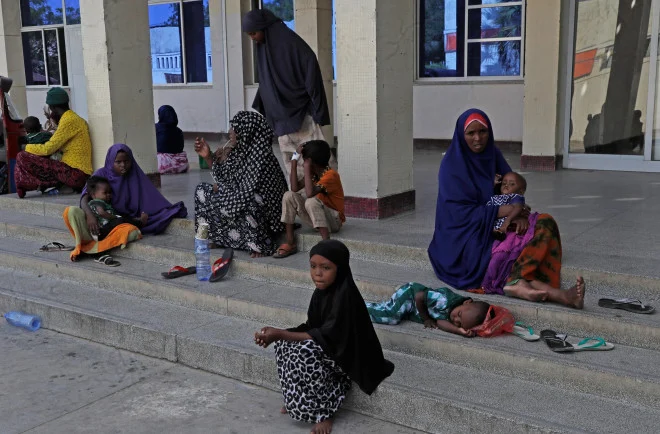
Patients sit at the entrance of Banadir Hospital in Mogadishu, Somalia, Tuesday, Nov. 11, 2025. (AP Photo/Farah Abdi Warsameh) Image license
Mogadishu (AX) — Nearly 400 health care facilities and several mobile units have closed across Somalia after funding support from the United States Agency for International Development (USAID) ran out, the country’s health minister announced Monday.
Minister of Health and Social Care Ali Haji Adan, speaking to the media in Mogadishu on Nov. 23, said the closures resulted from Somalia’s heavy reliance on international donors to finance essential health services.
The minister said the affected sites were mainly operating with humanitarian aid but could not continue after U.S. funding stopped.
He warned that Somalia’s health system remains highly vulnerable to changes in foreign assistance, as most community-level care services depend directly on international donors for funding.
“The suspension of financial support has severely harmed facilities involved in humanitarian aid projects and mobile health teams, which provided care to communities unable to access regular health services,” he added.
However, the minister did not specify the regions or districts where the facilities were located, nor did he provide figures showing how many people have currently lost access to health care.
Adan said nearly 600 other health facilities remain fully operational, supported by the country’s long-term health development programs.
The minister expressed hope that those facilities would continue providing essential services despite the financial challenges affecting Somalia’s health sector as a whole.
The minister’s comments come as international humanitarian agencies warn that decisions to reduce international aid are placing heavy pressure on the country’s health care system, which was already struggling with limited capacity.
Somalia relies heavily on donor-supported health programs to provide communities with maternal and child health care, essential vaccinations, disease prevention and treatment, particularly in rural areas and locations inhabited by people displaced by conflict and climate disasters.
Any shortfall in funding is raising serious concerns about the continuity of these services, as aid agencies face growing financial pressures.
The closures also come as Somalia continues to grapple with a series of humanitarian crises, including recurring droughts, severe food shortages, widespread displacement and outbreaks of preventable diseases.
The health minister did not present an immediate financial plan to reopen the closed facilities, nor did he give a specific timeline for restoring those services to the public.