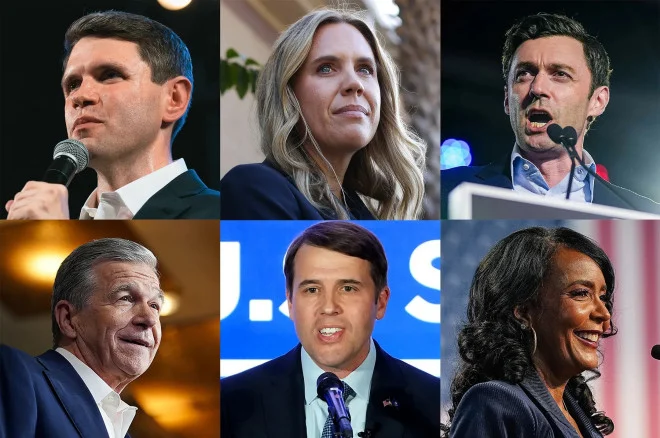
James Talarico, clockwise, Annie Andrews, Jon Ossoff, Keisha Lance Bottoms, Chris Pappas, and Roy Cooper
Source: Bloomberg (5); Getty Images
The Democratic Party won majorities in both chambers of the US Congress, dealing a major blow to Republican rule in Washington while opening the door to a new phase of confronting and restraining President Donald Trump’s policies.
- Advertisement -
Tuesday’s midterm elections revealed voters’ frustration with widespread inflation, the war in Iran and government corruption. Democrats recorded a series of victories across the country, taking states that had been controlled by Republicans for decades and where Trump had won by large double-digit margins two years ago.
Among the unexpected victories was James Talarico’s major win for a Senate seat in Texas, where no Democratic candidate had won statewide office in more than 30 years, as well as Annie Andrews’ hard-fought victory over Sen. Darline Graham in South Carolina. Trump had fully endorsed both defeated candidates.
In Michigan, progressive politician Abdul El-Sayed — one of several left-wing candidates who won Democratic primary elections — defeated Republican Mike Rogers. Even Maine Republican Sen. Susan Collins, known for her resilience and ability to survive difficult elections, lost to Democratic candidate Troy Jackson.
The results point to the collapse of the coalition that returned Trump to the White House two years ago, with young voters and Latino voters moving away from the Republican Party, according to data from The AP Voter Poll. Only about one-third of Hispanic voters said they supported Republican candidates in House races in their districts.
The outcome is a major blow to Trump, who held large rallies nearly every day over the past month to energize his supporters, but failed to prevent widespread losses for his party.
The results will reshape the remaining two years of Trump’s term
Although Trump has previously shown an ability to overcome efforts to restrain him, Democratic control of Congress will significantly shape his final two years in office and will effectively paralyze his legislative agenda.
Party leaders have made clear that they will use their new power to ensure that the final two years of Trump’s presidency are dominated by successive investigations targeting senior officials in his administration, as well as deep scrutiny of how he enriched his family. Impeachment proceedings targeting Trump and members of his Cabinet have not been ruled out. Defense Secretary Pete Hegseth and technology billionaire Elon Musk, formerly a senior adviser to Trump, are among the possible targets of investigations.
At celebratory events held Tuesday night, Senate Democratic Leader Chuck Schumer described the results as “a generational realignment of the Senate map.” House Democratic Leader Hakeem Jeffries said that “the American people are loudly demanding meaningful change.”
Trump immediately tried to shift blame for his party’s defeat, writing on social media before polling places had even closed on the West Coast that he was not on the ballot — despite spending weeks urging voters to vote as if he were a candidate. He promised to veto any legislation passed by Democrats, posting an image of a red hat bearing the word “VETO,” designed in the style of his campaign slogan, “Make America Great Again.”
In a late-night phone interview with Fox News, Trump insisted that he did not view the elections as a personal defeat. He said voters “didn’t like the candidates.”
Democrats had prepared for Trump to once again try to undermine confidence in the results if they won, after he had warned that noncitizens would vote in large numbers and filed lawsuits in Alaska and California. Instead, he told Fox that he would accept the results.
Despite the results, Senate Majority Leader John Thune wrote on X that “Senate Republicans will not sit on their hands while the socialist left wing of the Democratic Party tries to destroy everything we have accomplished.” He added that they would work with Trump “to stop the worst measures of Democratic extremism.”
Democrats charted a remarkable path to their Senate victory
Midterm elections typically put pressure on the president’s party, but Republicans had initially expected their Senate majority to be secure. Instead, Democrats won historic victories in some of the country’s most deeply conservative states.
Josh Turek defeated Rep. Ashley Hinson in Iowa, while Adam Hamilton unseated Sen. Roger Marshall in Kansas, becoming the first Democratic senator elected from the state since 1932. Other unexpected victories included Talarico defeating Ken Paxton in Texas, Andrews beating Graham in South Carolina, Sherrod Brown defeating Sen. Jon Husted in Ohio and Roy Cooper winning an open seat in North Carolina.
Trump played a prominent and visible role in many of the races. He backed scandal-plagued Paxton, helping him defeat incumbent Sen. John Cornyn in the Texas primary, despite warnings from Republican leaders that the move could prove costly. He also strongly criticized North Carolina Republican Sen. Thom Tillis, who chose not to seek reelection. He likewise stood by Graham, despite significant doubts within the party over whether she was the right person to fill the seat of her brother, who died unexpectedly earlier this year.
An unsurprising victory went to Democratic Sen. Jon Ossoff, who was reelected in Georgia after defeating Rep. Mike Collins. Rep. Chris Pappas also won the Senate race in New Hampshire, defeating former senator John Sununu to fill the seat of retiring Democratic Sen. Jeanne Shaheen.
One of the Senate races still unresolved is in Alaska, where the Trump administration filed a lawsuit seeking to block certification of the Senate results if Republican incumbent Dan Sullivan loses, arguing that the ballot included a second candidate named Dan Sullivan. The Senate race in Mississippi was also still too early to call officially.
In the House, Democrats made deep inroads into territory won by Trump, defeating candidates he supported and prevailing in some of the Republican Party’s strongest states. Democrats gained numerous seats in Iowa, Texas, Florida and Pennsylvania, and picked up new seats in Kentucky, Missouri, Nebraska, Ohio and Utah. In Iowa, all members of Congress representing the state had been Republicans before the election; Democrats will now represent three of those seats.
Knowing they faced a difficult night, Republicans spent tens of millions of dollars during the final phase of the campaign in states and districts that Trump had easily won by double-digit margins two years earlier, while Trump himself campaigned in areas that strongly support his party. But even the Republicans’ financial advantage could not contain the Democratic wave.
“I was not in