Mogadishu (AX) – The National Union of Somali Journalists (NUSOJ) has concluded two training sessions aimed at strengthening journalists’ professional skills. The sessions were held in Mogadishu and Galkayo and focused on media ethics, gender equality and cybersecurity.
The seminars, held from October 25 to 29, were supported by the United Nations Development Programme (UNDP) through the Bilan Project, with funding provided by the European Union (EU). Their primary objective was to promote women’s leadership, safety and equal participation across different sectors of Somalia’s media industry.
- Advertisement -
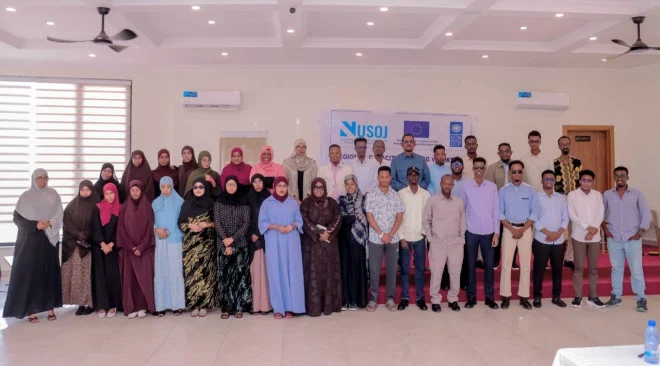
A total of 69 journalists benefited from the training, including 35 women and 34 men, exceeding the original target of 60 participants.
The training session in Galkayo, held from October 25 to 26, was attended by 35 journalists, comprising 18 women and 17 men. The reporters came from Puntland and Galmudug, specifically from the districts and cities of Garowe, Qardho, Galkayo, Adado, Abudwaq, Guriel and Dhusamareb. The forum provided professionals from the two administrations with an opportunity to exchange experiences, discuss the challenges they face and build professional networks. Meanwhile, the training held in Mogadishu from October 28 to 29 was attended by 34 people, including 16 women and 18 men.
“Journalists can serve the public best when they work in a safe environment, uphold media ethics and are granted fair rights. These programmes strengthened their practical skills and gave working journalists a safe forum to discuss discrimination, online threats and the challenges facing women in the media. We want these discussions to produce respectful media workplaces where men and women can contribute equally and work with dignity and safety,” said Nima Hassan Abdi, NUSOJ’s organising secretary.
Participants held detailed discussions on how ethical, gender-sensitive reporting can strengthen public trust and improve coverage of issues affecting women and other sections of society. The meeting also focused on fact-checking, balanced reporting and avoiding language that could fuel conflict. Discussions also addressed the role of newsrooms in upholding professional standards, taking responsibility for staff safety and resolving ethical complaints.
Workplace conditions were another major topic of discussion. Particular attention was given to harassment, discrimination, equal access to training opportunities and the need for clear mechanisms to report and address incidents. Participants also stressed the importance of written contracts, timely payment of salaries, maternity and sick leave, gender-based pay gaps, breastfeeding breaks and workplace health protections.
The cybersecurity segment addressed issues including online harassment, threats and the misuse of digital content, particularly sexually explicit images created using artificial intelligence (AI). Journalists examined ways to protect themselves, their data and their sources, while calling on media organisations to take strong action against online threats facing journalists.
Presentations, real-life examples, group exercises and round-table discussions enabled participants to relate the training’s key themes to the practical circumstances they encounter every day. In Galkayo, the training was officially opened by Mudug Governor Abdiweli Jibril Beyle, who praised the professional initiative.
The training sessions strengthened ties and knowledge-sharing among journalists from different locations and media outlets. The initiative forms an important part of NUSOJ’s broader efforts to improve working conditions, promote the leadership of women journalists, enhance their safety and ensure their equal representation in Somalia’s media industry.