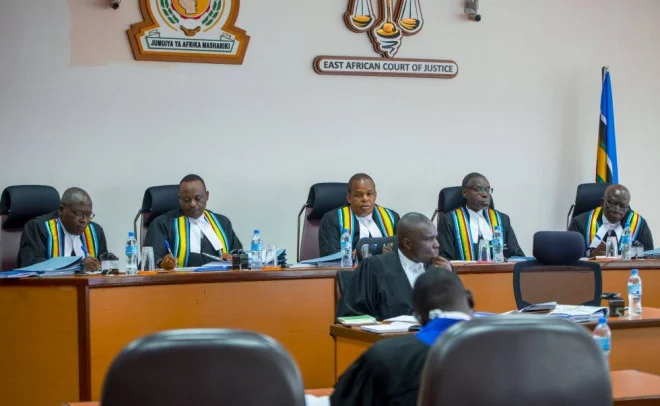
Mogadishu — Six judges of Somalia’s Supreme Court, including Baashe Yusuf Ahmed, whose position as chief justice became the subject of a dispute, have filed a case against the federal government at the East African Court of Justice (EACJ).
In an official notice dated Nov. 18, the court’s First Instance Division, based in Arusha, Tanzania, gave Somalia’s attorney general 45 days from the date of service of the notice to respond to the case, registered as Reference No. 69 of 2026.
The notice stated that if the government fails to respond within the specified period, the court may proceed to hear and determine the case in the absence of the federal government.
“You are hereby required to file a response within 45 days from the date this document is served on you. Should you fail to do so, the case will be heard and determined in your absence,” the court notice said.
The six judges who filed the case are Baashe Yusuf Ahmed, Salah Sheikh Ibrahim Diblawe, Abdulkadir Idris Essa, Abubakar Ahmed Ali, Abdikafar Hussein Isak and Abdiaziz Mohamed Yusuf.
The case names Somalia’s attorney general and the Federal Republic of Somalia as respondents.
The judges are challenging the steps taken by the federal government after President Hassan Sheikh Mohamud removed Baashe as chief justice of the Supreme Court on Nov. 4.
They are also seeking a legal investigation into alleged presidential interference with the independence of the Supreme Court and the obstruction of its work following the dispute between the two sides.
The case follows a bitter confrontation that began when Hassan Sheikh removed Baashe, one day before the Supreme Court was scheduled to issue a ruling on the constitutionality of amendments extending the terms of the president and parliament from four years to five.
On Nov. 5, a five-judge panel ruled that the constitutional amendments could not be applied retroactively to officials currently in office.
The court stated that Hassan Sheikh’s presidential term ends on May 15, 2026, while the terms of both chambers of the federal parliament ended on April 14.
It ordered political stakeholders to reach an agreement on the electoral framework within 30 days and directed that elections be held within 90 days.
The Supreme Court also ruled that Baashe’s removal was unconstitutional, saying the president had no legal authority to remove the chief justice unilaterally without following constitutional procedures.
The federal government rejected those decisions, insisting that the constitutional amendments provide the current administration with a legal basis to remain in office until the elections planned for 2027.
Somalia’s attorney general also rejected the Supreme Court’s jurisdiction to hear the case, casting doubt on the legality of the steps it had taken.
Despite the Supreme Court’s rejection, Hassan Sheikh on Nov. 7 attended the swearing-in of Ibrahim Idle Suleiman, who had been appointed the new chief justice, further intensifying the dispute over the leadership of the country’s highest judicial institution.
The ongoing crisis has also drawn international criticism.
United Nations human rights experts on Nov. 12 condemned Baashe’s removal, describing it as a violation of judicial independence.
The experts said that several Supreme Court judges had been stripped of their personal security details and subjected to movement restrictions.
They called for Baashe to be reinstated, for the judges’ security arrangements to be restored and for actions allegedly undermining the independence of the justice system to cease.
The latest case has brought the dispute before the East African Community’s judicial system, where the six judges are seeking a legal review of the federal government’s decisions.
Somalia became a full member of the East African Community in 2024, bringing it under the regional framework that includes the East African Court of Justice.
The EACJ is responsible for interpreting and enforcing the East African Community Treaty and hearing cases that fall within its jurisdiction.
The Nov. 18 notice marks the beginning of the formal process for seeking the government’s response and is not a ruling on the legality of Baashe’s removal or the constitutional decisions issued by the Supreme Court.
The federal government has not yet publicly clarified how it will respond to the case before the regional court.
The case opens a new legal front in Somalia’s political turmoil, as major disputes remain over constitutional review, the terms of the president and parliament, and the national electoral process.