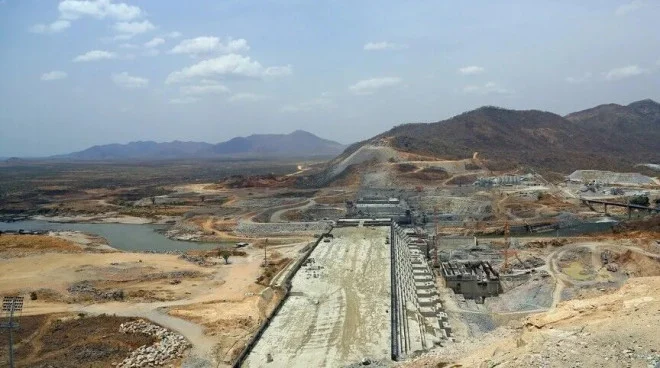
Egypt has declared the Grand Ethiopian Renaissance Dam (GERD) “illegitimate” and warned that it retains the right to take any measures it considers necessary to safeguard its water security, Irrigation and Water Resources Minister Hani Sewilam said Sunday.
Sewilam spoke during a Cairo briefing with foreign media representatives in Egypt, organized by the State Information Service.
- Advertisement -
For years, Egypt and Ethiopia have been locked in a dispute over the GERD, which Addis Ababa began constructing on the Blue Nile in 2011. Cairo has repeatedly pressed for a legally binding agreement governing the dam’s operation to protect its water supplies.
Sewilam said the dam’s completion and the passage of time did not amount to Egypt’s acceptance of the situation or a surrender of its rights.
He said the 2015 Declaration of Principles, signed by Egypt, Ethiopia and Sudan, was designed as a roadmap establishing commitments to cooperation, an agreement on the dam’s initial filling and annual operations, and the coordination and exchange of data.
The declaration does not authorize Ethiopia to act unilaterally on issues concerning the dam, Sewilam said. He added that continuing to fill and operate the facility without an agreement violates those commitments.
“The dam is illegitimate and will remain so. Egypt has the right to take appropriate action to remove the harm caused to it,” he said.
“We gave Ethiopia more than one opportunity and tried every possible way to reach understandings, but it did not respond and also violated the Declaration of Principles,” he added.
Potential risks
Sewilam cautioned that operating the dam without coordination could produce sudden surges or steep drops in water flows, with possible consequences for dams in both Egypt and Sudan.
Egypt’s central concern, he said, is not simply Ethiopia’s use of the dam to produce electricity, but the timing and volume of water releases and the rules that govern them.
“Ethiopia’s actions and statements by its officials indicate that the primary purpose of building the dam is not electricity generation,” he said.
Sewilam emphasized the need for a legally binding agreement that establishes procedures for prolonged droughts and periods of repeated flooding.
He also rejected Ethiopia’s assertion that Egypt receives the “lion’s share” of Nile water.
Egypt’s annual allocation of 55.5 billion cubic meters accounts for about 2.7% of the approximately 2 trillion cubic meters of rainfall recorded across the Nile Basin, he said.
According to Sewilam, Ethiopia received more than 1 trillion cubic meters of rainfall in 2023, including roughly 467 billion cubic meters in the Ethiopian section of the Nile Basin. Its renewable water resources total about 122 billion cubic meters a year, he said.
He said estimates of annual groundwater recharge in Ethiopia range from 51 billion to 81 billion cubic meters and are connected to rainfall. Egypt’s deep groundwater reserves, by contrast, are non-renewable, he said.
Ethiopia has more than 18 million hectares of agricultural land, compared with approximately 4.03 million hectares in Egypt, Sewilam said.
He said Ethiopia’s rain-fed agriculture consumes about 148 billion cubic meters of “green water” each year, in addition to approximately 9.68 billion cubic meters of “blue water.”
Green water refers to rainfall, while blue water comes from rivers and groundwater sources.
Sewilam put Ethiopia’s total annual agricultural water use at around 158 billion cubic meters. The water footprint of its livestock sector, he said, is approximately 85.5 billion cubic meters, the majority of it green water.
He urged wider cooperation in rainwater harvesting, groundwater management and efforts to make agricultural water use more efficient.
He also highlighted Ethiopia’s potential for solar and wind power, saying a more diverse energy mix could reduce water-related pressures.
Cairo and Khartoum have called for a legally binding trilateral agreement among Egypt, Sudan and Ethiopia governing the GERD’s filling and operation, arguing that it is necessary to protect their water rights and interests.
Ethiopia maintains that operating the dam does not require a binding agreement and says it has no intention of harming the interests of other countries.
The dispute prompted a three-year suspension of negotiations among Egypt, Sudan and Ethiopia in 2020. Talks resumed in 2023 but stalled again in 2024.