
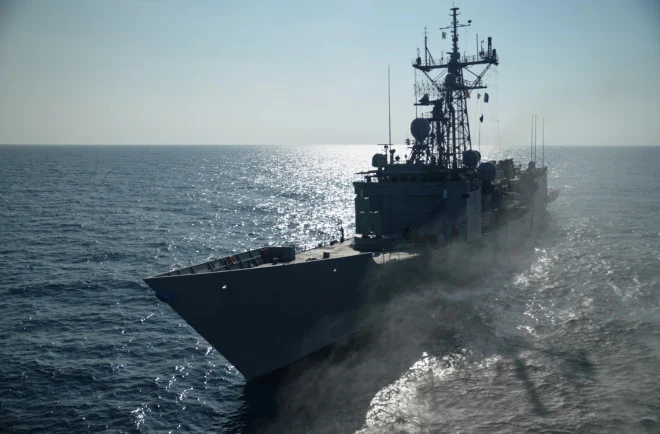
The Spanish frigate Santa Maria, flagship of the European Union’s anti-piracy mission, Operation Atalanta, sails off Djibouti, about 40 nautical miles from the Bab el-Mandeb Strait, Thursday, Nov. 5, 2026. (AP Photo/Sam McNeil) License this photo
Across the blue waters of the Gulf of Aden, a large cargo ship moves cautiously toward the strategic Bab el-Mandeb Strait, a busy waterway now overshadowed by regional conflicts and the growing threat of piracy. Not far away, specially trained Spanish forces aboard a warship remain on high alert, their weapons ready.
“Fuego!” shouted the officer leading the exercise as four members of the special forces, wearing sunglasses, face coverings and bulletproof vests, repeatedly fired pistols and assault rifles at targets marked with the most vulnerable parts of the human body.
Although this was only a military exercise, the threat posed by pirates is real and ongoing. The fast-moving ship is leading the European Union’s maritime security operation in the Gulf of Aden and the waters off Somalia. The forces are sharpening their combat skills so they will be ready if ordered to forcibly seize vessels captured by pirate groups.
Piracy has once again surged between the Red Sea and the western Indian Ocean, as conflicts in Yemen, the Horn of Africa and Iran have disrupted the stability of communities surrounding shipping routes vital to the global economy. Naval commanders point to an indirect connection between the ongoing wars and the resurgence of piracy.
“Instability creates more instability. Insecurity encourages illegal activity. And illegal activity causes communities to turn toward the sea,” said Vice Adm. Ignacio Villanueva, commander of the European Union’s Operation Atalanta, in an interview with The Associated Press.
Operation Atalanta, a broad naval force established in 2008 to combat piracy, patrols the western Indian Ocean and the Gulf of Aden, at the southern edge of the Arabian Peninsula. About 80 kilometers (50 miles) to the north lies Bab el-Mandeb, one of the world’s most important economic chokepoints, through which, in times of stability, nearly 12% of global trade passes, including a quarter of all container traffic between Asia and Europe.
Spanish Lt. j.g. Francisco de Asis Aznar, officer of the watch, looks through binoculars on the bridge of the frigate Santa Maria during a European Union anti-piracy patrol in the Gulf of Tadjoura off Djibouti, Thursday, Nov. 5, 2026. (AP Photo/Sam McNeil) License this photo
The Bab el-Mandeb Strait, which is less than 30 kilometers wide, has become an arena for fierce competition between Yemen’s Saudi-backed government forces and the Iran-backed Houthi rebels. As traffic through the Strait of Hormuz has faced widespread disruption, Bab el-Mandeb has become another vital route for oil exports from the Persian Gulf, further increasing the importance of the strategic waterway.
A Spanish frigate patrols for pirates
The Associated Press was granted rare access to the Spanish warship leading the European Union’s Operation Atalanta in the region.
More than 200 male and female sailors are aboard the ESPS Santa María, a 40-year-old warship weighing 4,000 tons and equipped with heavy machine guns, artillery, torpedoes and other modern missiles. A helicopter and drones regularly take off from the rear of the ship to conduct aerial surveillance and deter groups seeking to carry out acts of piracy.
Attacks targeting cargo ships traveling off East Africa threaten the livelihoods of Western countries, said Cmdr. Fernando María Zumalacárregui Alario, commander of the Santa María.
“If it is endangered, if it is threatened, you will not get the things you need to live. The cost of living will skyrocket, and our lives will become much worse,” he told AP from the ship’s upper command deck.
Since the Houthis began targeting ships passing through Bab el-Mandeb in November 2023, citing Israel’s war in Gaza, there have been 79 piracy attacks across the region, nearly 30 of them occurring after the war involving Iran erupted in February, said Portuguese Commodore José Rodrigues Pedra, the naval commander of Operation Atalanta.
“I am not saying there is a direct connection to the current crisis, but what I can confirm is that conflicts generate further turmoil,” the commander said from his private cabin aboard the Santa María.
Operation Atalanta also operates a surveillance aircraft from a French military base in Djibouti. The aircraft conducts aerial patrols using radar, advanced onboard cameras and naval imaging systems equipped with long-range lenses.
Intelligence gathered is shared with allied military units participating in the operation from European countries, the United States, South Korea, Japan, India and other regional powers.
Atalanta is one of two European Union naval forces in the area. The other, known as Operation Aspides, focuses specifically on security in the Red Sea and has more ships deployed there.
Pirates are exploiting turmoil in the region
After years of declining attacks, Somali pirates are once again making a comeback, driven by economic hardship, widespread malnutrition, political disputes and internal conflicts, experts say. About 30% of the population is facing dangerous levels of food insecurity, according to the United Nations in February, amid decisions to cut international aid.
Pirates based in the Puntland administration have hijacked oil tankers and also seized a Turkish vessel carrying weapons for the Somali government. Off Yemen’s coast, pirates have attacked ships before taking them toward Somalia, demonstrating a new tactic exploiting the turmoil in the southern Arabian Peninsula.
The Associated Press confirmed the resurgence, with six commercial ships hijacked between April and August this year.
Five of those vessels were later freed. However, the MT Asana, flying the Tanzanian flag and seized in July, remained in the hands of pirate groups in Somali waters, according to the latest Operation Atalanta report issued Oct. 16. The International Maritime Organization said earlier that month that 22 sailors were still being held hostage aboard the vessel.
Even when ships are forcibly seized, captive sailors face mortal danger. Five crew members died during the September operation to free the oil tanker Honour 25, which had been hijacked since April. The IMO said 44 sailors were rescued from that vessel and two other tankers, named Eureka and Sibu 1, also known as Seamull.
Many attacks have targeted fishing boats, which the groups use as floating bases from which to launch assaults on cargo ships. Indian forces rescued an Iranian fishing boat early in November after an operation lasting more than 48 hours, India’s Defense Ministry said.
Piracy