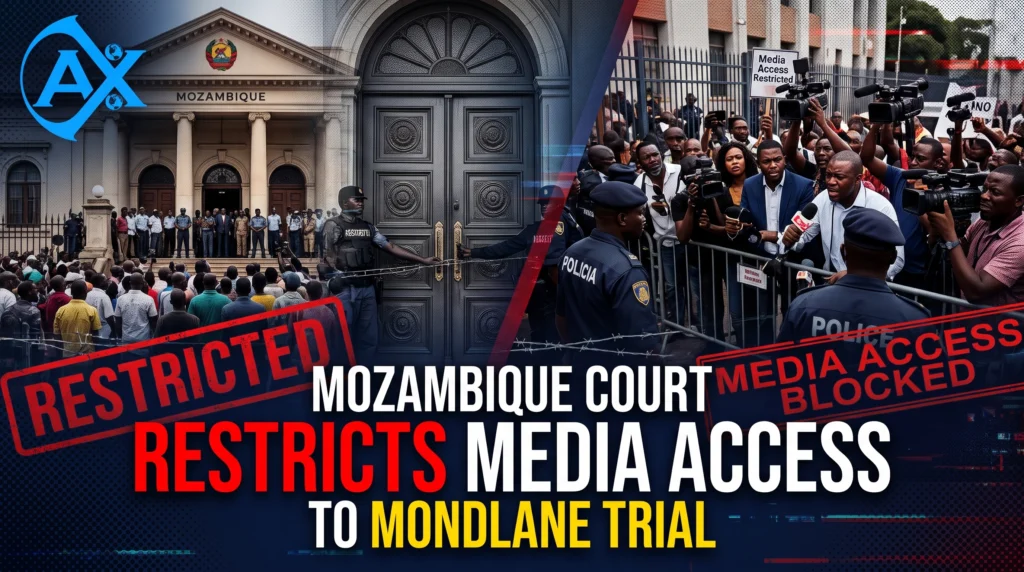
Mozambique’s Supreme Court has announced that only selected media outlets will be allowed to attend the trial of former presidential candidate Venâncio Mondlane, scheduled to open November 17, drawing condemnation from a regional press freedom organization.
Mondlane, leader of the National Alliance for a Free and Autonomous Mozambique (Anamola), faces multiple criminal charges linked to deadly demonstrations held after the election. The restrictions on courtroom coverage add a press freedom dispute to a case involving a prominent political figure and post-election violence.
The Mozambican chapter of the Media Institute of Southern Africa (MISA) said the decision represented a setback for media freedom. Its criticism centers on the exclusion of journalists from proceedings of significant public interest and the consequences for audiences who rely on those outlets.
MISA challenges space justification
Borges Nhuamirre, a senior member of MISA, challenged the use of limited space as grounds for excluding media organizations from the trial.
“Excluding the press from covering an event of significant public interest, on the grounds of a lack of space, can only be defined as a restriction on freedom of the press and, consequently, on the freedom of expression of the Mozambican people, who constitute the audience for the media outlets that have been excluded,” Nhuamirre said.
His statement places the dispute beyond the question of which reporters receive courtroom access. MISA’s position is that excluding outlets also affects the public’s ability to receive information through the media organizations they follow.
The court’s announced arrangement permits some media attendance rather than closing the proceedings to all journalists. But MISA’s objection is to the selective nature of that access: allowing certain outlets to cover the hearing while preventing others from attending.
The information available for this report does not identify the outlets selected for admission, those excluded or the criteria used to distinguish between them. It also does not establish how many journalists will be allowed inside.
Criminal case linked to deadly demonstrations
Mondlane’s trial concerns multiple criminal charges connected to demonstrations that followed the election and turned deadly. The supplied details do not specify the individual charges or the acts prosecutors attribute to him.
The connection between the case and the demonstrations should not be taken as a finding of criminal responsibility. The charges remain allegations to be considered through the judicial process.
Mondlane’s status as a former presidential candidate and Anamola leader gives the proceedings clear political significance. The case involves both the prosecution of a political figure and the aftermath of fatal unrest, making independent reporting on the hearings particularly important to public understanding.
No account of Mondlane’s response to the charges, his lawyers’ position on the access restrictions or the prosecution’s detailed case was included in the information provided. Those positions cannot be inferred from the court’s announcement about media attendance.
Access dispute puts transparency in focus
The immediate dispute is over who will be able to observe and report from the courtroom when the trial opens. Direct attendance allows journalists to hear arguments and follow proceedings themselves, rather than relying solely on accounts supplied by others.
MISA’s warning highlights the distinction between some coverage being available and different media organizations having an opportunity to report independently. The presence of selected outlets does not resolve its objection to the exclusion of the rest.
Limited courtroom capacity is the justification addressed in Nhuamirre’s criticism. However, the available information does not explain whether any alternative reporting arrangements will be offered to excluded organizations, such as shared access or a way to follow proceedings outside the courtroom.
Nor does it establish whether the restrictions apply only to the opening hearing or will remain in place throughout the trial. That distinction will matter for assessing how broadly the decision affects continuing coverage.
For now, the announced November 17 opening brings two issues into focus: the criminal allegations against Mondlane and the ability of the press to scrutinize the proceedings. MISA has made clear that it regards the media access decision as a matter affecting not only journalists but also the Mozambican public’s freedom to receive information.