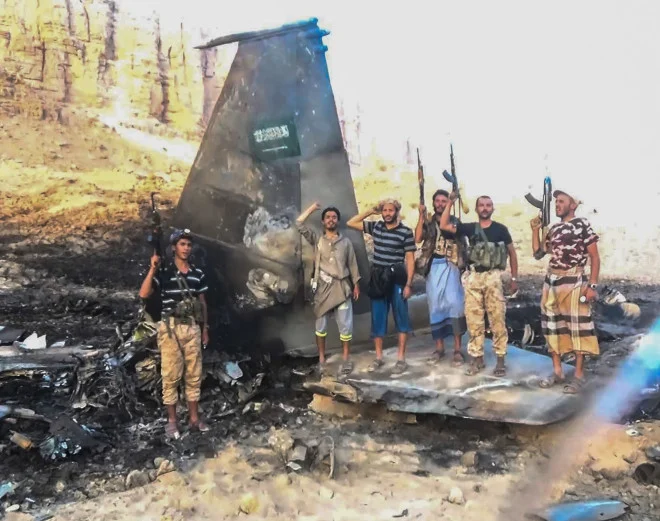
Houthi fighters stand amid the wreckage of a Saudi F-15 fighter jet that the group said it had shot down in Marib province. Photograph: Houthi Group press Service/UPI/Shutterstock
Up to 169 people have reportedly died in Yemen over the past three days as Iran-aligned Houthi forces battle Saudi-backed government troops for strategic high ground along the Red Sea coast, driving thousands from their homes.
- Advertisement -
Houthi military officials said at least 118 people had been killed in fighting and Saudi air and artillery attacks across Taiz, al-Jawf, Marib and Saada provinces since Sunday, Agence France-Presse reported. Yemeni government sources put the number of deaths among their forces at no fewer than 36.
The Houthis said Saudi Arabia bombed the port city of Mocha on Tuesday, killing six civilians, including two children. The group also reported that a Saudi airstrike on a prison in north-western Yemen’s al-Jawf province killed nine detainees.
Saudi Arabia, which supports Yemen’s UN-recognised government in its fight against Houthi forces, issued an alert in the country’s south on Tuesday ahead of possible strikes. The warning followed Houthi attacks on Riyadh over the weekend, the first such strikes on the Saudi capital in years.
The latest escalation follows a sweeping Houthi offensive launched three weeks ago, during which the group captured large sections of Yemen’s Red Sea coastline from forces aligned with the government. The gains represent the most substantial shift in territorial control in the country’s civil war in four years.
The offensive has jolted global energy markets, already under pressure after Iran closed the strait of Hormuz, and has widened the regional dimensions of the US-Iran war, which has now entered its seventh month.
Last week, the Houthis seized Mocha and other strategically important cities, placing the Bab al-Mandab strait under their control. The waterway carries 10% of global maritime traffic and has assumed added significance since the closure of Hormuz.
The renewed violence is deepening Yemen’s already severe humanitarian emergency. About 22 million people require humanitarian assistance, while 5.2 million have been displaced within the country.
Yemen’s civil war began in 2014, when Houthi forces captured the capital and overthrew the government. A Saudi-led coalition subsequently intervened with an air campaign supporting the internationally recognised government and allied militias.
A UN-brokered ceasefire took effect in 2022 and largely endured until the Houthis began their latest offensive.
In recent days, the fiercest battles have centred on the strategically important Kahboub mountains near the Red Sea coast, where the Houthis are seeking to secure their recent gains. Government forces have attempted to block the advance on several fronts and prevent the mountain range from falling to the group.
Holding the mountains would give the Houthis a commanding position over coastal areas of the Red Sea and further isolate Aden, the seat of Yemen’s government forces, from the western coast. It would also make any future government counteroffensive more difficult.
Houthi forces have pushed forward along several routes, notably around the outskirts of Taiz province and near the coastal area of Ras al-Ara, as they work towards the Kahboub mountains. Houthi-affiliated media have reported advances, while government outlets say their forces have repelled incursions.
Since the campaign began, the Houthis have driven government-aligned forces from western Yemen. Saudi Arabia is concerned that an Iranian-backed group’s control of Bab al-Mandab would put two shipping routes crucial to its energy exports in the hands of Iran and its allies.
Saudi Arabia has carried out hundreds of strikes in Yemen in recent days in an effort to halt the Houthi advance, but with limited results.
Donald Trump reportedly considered launching strikes against the Houthis over the weekend but abandoned the plan at the last moment. The UK, meanwhile, said it would support the aerial refuelling of Saudi aircraft conducting defensive missions, keeping open the possibility of further international involvement.
G7 members have urged Iran to stop supplying weapons to the Houthis. In a joint statement issued ahead of the UN general assembly, the countries called on the group to end attacks on Saudi Arabia, which have damaged vital oil infrastructure and injured dozens of people.
“We call on the Houthis to immediately cease all military actions, all threats and attacks against civilian shipping, and to return to the political process in good faith,” the statement said.
The fighting has killed about 700 people and displaced more than 100,000, prompting some Yemenis to attempt to escape by sea. Civilians have crossed the Red Sea westwards into Djibouti, while aid organisations warn that conditions for those still in Yemen are rapidly worsening.
Babar Baloch, a spokesperson for the UN refugee agency, said on Tuesday that internal displacement in Yemen could reach 230,000 people, with more than 10,000 potentially fleeing to Djibouti if the fighting persists.
Saudi Arabia has sought international backing for an effort to reverse the Houthi offensive. Crown Prince Mohammed bin Salman asked Trump to attack the group, but the US president has so far declined.
Trump spoke on Monday with Rashad al-Alimi, head of Yemen’s governing body, who requested US military assistance. Trump expressed solidarity but made no commitment to provide military support, a source told Agence France-Presse.