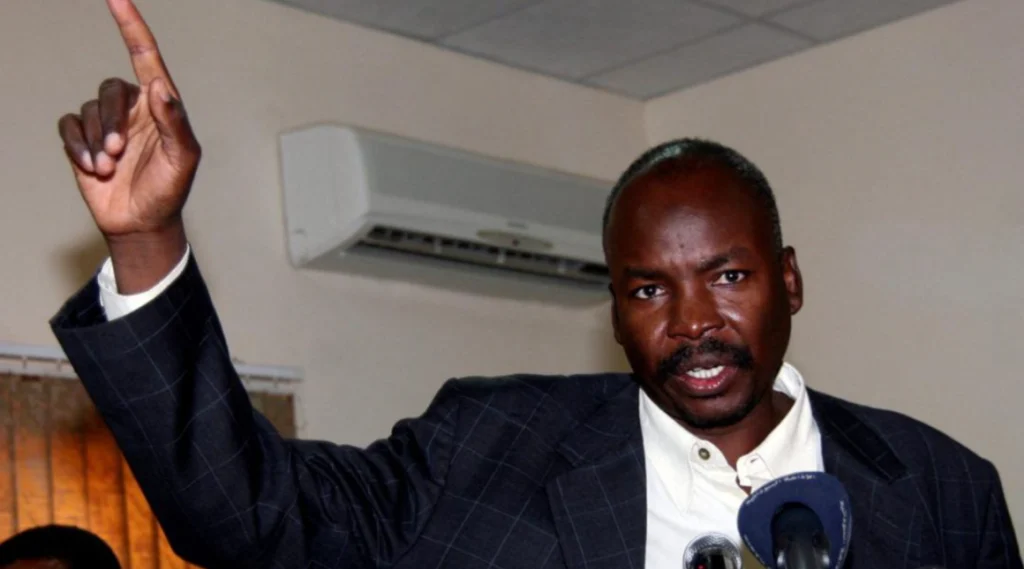
Sudan: Haroun Interview Revives Scrutiny of War Crimes and the “Alliance of Blood”
Sudan’s war is deepening a humanitarian disaster, with severe food shortages and essential services largely collapsed as fighting between the army and the Sudan Founding Alliance Forces (Tasis) leaves tens of thousands dead and millions displaced.
Observers warn that former regime figures and leaders of the Islamic Movement are intensifying their activity while the military continues to pursue a battlefield solution—developments they say could push the country toward an even more devastating phase.
Against that backdrop, Ahmed Haroun, the head of the dissolved National Congress Party and a fugitive wanted by the International Criminal Court (ICC), has re-emerged publicly, provoking sharp reactions in Sudan and abroad. The ICC accuses Haroun of war crimes and crimes against humanity. He was first arrested in April 2019, after Omar al-Bashir was removed from power following mass protests.
The court has repeatedly called for Haroun and al-Bashir to be surrendered. Haroun faces 20 counts of crimes against humanity and 22 counts of war crimes linked to his alleged role in recruiting militias responsible for ethnic massacres in Darfur during the early 2000s. In 2024, the United States announced a reward of up to $5 million for information leading to his arrest.
As anger grew over Haroun’s public appearance, authorities in Port Sudan reportedly leaked news of his arrest without issuing an official statement. National Congress Party leaders, from the Muslim Brotherhood’s former ruling party, passed the information to media outlets.
The Islamic Movement’s Staged Performance
Khalid Omar Youssef, an engineer and prominent member of the Sumoud Alliance, challenged the reports that Haroun had been arrested, calling them “a crude charade that fools no one”. He said the announcement appeared designed to absorb public outrage over Haroun’s latest media appearance.
In a Facebook post, Khalid Omar said “al-Burhan did not suddenly discover Haroun’s presence in Sudan following the interview”. Haroun, he wrote, had stayed in the country after being released from prison when the war began, “under al-Burhan’s hearing, watchful eye and protection”.
Haroun had also played a role in directing the war, according to Khalid Omar’s account. He said leaders of Haroun’s party and people close to him held powerful positions in the Port Sudan government, as well as within its political and security structures. The talk of an arrest, he argued, was a response to the backlash over Haroun’s appearance—not the result of a new discovery about his location or activities.
Observers say the incident highlights efforts by the Islamic Movement to regain influence after its 2019 downfall. With popular mobilisation expanding, the civilian political track receding and state institutions weakening, they say the movement has used the vacuum to strengthen its leverage over military leaders.
During the podcast, Haroun proposed replacing geographical constituencies with an electoral system based on proportional representation and called for a new social contract between political forces. Observers viewed the proposals as another indication of internal disputes over political influence and the future role of the military establishment.
They say an alliance between Islamic Movement figures led by acting Secretary-General Ali Karti and al-Burhan has helped normalise the movement’s presence through “popular resistance” groups. The same forces are accused of taking part in military operations that have caused massacres and extensive destruction in Darfur and Khartoum, while worsening ethnic and social tensions.
The developments recall the Muslim Brotherhood government’s policies in Darfur, where approximately 300,000 people died and millions were displaced. Those crimes prompted international arrest warrants for al-Bashir and several of his associates, including Haroun.
Impunity
Haroun’s return to the public arena also sends a message, observers say, that al-Burhan is shielding individuals accused of war crimes and that the army has effectively sanctioned impunity throughout the conflict.
In April 2026, two major fact-finding missions warned that impunity remained widespread as grave human rights violations continued to intensify. The warning appeared in a joint statement issued on Monday by the Independent International Fact-Finding Mission for the Sudan and the African Union’s Joint Fact-Finding Mission on the Human Rights Situation in Sudan.
The statement said accountability for atrocities in Sudan was essential to stopping further abuses. “Unless perpetrators are held accountable, impunity—which is a key driver of this conflict—will continue to spread and undermine prospects for lasting peace in Sudan and the wider region,” it said.
The missions again urged all parties to the conflict, member states of the African Union and United Nations, and regional and international organisations to create an independent, complementary judicial mechanism to prosecute those responsible for international crimes in Sudan. Such a mechanism, they said, should work alongside existing international justice efforts.
United Nations and other international reports have recorded thousands of serious violations attributed to the Sudanese army and allied militias. Reports from the Office of the United Nations High Commissioner for Human Rights and the Independent Fact-Finding Mission document extensive use by the military establishment of aircraft, drones and heavy artillery in attacks on populated neighbourhoods, markets and vital service facilities.
The Al Jazeera Human Rights Observatory reported serious abuses in August this year, allegedly carried out by the Federal Investigations Department, the Security Cell and Muslim Brotherhood-linked militias in Wad Madani and elsewhere in Al Jazirah State.
The Alliance of Death
Haroun’s appearance has made the relationship between al-Burhan and the Islamic Movement harder to disguise, observers say. More than a year ago, Haroun discussed the war and its possible direction; he has now appeared again from army-controlled territory to speak about Sudan’s future.
More than two months ago, al-Burhan proposed a Sudanese-Sudanese dialogue. The initiative attracted little backing in Sudanese political circles, while observers associated it with the Islamic Movement’s broader manoeuvres.
Observers emphasise that dialogue alone—even one involving a wide range of participants—cannot alter the country’s political equation unless it is paired with measures to limit the war’s influence over the political process.
They note that excluding the National Congress Party and the Tasis Alliance, which is linked to the Rapid Support Forces (RSF), offered an early measure of the initiative’s credibility. It also strengthened suspicions that the dialogue had been designed to serve the Muslim Brotherhood’s interests.
Politicians say the initiative, which they describe as a “regime dialogue”, appeared unlikely to succeed even before it began. They cite the lack of a genuine national consensus, the ongoing war and the failure to make a ceasefire and the humanitarian emergency central priorities.
At meetings in Addis Ababa on 22–23 August last year, civilian groups opposed to the war had already rejected “being part of the window dressing for a dialogue that does not lead to an end to the war”.
The groups compared the proposal with the “National Dialogue of the Broad-Based Government”, known as the Al-Wathba Dialogue, which al-Bashir launched in 2014. They dismissed it as “peace among those who are present”, arguing that it deepened divisions by excluding broad sections of Sudanese society—particularly influential actors on the ground and civilian groups that oppose the war.