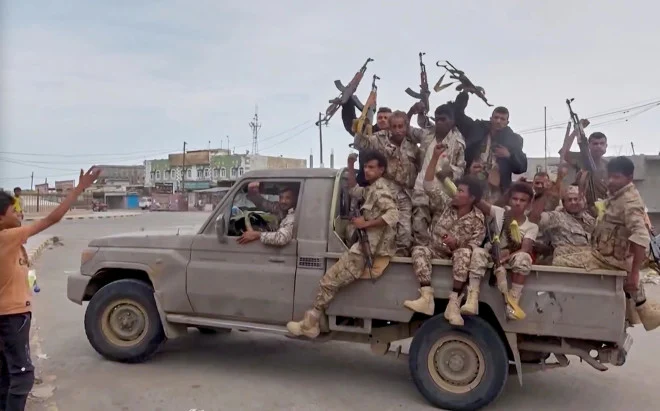
In under 48 hours, Houthi rebels captured Yemen’s Red Sea coast from pro-government forces in a stunning setback for U.S. interests and Washington’s regional partners.
People familiar with the offensive told The Associated Press that the Houthis received battlefield direction from advisers with Iran’s Revolutionary Guard. Their involvement represented Iran’s most direct intervention on behalf of its longtime ally since Yemen’s civil war began in 2014.
- Advertisement -
The operation underscored how Iran has transformed the Houthis into a powerful regional partner capable of opening another front in the broader conflict with the United States. The rebels’ largest territorial advance in years, combined with the shutdown of a crucial Saudi pipeline, increased their ability to disrupt Saudi oil exports, lifted global fuel prices and gave Tehran added leverage. The United States has appeared hesitant to assist its Saudi ally, even as the Houthis have gained ground in Yemen’s renewed civil war.
The AP interviewed 10 officials and soldiers to reconstruct the Houthi offensive. Those interviewed included a senior Houthi official, two regional officials, a senior Yemeni military commander and a member of Yemen’s ruling presidential council. All spoke anonymously because they were discussing internal decision-making.
The Houthis’ rapid 115-kilometer (75-mile) push capitalized on fractures among forces aligned with Yemen’s Saudi-backed, internationally recognized government. The rebels penetrated the communications network of the National Resistance, one of the principal forces, enabling them to monitor movements and deepen the confusion within its ranks.
As government-aligned troops retreated in disarray, National Resistance leader Lt. Gen. Tariq Saleh escaped to Saudi Arabia. Residents abandoned the key port city of Mokha overnight, leaving it open for the Houthis to enter without resistance on Sept. 10. The capture of nearby strategic islands also expanded the rebels’ capacity to threaten Saudi oil shipments moving through the Red Sea.
Iran had been strengthening the Houthis
The Houthis had not launched a major coastal campaign since 2017, when government forces expelled them from the area. In the years that followed, the rebels concentrated on efforts to seize Marib, an oil-rich province in central Yemen.
A truce took hold in 2022. The next year, the Houthis began targeting Red Sea shipping in response to the war in Gaza. Those attacks continued until an intensive U.S. bombing campaign in 2025. After the United States and Israel attacked Iran in February, the Houthis largely stayed out of the fighting.
Beginning last year, Iran increased training and logistical assistance for the Houthis, including support for more sophisticated missiles, drones and uncrewed attack boats, said Mzahem Alsaloum. He has tracked Iranian-backed groups for nearly a decade and now leads a private intelligence company.
In July, the Houthis resumed attacks on Saudi Arabia, accusing Riyadh of striking the airport in Sanaa, the rebels’ capital. The attack appeared intended to stop a flight from Tehran.
Alsaloum and the senior Houthi official said that flight eventually landed carrying Revolutionary Guard advisers. They joined other Guard personnel and advisers from Iran’s Lebanese ally, Hezbollah, who were already stationed in Yemen.
Iranian advisers took on a greater battlefield role
In early August, the Houthis restarted attacks against government forces, concentrating on Taiz, a city in the mountains overlooking the coast, while launching missiles and drones at Mokha.
The senior Houthi official said Iranian advisers had previously concentrated on strategic planning rather than operating on the front lines. During the latest escalation, however, they were “present at all levels,” helping plan tactical movements and coordinate with commanders in the field.
Two regional officials who receive regular briefings on Yemen’s developments likewise said Iran supplied direct assistance that contributed to the rebels’ swift advance.
Alsaloum said the advisers not only helped with command decisions but also assessed communications and satellite intelligence — capabilities the Houthis did not possess in sufficient measure.
Iran’s U.N. mission did not answer requests for comment.
Government-backed forces were fractured
The National Resistance, which has about 30,000 fighters, was the most powerful pro-government force along the coast. Yet it had not faced significant combat since 2017.
For a month, Houthi units struck its positions with 130 ballistic missiles and 145 suicide drones, according to National Resistance spokesman Maj. Gen. Sadiq Dwaid. He said his forces were dispersed across 170 kilometers (100 miles), stretching from Mokha into the mountainous interior, while facing what he estimated to be 75,000 Houthi fighters.
In early September, the Giants Brigade, another militia, moved in to support the National Resistance and briefly helped drive the rebels back. But the Giants Brigade had not coordinated with the National Resistance, a government official said, angering commanders in the field.
The militias had long been rivals, a relationship shaped by an earlier contest between Saudi Arabia and the United Arab Emirates over control of the anti-Houthi campaign. That dispute culminated in the UAE’s abrupt withdrawal from Yemen in January.
There was no “unified command,” the senior military official said. “This was a priceless opportunity for the Houthis.”
A rapid offensive triggered a chaotic withdrawal
On Sept. 9, Houthi forces moved south toward Mokha through a narrow mountain valley, subjecting opposing positions to intense bombardment.
After breaking into the government forces’ communications, the Houthis listened to their exchanges and exploited their internal divisions, one government official said. National Resistance leaders, the official added, lost contact with several commanders in the field.
By afternoon, the rebels had taken the mountain road and a nearby military base, severing government supply routes into Mokha. Lt. Gen. Tariq Saleh, the National Resistance leader, was compelled to flee and later sought refuge in Saudi Arabia.
At roughly 6 p.m., National Resistance field units received orders to withdraw to Mokha. When thousands of fighters began reaching the city, troops already stationed there assumed a major Houthi assault was about to begin and started fleeing, two National Resistance fighters told the AP.
Issa Gubwani, a Mokha resident, said he watched fighters stream out in military vehicles and pickup trucks. “They left us to face our fate,” he said. Tens of thousands of civilians joined the flight.
The Houthi official said that when rebel forces entered Mokha early on Sept. 10, “the city was empty.”
Government forces seek to regroup
The senior government military official said Yemeni forces were shocked that Saudi warplanes did not strike the Houthis during their advance on Mokha. Saudi Arabia’s government media office did not respond to a request for comment.
Two government officials said the Houthis captured weapons and military supplies, including armored vehicles, rockets, artillery shells and ammunition. Much of the equipment had been provided by the UAE and Saudi Arabia. The rebels later showed some of the seized arms during a televised parade.
The National Resistance said 500 of its fighters died in the battles, a figure that could not be independently verified. The Houthis have not released their own casualty figures.
As government forces attempt to reorganize, supporters of the different militias have exchanged accusations of blame and treason online. The Houthis, meanwhile, are fortifying the territory they captured, according to the senior Houthi official.
“Losing the West Coast is not the end of the battle; rather, it marks the beginning of a fiercer battle,” Brig. Gen. Walid Ziyad, a senior National Resistance commander, wrote on social media.
___
Associated Press reporters Sarah El Deeb in Beirut, Ahmed al-Haj in Aden, Yemen, and Lee Keath and Victoria Eastwood in Cairo contributed to this report.