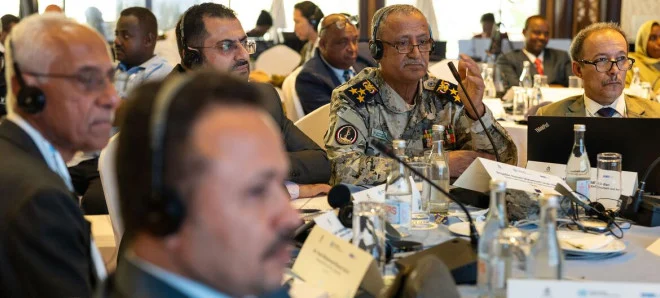
© UN Nairobi Participants at the 5th Regional Maritime Law Enforcement Dialogue for the Red Sea and Gulf of Aden.
Nairobi (AX) — Maritime security officials from Somalia, Ethiopia, Yemen and Djibouti gathered in Nairobi this week to coordinate efforts against threats confronting the Red Sea and Gulf of Aden.
- Advertisement -
Facilitated by the UN Office on Drugs and Crime (UNODC), with support from the European Union, INTERPOL, the International Maritime Organization (IMO) and the Intergovernmental Authority on Development (IGAD), the two-day Maritime Law Enforcement Dialogue centered on stronger information-sharing and closer regional cooperation.
The meeting sought to improve coordination and joint action among countries confronting common maritime threats.
Officials described the discussions as particularly urgent, with continuing maritime tensions in parts of the Middle East adding to security pressures in the Red Sea and Gulf of Aden.
“If you are talking about threats, the current attacks on the freedom of navigation in the Strait of Hormuz have an impact on Gulf of Aden because [they are] affecting maritime security. Pirates use this opportunity and the distraction of the maritime forces globally to do more attacks in this area, because they know that everyone is busy [looking in another direction],” said Abdurrahim Muhammad Ali of the Djibouti Maritime Authority.
The Red Sea and Gulf of Aden are vital maritime links between regional economies and international markets. Disruptions along the route can ripple through shipping networks, supply chains and the movement of goods well beyond the region.
Mostafa Elbanna, UNODC’s Regional Coordinator for the Red Sea and Gulf of Aden under its Global Maritime Crime Programme, said the region is confronting a wide-ranging set of connected challenges.
“[This is a great time] to have this kind of discussions and dialogue with different agencies and law enforcement to talk about their challenges, and also the way forward when it comes to maritime security,” he said.
The agenda included piracy, illegal fishing, human trafficking, migrant smuggling and narcotics trafficking.
Participants said incidents and developments in one part of the region can increasingly affect neighboring countries, underscoring the need for timely information and coordinated responses.
While piracy levels remain far below the peak recorded more than a decade ago, Elbanna said authorities are now in a stronger position to respond, thanks to improved law enforcement, better data collection and deeper regional cooperation.
For landlocked Ethiopia, officials said protecting maritime routes is also central to the national economy.
Capt. Kibru Mesfin of the Ethiopian Maritime Authority said most of Ethiopia’s trade moves through neighboring Djibouti, making safe and reliable sea lanes essential.
He warned that interruptions to maritime routes can increase shipping and insurance expenses, delay vital goods and reduce export capacity, putting added strain on businesses and consumers.
Mesfin called for closer ties among maritime authorities, coast guards and law enforcement agencies throughout the region to help keep commerce moving.
He also appealed for more structured and harmonized arrangements for exchanging maritime information among neighboring countries, including Djibouti, Yemen and Somalia.
Creating a National Maritime Information Centre and reinforcing regional links would give authorities faster access to the information required for maritime security and sound decision-making, he said.
Officials from participating countries said maritime threats frequently cross borders and affect states facing similar risks.
Ali identified maritime terrorism, illegal fishing, robbery, trafficking, irregular migration and smuggling as among Djibouti’s principal concerns.
“The practical outcome is to get closer and share information from Yemen, Somalia and Ethiopia. We have the same challenges,” he said.
Participants examined measures to improve maritime domain awareness, expand operational collaboration and deliver more unified responses to incidents at sea.
Officials said sustained cooperation remains among the most effective ways to protect seafarers, secure commercial routes and preserve stability along some of the world’s busiest shipping corridors.