
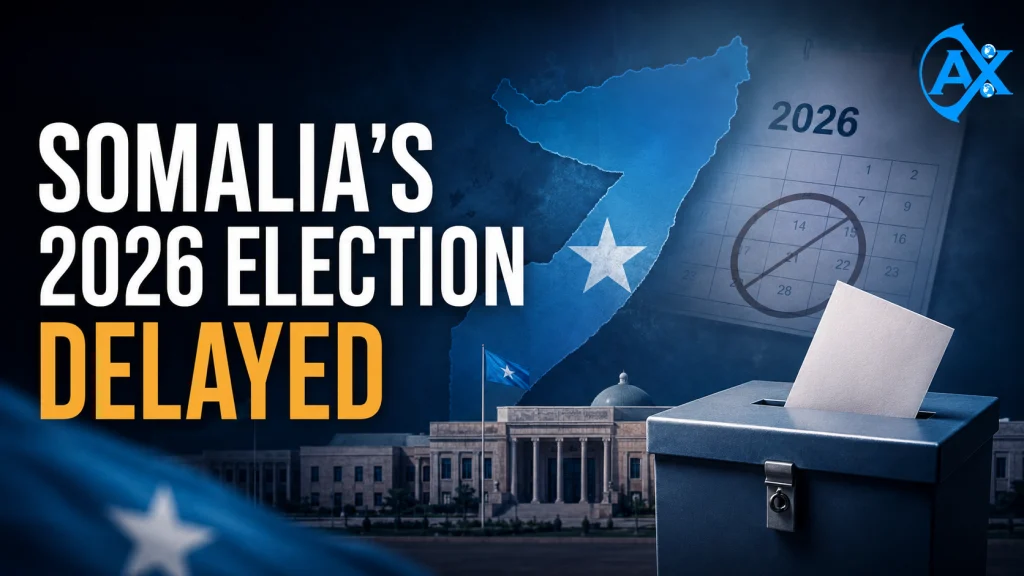
MOGADISHU, Somalia — Somalia’s planned 2026 national election was delayed after federal lawmakers approved constitutional amendments extending the terms of the president and parliament from four years to five years, moving the next federal vote into 2027.
The change has quickly become one of the most important political issues in Somalia, not only because it affects the timeline for national leadership, but because it touches on a larger unresolved question: how and when the country can move from a long-running indirect electoral system to direct voting.
- Advertisement -
The government argues the extra time is necessary to prepare for one-person, one-vote elections, a major political shift that would require legal reforms, technical planning, broad political agreement and security guarantees across a country still facing armed conflict and institutional fragility. Opposition figures and some political actors, however, say the delay raises serious concerns about mandate extensions, constitutional legitimacy and public trust in the transition process.
At the center of the debate is a difficult balancing act. Somalia has for years said it wants to leave behind its indirect election model, under which selected delegates and lawmakers play the leading role in choosing national leaders. But moving to universal suffrage is far more complicated than changing a date on the calendar. It means building systems that many stable states take for granted: voter registration, clear electoral rules, polling locations, trained staff, legal dispute mechanisms and enough security to allow citizens to vote safely.
That is why the delay matters far beyond the formal question of whether the next federal election will happen in 2026 or 2027. It has become a test of whether Somalia can carry out ambitious constitutional and electoral reform without triggering a new political crisis.
What changed
In March 2026, Somalia’s federal parliament approved constitutional amendments that extended the terms of both the president and lawmakers from four years to five years.
Under the previous timeline, President Hassan Sheikh Mohamud, who returned to office on May 15, 2022, had been expected to face an election in 2026. The amendments altered that schedule and effectively delayed the federal vote by about one year.
The government has linked the new timeline to preparations for a direct election system based on universal suffrage. Officials say the country needs additional time to put in place the legal and administrative framework required for such a transition.
That explanation has not ended the controversy. For critics, the main concern is that extending terms before consensus is fully secured can be viewed as a mandate extension rather than a neutral administrative adjustment. In Somalia’s political history, electoral timing has rarely been a technical matter alone. It is usually tied to questions of power-sharing, constitutional interpretation and trust between rival actors.
Why the election was delayed
The immediate reason for the delay is clear: parliament changed the constitutional term length from four years to five years. But behind that decision are several connected factors that help explain why the electoral calendar shifted.
1. Constitutional amendments changed the timetable
The most direct cause was the constitutional revision itself. Once parliament approved the extension of federal terms, the expected 2026 election timeline no longer applied. That legal change created the basis for moving the vote to 2027.
In political terms, however, constitutional changes are not only legal instruments. In Somalia, they can also reshape delicate understandings between the federal leadership, opposition actors and federal member states. That is why the amendments have drawn such close scrutiny.
2. Somalia says it is preparing for one-person, one-vote elections
The government’s core argument is that the delay is tied to a historic electoral shift. Somalia has relied for decades on an indirect model because of insecurity, weak institutions and recurring political disputes. A direct national vote would represent a major break from that system.
Such a transition is politically significant because it speaks to legitimacy. For many Somalis, the promise of direct voting is tied to the idea of citizenship and equal political participation. For years, national leadership has emerged through indirect mechanisms rather than a broad public ballot. Any real move toward universal suffrage would therefore mark one of the country’s biggest political changes in decades.
But a direct vote is not created by political will alone. It needs functioning systems and accepted rules. The government says more time is needed to build those foundations.
3. The technical requirements are substantial
Organizing nationwide direct elections requires much more than setting polling day. Somalia would need voter lists, polling stations, staff training, ballot management systems and mechanisms for handling complaints and disputes. It would also need rules governing political parties, electoral administration and, potentially, electoral boundaries.
Each of those issues is complex in any country. In Somalia, they are even more difficult because institutions remain uneven, federal arrangements are contested and state authority is not uniformly strong across all territory.
Even if there is broad political support for direct voting in principle, turning that ambition into practice would require time, money, administrative capacity and cooperation among actors who often disagree on the basic rules of the process.
4. Political disagreements remain unresolved
The delay also reflects a deeper political problem: Somalia’s election rules are rarely accepted automatically by all sides. Opposition leaders and some regional actors have challenged parts of the process and questioned whether the delay is legitimate.
That matters because elections in Somalia have often depended on negotiation as much as on formal law. If major political players believe the process is being driven without adequate consensus, even a legally approved framework can become politically unstable.
This is one reason the debate over the 2027 timeline has become so intense. It is not simply a disagreement over scheduling. It is a disagreement over who gets to define the transition, on what terms and with what level of national consent.
5. Security remains a major obstacle
Al-Shabaab remains active in parts of Somalia, and that alone complicates any attempt to organize a nationwide direct election. Securing voter registration, transporting materials, protecting polling sites and ensuring freedom of movement for voters and officials would all be major operational challenges.
Security threats also affect public confidence. A one-person, one-vote election depends not only on legal eligibility but on citizens being able to reach voting sites safely and trust that the process can take place without intimidation or disruption.
In a country still confronting insurgency, those conditions cannot be assumed.
6. Federal tensions have made consensus harder
Disputes between the federal government and some federal member states have also affected the electoral process. Somalia’s political system depends heavily on negotiation between Mogadishu and regional administrations, and disagreements over power-sharing can spill directly into election planning.
Without broad agreement between the center and the member states, election arrangements risk being contested before they even begin. That is especially important in moments of constitutional change, when mistrust can deepen quickly.
Why the delay matters
The significance of the delay lies in both principle and consequence. In principle, Somalia is trying to decide whether it can move toward a more direct democratic system. In consequence, it must do so without damaging an already fragile political order.
A credible election process could help strengthen state legitimacy, reassure citizens and demonstrate that constitutional reform can produce meaningful institutional progress. If managed well, the extra time could be used to build the groundwork for a more inclusive national vote than Somalia has previously been able to hold.
But the opposite is also possible. If the delay is widely seen as a political extension rather than a carefully negotiated reform process, it could deepen mistrust between the government and opposition groups. In Somalia, mistrust is not a minor political inconvenience. It can quickly become a national crisis, especially when electoral timelines are involved.
The issue also matters because Somalia’s political system has long depended on negotiated timelines and elite consensus. When those break down, the effects can spread through institutions, regional relations and security coordination. That is why disputes over election schedules in Mogadishu often carry wider implications than they would in more consolidated democracies.
The direct election question
For many ordinary Somalis, the debate is not only about term extensions. It is about whether they will finally be allowed to vote directly for national representatives after decades of indirect selection systems.
That aspiration gives the government’s argument political weight. A move toward universal suffrage would be widely understood as a milestone in Somalia’s state-building journey. It would suggest that the country is trying to replace elite-mediated political arrangements with a broader form of participation.
Still, the appeal of direct voting does not remove the practical and constitutional questions surrounding the delay. Supporters of reform may welcome the goal while still asking whether the process has been sufficiently inclusive, lawful and realistic. Likewise, critics of the delay may not oppose direct elections themselves, but rather the way the transition is being managed.
That distinction is important. Somalia’s debate is not simply between those who support democracy and those who do not. It is often between actors who agree on the end goal but disagree sharply on timing, method and political safeguards.
Security and state-building pressures
The election delay comes at a time when Somalia is also dealing with broader national pressures. The country remains in conflict with al-Shabaab while navigating a transition toward greater responsibility for its own security forces.
Political instability in Mogadishu can affect that effort in several ways. It can consume leadership attention, strain relations with regional administrations and reduce the level of coordination needed for both security operations and electoral planning. In fragile settings, politics and security are rarely separate tracks. Weakness in one often feeds instability in the other.
That means the election dispute is not only about institutional design. It is also about whether Somalia can manage reform while under pressure from an active insurgency and while trying to sustain momentum in broader state-building efforts.
What happens next
The delay has increased pressure for dialogue between the federal government, opposition groups and federal member states. Whatever legal basis exists for the new timetable, political sustainability will likely depend on whether the main actors can build enough agreement around the path forward.
That dialogue would need to address more than the date of the next vote. It would likely have to include the rules for direct elections, the pace of implementation, the role of regional administrations, mechanisms for dispute resolution and the minimum security conditions required for a credible process.
The central question now is whether the extra year will be used to build confidence or whether it will become another source of confrontation. If the period to 2027 produces real preparations for universal suffrage and broader political buy-in, the delay could eventually be defended as a difficult but necessary step. If not, critics are likely to argue that the extension weakened trust without solving the underlying problems.
Background: Somalia’s election system
Somalia has for decades relied on indirect elections, a system shaped by insecurity, weak institutions and repeated political disputes. Under that model, selected delegates and lawmakers play the main role in choosing national leaders rather than a full popular vote.
The persistence of that system has reflected the country’s political realities, but it has also left unresolved demands for broader democratic participation. That is why the promise of one-person, one-vote elections carries such symbolic and political importance.
Yet symbolism alone will not be enough. A direct electoral system requires institutions capable of registering voters, organizing polling, protecting the process and managing disputes in a way that is accepted by political competitors.
Somalia’s election delay, then, is best understood not as a single isolated decision but as the result of overlapping pressures: constitutional change, democratic ambition, security constraints, federal disagreements and a long struggle to build a more stable political order.
The question facing the country is whether those pressures can be managed through negotiation and institution-building, or whether the delayed timetable will become another flashpoint in Somalia’s fragile transition.