
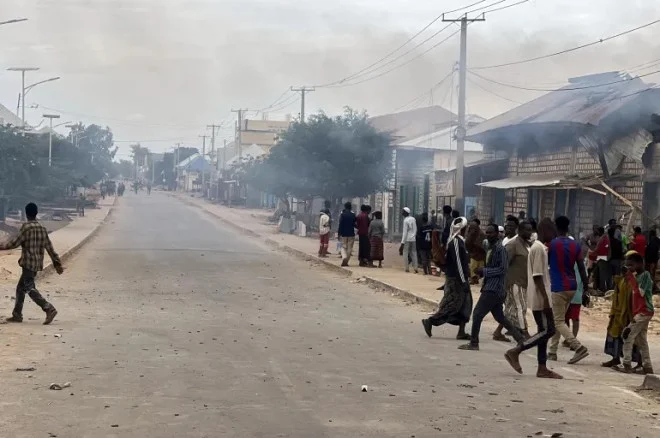
Civilians stand amid smoke rising from a shop struck by artillery after fighting between Somalia’s federal troops and armed opposition groups in Baidoa, Somalia [Reuters]
Somalia’s army says it has forced opposition fighters from Baidoa, the largest city in the country’s South West State, following hours of intense combat.
- Advertisement -
The fighting began before dawn on Monday after forces loyal to South West State’s former president, Abdiaziz Hassan Mohamed Laftagareen, attacked federal military positions, according to the Defence Ministry.
The ministry said the attackers deployed vehicles packed with explosives but were pushed back, with federal forces killing 30 of the fighters. It also alleged that Laftagareen’s forces were operating alongside al-Shabab, the armed group linked to al-Qaeda.
Laftagareen’s camp, however, said earlier in a Facebook post that its forces had seized the city centre.
Al Jazeera correspondent Catherine Soi, reporting from Nairobi, Kenya, said residents had described fierce fighting during the early morning hours.
“People were just waking up, starting their morning prayers, when they started hearing blasts, gunfire, heavy fire as well. We have been talking to people who live in Baidoa who say that some of their homes and buildings have been destroyed,” Soi said.
Residents told the AFP news agency that the violence was the most severe since the Somali army captured Baidoa in March. Doctors Without Borders, which operates medical facilities in the city, said several wounded people had arrived at its hospital and that fighting had taken place on two fronts.
Baidoa is located about 245km (150 miles) northwest of Mogadishu, Somalia’s capital, and is home to hundreds of thousands of people displaced by conflict and climate-related disasters.
Laftagareen had governed South West State for more than seven years before breaking with Mogadishu in March over constitutional amendments advanced by President Hassan Sheikh Mohamud.
The amendments added a year to Mohamud’s term and significantly reshaped Somalia’s fragile power-sharing system, which is set out in the country’s 2012 provisional constitution.
The changes triggered clashes in several parts of Somalia, including Mogadishu. During the unrest, the national army took Baidoa, prompting Laftagareen to resign.
His supporters have continued to attack the city, including an unsuccessful attempt in May to regain control of the state.
The renewed violence is deepening a humanitarian emergency in Somalia, where millions of people are confronting malnutrition and famine.