
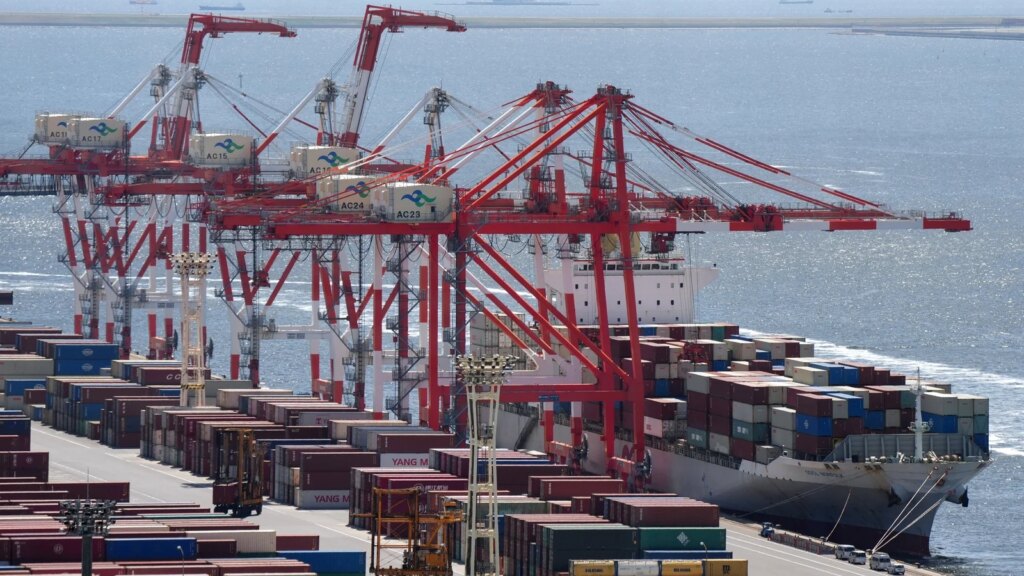
The US has proposed new tariffs on goods from 14 economies, including the European Union and China, escalating President Donald Trump’s effort to overhaul Washington’s trading relationships after a months-long investigation into alleged excess production.
The US Trade Representative’s (USTR) office announced the proposed duties after concluding an eight-month Section 301 investigation into unfair trade practices involving 16 trading partners. The inquiry included close US allies such as Japan, the European Union and South Korea.
Mexico and Norway were not included in the proposed tariff measures for now.
A senior US official said the targeted economies were China, Bangladesh, Cambodia, the European Union, India, Indonesia, Japan, South Korea, Malaysia, Singapore, Switzerland, Taiwan, Thailand and Vietnam.
The official said the US had determined that each of those economies “creates, sustains, or contributes to structural excess capacity and production in manufacturing sectors through various acts, policies and practices that we find to be unreasonable and burden or restrict US commerce”.
USTR describes structural excess capacity as a situation in which countries “are promoting production and capacity divorced from the realities of demand and market principles”, the official said. Such practices can include industrial policies, state subsidies and the use of components imported from non-market economies.
RTÉ’s Europe Editor Tony Connelly reports on the implications for the EU
We need your consent to load this rte-player contentWe use rte-player to manage extra content that can set cookies on your device and collect data about your activity. Please review their details and accept them to load the content.Manage Preferences
EU expects US to honour 15% tariff deal
The EU said it rejected the basis for the proposed tariffs and expected Washington to honour the agreement reached with Brussels last year.
“We will study the findings,” European Commission spokesman Olof Gill said.
“At the same time we strongly reject the premise that Europe is a source of structural overcapacity. To the contrary, Europe is among those most exposed to overcapacity,” he said.
“The EU and the US share a real concern about global overcapacity, much of it state-driven and concentrated in third countries. We regret the lack of joint action.”
Mr Gill said the Commission would continue working with Washington to implement the tariff agreement reached in 2025, which capped Mr Trump’s duties on goods from the bloc at 15%.
“We expect any measure from this investigation to respect it in full, including when combined with existing duties,” he said.
The new tariffs will not be added to sector-specific duties on items such as automobiles
Outcome does not impose new tariffs on EU, McEntee says
Helen McEntee said the existing 10% tariff on goods from the EU remains in place
The Minister for Foreign Affairs and Trade Helen McEntee welcomed progress towards securing an exemption from US tariffs for Irish whiskey.
She said she would discuss the developments with EU Commissioner for Trade Maroš Šefčovič and other trade ministers at a scheduled Foreign Affairs Council Trade meeting next Monday.
“We are still examining the details of the announcement, and our initial assessment is that the outcome of the investigation respects the agreement reached between President von der Leyen and President Trump in Turnberry last year,” she said.
“The outcome today does not put any new tariffs in place but are open for further public comment. For now, the current tariff of 10% on goods from the EU remains in place, unless otherwise exempted.”
The Minister said it was “positive” that Irish whiskey appeared in the part II annex listing goods excluded from the proposed action.
“Our ambition is to ensure reduced tariffs in other key areas such as MedTech and the technology sectors,” she said.
China to face highest tariffs among 14 trading partners, US official says
China would face the highest rates among the 14 trading partners. The proposed 20% excess-capacity tariff on Chinese goods would be added to roughly 25% in tariffs imposed during Mr Trump’s first term, the US official said.
That would leave China facing a higher overall rate than Vietnam, which is subject to the proposed 20% duty, the official added.
The new tariffs would not be added to sector-specific duties covering products such as automobiles and steel, the senior US official said.
In July, Mr Trump imposed a separate round of tariffs on 60 economies, accusing them of failing to take sufficient action against forced labour.
For economies affected by both the forced-labour and excess-production measures, the duties would not be cumulative, the US official said.
Instead, the higher of the two rates would apply.
The measures are widely seen as an effort to reconstruct Mr Trump’s global tariff programme, parts of which were struck down by the US Supreme Court in February.
The official said Mr Trump’s meeting with Chinese President Xi Jinping was ‘really great’
The US official said the proposed duties would remain within tariff limits set by trade agreements negotiated by the Trump administration. That includes a 20% ceiling for China under a year-old trade truce with Beijing, which is due to expire on 10 January.
The duties would not cover about $30 billion (€27 billion) worth of Chinese imports that the US is considering for tariff reductions through a bilateral process known as the Board of Trade, the official said.
Washington did not expect Beijing to retaliate against the excess-capacity duties, the official added.
“We know that they don’t like these actions, but we are seeking stability with the Chinese. China is seeking stability with us,” the official said.
Mr Trump’s meeting with Chinese President Xi Jinping last week was “really great”, the official said, adding that progress had been made in recent days on supplies of Chinese rare earth minerals.
China and other affected governments are nevertheless likely to challenge the findings. Beijing has long rejected claims that it depends excessively on exports to drive economic growth.
The tariff rates would also comply with agreements signed with other trading partners, the official said. Those include the 15% ceiling agreed with the EU, Japan, South Korea and Taiwan, along with a 19% cap negotiated with Malaysia.
India and Vietnam are among the countries that do not yet have completed trade agreements with Washington.
The US official said the proposed duties were expected to encourage the negotiation and completion of additional trade agreements, potentially at a G20 leaders’ summit in Miami in December.
The proposed tariffs will go through a public notice and comment process, followed by a hearing before they can take effect.
That process could delay implementation until January, the official said.
USTR was continuing to examine excess-capacity claims involving Norway and Mexico, the official said, but gave no timetable for completing those reviews.
US officials briefed congressional committees on the changes late yesterday.
The affected economies were also notified, the official said.
The new tariffs are likely to come into effect in January at the earliest, the senior US official said
In a separate announcement, the US Trade Representative’s office proposed additional tariffs on imports from Brazil, including aircraft, citing what it described as a failure to address US trade concerns.
The excess-capacity issue spans numerous industries, including batteries, cement, chemicals and processed food, the senior US official said.
The proposed duties could further strain US companies already facing higher costs from earlier tariffs. Businesses may pass more of those expenses on to consumers, many of whom are already under pressure from the high cost of living.
Affordability was a central issue in recent midterm elections, in which President Trump’s Republican Party was swept from power in both chambers of Congress by Democrats.
US consumer inflation reached 3.7% year-on-year in September, close to a three-year high, as prices were driven higher by the effects of Mr Trump’s war on Iran, tariffs and the huge investment boom in artificial intelligence.
Federal Reserve policymakers, who are responsible for steering inflation towards a long-term target of 2%, have said the effects of most of Mr Trump’s earlier tariff measures have already worked through the economy.
They have also warned, however, that further duties could fuel additional price increases.
A Reuters/Ipsos opinion poll conducted after November’s midterm elections found that 62% of respondents supported efforts to repeal the tariffs.
The new tariffs are expected to take effect in January at the earliest, the senior US official said.
The Trump administration has identified China as the largest source of excess industrial capacity, accusing it of flooding global markets with steel, aluminium, electric vehicles, appliances, solar products and other goods.
China has rejected those allegations, arguing that its exports are the result of competitive advantages.
The investigation also examined Chinese investment in Southeast Asian countries, including Vietnam, Indonesia and Cambodia. Washington alleges that such investment is being used to manufacture goods for the US market and circumvent existing US tariffs.