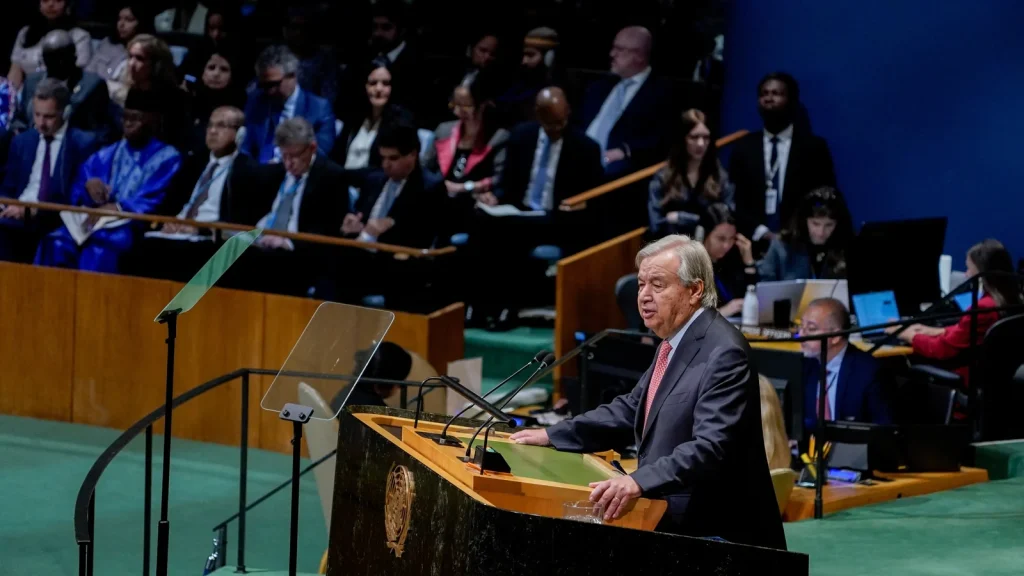
In his final address to the UN General Assembly, Secretary-General Antonio Guterres delivered a stark warning about a world struggling to keep pace with its crises, calling on leaders to regulate artificial intelligence, end wars, confront climate change and overhaul institutions he said are increasingly failing to meet global challenges.
The former Portuguese prime minister, whose second five-year term ends on 31 December, renewed his appeal for international oversight of AI risks as the UN’s 15-member Security Council prepares to host AI leaders for a briefing on the rapidly advancing technology.
- Advertisement -
Mr Guterres also addressed the organisation’s growing paralysis as nearly 130 world leaders gathered in New York, while Chinese President Xi Jinping and other senior figures – including leaders from South Africa, India and Germany – stayed away from the diplomatic meeting.
Follow live: World leaders gathering for UN General Assembly
The speech brought the curtain down on a decade in which Mr Guterres sought to cast the UN as both a broker in conflicts and a venue for governing emerging technologies. His tenure, however, has unfolded as major powers increasingly sidestep the organisation and Washington cuts back its funding.
“Those countries leading this technological revolution must share information on emerging safety risks, cooperate on testing and evaluation – and work towards common safeguards that protect us all,” Mr Guterres told the assembly.
He urged leaders meeting in New York to “advance the conditions for the responsible pacing of AI and the additional safeguards needed to address risks” and to “work towards a multilateral AI risk management framework, supported by credible and independent oversight.”
Antonio Guterres received a standing ovation after speaking during the 81st United Nations General Assembly
Mr Guterres has been a persistent advocate of global rules for artificial intelligence.
In 2023, the UN established a 39-member advisory body on AI, bringing together technology executives, government officials and academics from countries including the US, Russia and Japan.
The Security Council, whose mandate includes maintaining international peace and security, held its first meeting on the dangers posed by artificial intelligence that same year. China warned that the technology must not become a “runaway horse”, while Washington cautioned against its use to censor or repress people.
Turning to the Middle East, where the conflict has expanded as Houthi gains along the Red Sea coast threaten shipping routes and tensions continue in the Strait of Hormuz, Mr Guterres called for “de-escalation and dialogue”.
“Together, let’s send a clear message from this hall: The fighting must stop. Humanitarian aid must flow. And navigational rights and freedoms must be fully restored in accordance with international law,” Guterres said.
Addressing criticism of the UN system from US President Donald Trump and others, who have described it as bloated and ineffective after Washington withdrew from several UN agencies and reduced funding, Mr Guterres said “our mechanisms for collective action are under growing strain”. He added that global institutions “continue to reflect the power realities and interests of a largely bygone age”.
Taoiseach to meet Guterres, Mamdani this week
During this week’s General Assembly sessions, Taoiseach Micheál Martin is due to hold several bilateral meetings and attend engagements focused on developments in the Middle East.
Among them is a meeting of the ‘Global Alliance for the Implementation of the Two-State Solution’.
Taoiseach Micheál Martin is due to participate in several bilateral meetings with leaders
The group is working towards a two-state solution and backing efforts to secure a permanent ceasefire in Gaza.
The Taoiseach is also expected to attend an event hosted by French President Emmanuel Macron, Canadian Prime Minister Mark Carney and British Prime Minister Andy Burnham, marking nearly a year since the Gaza peace plan was announced.
Meetings have also been scheduled between Mr Martin and outgoing UN Secretary General António Guterres, New York Governor Kathy Hochul and Mayor Zohran Mamdani.
The wars involving Iran and Ukraine, the rapid development of artificial intelligence and mounting pressure on the international system are expected to shape the agenda this week.
US President Donald Trump is due to address the Assembly – which begins at 3pm Irish time – later today and meet Ukrainian President Volodymyr Zelensky, Mr Burnham and Japanese Prime Minister Sanae Takaichi.
Read more: Ireland must navigate diplomatic relationships at UN General Assembly
Iran foreign minister arrives in New York
Iranian Foreign Minister Abbas Araghchi arrived in New York last night to lead Iran’s diplomatic delegation at the annual gathering.
Mr Araghchi is the highest-ranking Iranian official to travel to the United States since the Middle East war began with US-Israeli strikes on Iran in February.
After arriving, Mr Araghchi spoke by phone with Mr Guterres and discussed the UN General Assembly agenda, Iranian state television reported.
“Our most important objective is to use a major international platform to defend the legitimacy, rights, and interests of the Iranian people,” Mr Araghchi was quoted as telling Iranian journalists.
French President Emmanuel Macron walks with Jerome Bonnafont (L), Permanent Representative of France to the UN after a meeting with US President Donald Trump at Trump Tower
Earlier, Iranian state media had said the delegation would be led by President Masoud Pezeshkian and that the US had denied visas to members of his team, including his communications staff.
But in a post on X following Mr Araghchi’s arrival in New York, Foreign Ministry spokesman Esmail Baghaei described the minister as “head of a diplomatic delegation” attending the General Assembly.
Mr Baghaei said Mr Araghchi “will hold talks and consultations with numerous officials and foreign ministers attending the session.”
Before leaving for New York, Mr Pezeshkian pledged to “firmly defend” Iran’s position.
“We emerged with our heads held high, and this is a source of dignity and pride for all of us. Therefore, we will firmly defend our positions in international forums,” he said before departing Iran, according to footage broadcast by state television.
Although the US has authorised an Iranian delegation to attend the UN gathering, it has imposed restrictions similar to those introduced last year.
Iran’s delegation will not, for example, be permitted to buy luxury goods or other items during its stay in New York City, the State Department said.
Iranian state media said the US had refused visas to members of the delegation, including its communications team.
Additional reporting Jackie Fox