
Sri Lanka is preparing to begin the trial of 24 men accused of helping plot the 2019 Easter Sunday bombings, the country’s deadliest attack on civilians.
On 21 April 2019, suicide bombers targeted three luxury hotels and three churches, killing 279 people, including 45 foreign nationals. Investigators have attributed the coordinated assault to a homegrown Islamist extremist group.
- Advertisement -
Twenty-five men were originally indicted over their alleged roles in the attacks. One, who was among Sri Lanka’s Muslim minority, has since died in custody, leaving 24 defendants to face trial.
The proceedings are scheduled to begin at 9.30am local time (5am Irish time) at the High Court of Colombo.
People take part in a silent march marking the seventh anniversary of the 2019 Easter Sunday bombings
“Considering the interest in this case, we are making special security arrangements,” police said in a statement.
The case has already set a legal precedent in Sri Lanka: prosecutors have brought 23,270 charges, the largest number ever filed in a single case.
The indictments include murder, conspiracy to commit terrorism, and the possession of firearms and explosives under the Prevention of Terrorism Act.
Prosecutors allege that Mohamed Naufar was the operation’s ringleader, providing support to the eight-member team that carried out the synchronised attacks.
Each of the defendants has denied any involvement.
Local media reported that convictions could result in death sentences for some defendants. Sri Lanka, however, has not carried out an execution since 1976, and capital sentences are generally converted to life imprisonment.
The issue of capital punishment came into sharper focus in July, when two security officials were sentenced to death in a separate case after being found responsible for failing to prevent the attacks despite receiving intelligence warnings.
‘Mastermind’ spy boss
Three of the men held in Sri Lanka have also been charged by US authorities with terrorism-related offences connected to the bombings in December 2020.
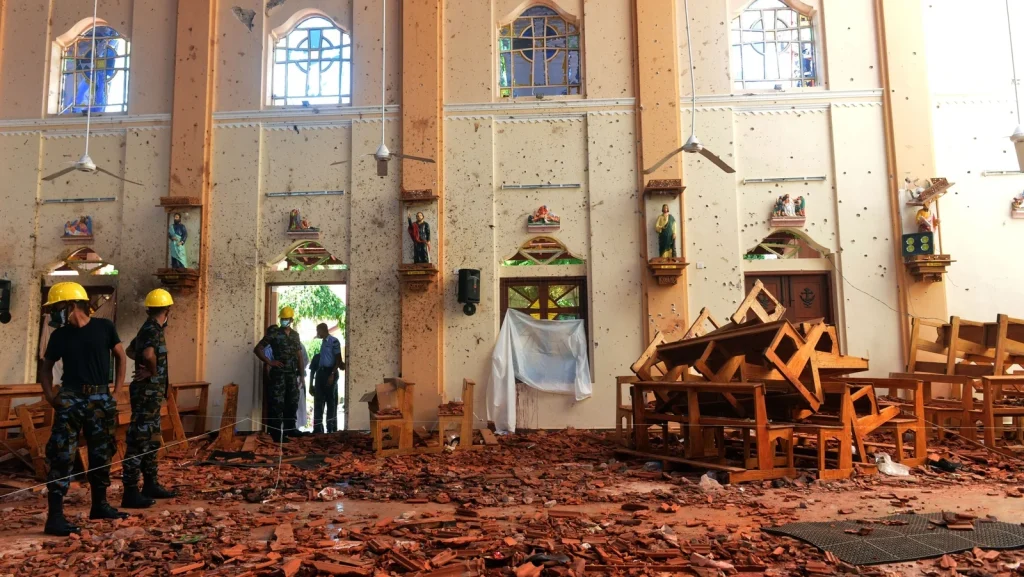
Security personnel stand guard outside the St Anthony’s church in Colombo
Five Americans were among those killed, including an employee of the US Commerce Department who was visiting Colombo on official business.
The victims also included nationals of Australia, Bangladesh, China, Denmark, India, Japan, the Netherlands, Portugal, Spain, Sweden, Switzerland, Turkey and Britain.
The trial is taking place as a separate, highly sensitive inquiry examines allegations that elements of the Sri Lankan state may have maintained links with those behind the attacks.
Former intelligence chief Suresh Sallay is in custody and faces accusations that he orchestrated the bombings. He denies the allegations.
Public Security Minister Ananda Wijepala told parliament in June that investigators believed Mr Sallay was the “mastermind” of the attacks and had cooperated with Islamist extremists before the bombings.
Investigators allege that the network was developed to create a security threat, which could then generate political support for the Rajapaksa family. The family returned to power several months later after Gotabaya Rajapaksa was elected president.
Court filings state that investigators believe the intended result was chaos, allowing Mr Rajapaksa — a former defence chief whose supporters credit him with defeating Tamil separatist rebels in 2009 — to emerge as the figure most capable of restoring order.
The Rajapaksa camp, which backs the once-dominant family that shaped Sri Lankan politics for almost two decades, has rejected claims of state involvement.
Successive Mr Rajapaksa administrations have acknowledged using Islamist militants as intelligence assets during the country’s decades-long civil war, which ended in 2009.
Supporters of the family, however, say the militants betrayed their handlers and carried out the 2019 bombings on their own.