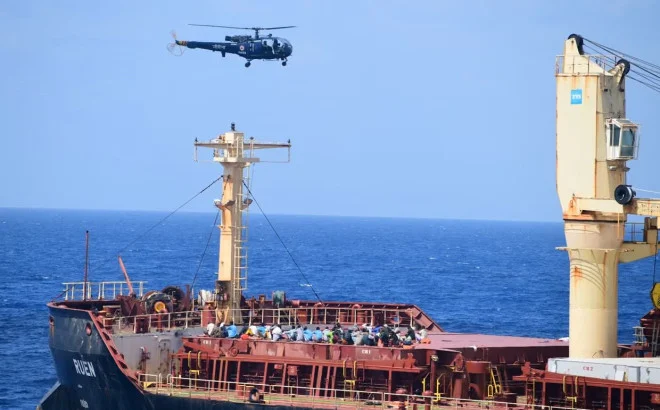
The Indian Navy recaptures the MV Ruen, a Maltese ship, from Somali pirates off the Indian coast in March 2024, after a three-month hijacking. Photograph: Indian Navy X/AFP/AFP/Getty Images
Somali piracy is surging back to levels not seen in a decade, as turmoil in the shipping industry linked to the US-Israeli war against Iran coincides with renewed political instability in Somalia and leaves commercial vessels increasingly exposed off the Horn of Africa.
- Advertisement -
Eight hijackings have been recorded since late April, including two within a fortnight in August. One involved an oil tanker linked to Iran; the other targeted the Cameroon-flagged Lutuf, which was carrying military equipment for Turkey.
From 2005, more than 1,000 attacks were recorded over seven years in waters off Somalia, home to Africa’s longest coastline. Thousands of crew members were held hostage, generating $400m (£296m) in ransom payments for the piracy network’s financiers, its low-level “foot-soldier” pirates and the communities that supplied them with goods and services. The attacks declined only after a multinational anti-piracy force was sent to the region.
The Lutuf seizure has emerged as the most prominent of the latest incidents. Turkey has been deepening its role in Somalia following a 2024 agreement to help develop the country’s navy. Two weeks after the capture, a joint Turkish-Somali operation secured the vessel’s release and destroyed four pirate boats.
But Mohamed Mubarak, head of the Puntland State security coordination office, and other local officials said a $2.5m (£1.85m) ransom was also paid. The reported payment has raised fears that lucrative settlements could fuel further attacks.
Writing for the Center for Maritime Security in July, the thinktank’s national security adviser, Matthew Reisener, said naval operations by Iran in the Strait of Hormuz and by Iran-backed Houthi forces in the Red Sea – launched in response to the US-Israel war on Iran – were enabling regional piracy “to once again thrive”.
“Not only have the global navies that once combatted piracy off the Horn of Africa diverted their resources to counter the threats against ships in these critical waterways,” he wrote, “but these conflicts have also drawn maritime traffic closer to Somalia’s coastline, creating openings for opportunistic pirates to target commercial ships.”
Reisener estimates that about 70% of the shipping that used the Red Sea before Houthi attacks began is now taking the longer route around South Africa’s Cape of Good Hope.
A May report from the International Institute for Strategic Studies drew a similar link. “The recent deterioration of maritime security followed a prolonged period of relative calm in the waters off the Somali coast, which resulted in the redeployment of international anti-piracy fleets and the relaxation of commercial risk-management practices,” it said. “These factors – alongside the distraction posed by Houthi attacks in the Red Sea – have converged to create an opening that Somali pirates have been quick to exploit.”
Analysts have also pointed to higher oil prices caused by the war, which have increased the value of oil cargoes and made them more attractive targets.
Somalia, one of the world’s least developed countries, has been marked by conflict and clan warfare since the fall of the autocratic ruler Mohamed Siad Barre in 1991. The country has lacked a strong central government, while inadequate patrol vessels and the failure to pay coastal-patrol personnel consistently have hampered efforts to secure its extensive shoreline.
Yemenis protest against Houthi attacks on Red Sea shipping. Experts warn that these attacks in response to the US-Israel war on Iran are allowing piracy to thrive. Photograph: Anadolu/Getty
Historically, piracy has flourished amid worsening political, factional and regional rivalries. Observers say the latest increase has been compounded by the focus in Somalia and abroad on arms-smuggling networks supplying Yemen on behalf of Iran. Analysts believe some of those networks have developed closer links with Somalia’s Islamist al-Shabaab group, which is again expanding its territorial control in central and southern Somalia and seeking relationships with the Houthis in Yemen.
Local officials interviewed by the Guardian said pirate groups had adopted a particularly aggressive tactic during the latest wave: using previously captured ships to pursue and seize additional vessels.
They said the Lutuf was intercepted three nautical miles from Somalia’s coast near the fishing town of Maraya by the MV Sward, a cement carrier previously hijacked and converted into a pirate mothership. Eight gunmen from the Sward boarded the Lutuf and overpowered its armed guards.
The latest attacks have also demonstrated greater technological capability. Officials said pirate groups were using SpaceX’s Starlink satellite internet service to track potential targets and maintain rapid communications among their teams.
The development matches Lloyd’s List’s assessment of an increasingly “more capable and adaptive Somali piracy threat”, one that is already testing weaknesses in the anti-piracy protections used by commercial carriers.
Since the Lutuf ransom was paid, residents of Galkayo, a commercial centre in the north-central Mudug region, have reported a noticeable increase in cash moving through the local economy. Khat consumption has reportedly risen, while more costly sports utility vehicles have appeared on the roads.
During the earlier piracy boom, the influx of money into coastal communities and centres such as Galkayo produced major social consequences, including increased alcohol and drug use and prostitution.
The Lutuf’s release may also signal the tougher response needed to confront the renewed threat. The vessel was freed only after a series of drone strikes against the pirate groups involved, targeting locations at sea and on land. Nine armed men were killed by a missile fired from a Turkish drone as they prepared boats to reinforce the gunmen aboard the Lutuf.
The central question is whether the resurgence can be contained.
In May, the UK-based academics Anja Shortland and Federico Varese, who studied Somalia’s piracy crisis in 2014, wrote in The Conversation that it was unclear whether the international community had either the appetite or the capacity to recreate the anti-piracy force deployed more than a decade ago.
“What happens next will depend on how the current hijacks proceed. Pirates rely on ransoms for reinvestment and to attract young men into their no-win-no-fee contracts. Fast and generous payments … may free the captive ships. But they will lead to escalating risks for everyone else.
“No state or alliance also currently has the will or capacity to run a naval mission on the scale seen in 2011 and 2012, when navies worldwide spent more than US$1bn annually on counter-piracy operations off Somalia.
“Although piracy manifests as a sea-based problem, it can only be solved on land.”