Geraldine Achiah had been married for only two months when she died in September, leaving behind an 18-year-old son who is mourning his mother and seeking justice over relatives’ allegations that her husband fatally beat her.
Achiah, an elementary school teacher in her 30s, had urged her only child, Courage Abombi, to follow his ambition of becoming a mechanical engineer. He took a university entrance examination the day after her burial.
- Advertisement -
“My mom died an unexpected and painful death,” Abombi said.
Her case has emerged amid a worsening femicide crisis in Cameroon. Nearly 70 women have been killed this year in gender-related violence, according to the Ministry of Women’s Affairs. That number is higher than the government’s estimates of at least 50 cases in 2023 and 67 in 2024.
The increase has fueled protests in cities including Douala and Yaounde, where demonstrators have called for stronger legal safeguards, more thorough investigations and accountability for those responsible. Many cases remain unresolved, activists say, while others are never reported.
Police said Manfred Amambua, Achiah’s husband, has denied killing her. He has been charged with murder and remains in custody awaiting trial. His lawyer could not be reached for comment.
Hospital records reviewed by The Associated Press documented “several bruises on her face and lips” before her death. Ndzana Bienvenu, an officer involved in the investigation, said police had also obtained phone footage showing Achiah and her husband after the alleged assault, as well as a blood-stained bedsheet.
Achiah’s family says it is pursuing justice for her and for other women who have died in similar circumstances.
“We want justice for our daughter who died a violent death. This was a teacher who imparted knowledge on thousands of young Cameroonians,” said Regina Ngukum, Achiah’s cousin.
A crisis rooted in inequality
Activists say femicide in Cameroon is driven by economic dependence, unequal access to family property and weak legal protections in a society where men have traditionally exercised greater authority at home.
Information pamphlets distributed by the organization Sourires de Femmes are displayed during a sit-in campaign against women killing, Yaounde, Cameroon, Sept. 18, 2026 (AP Photo)
For women supporting children, financial hardship can make escaping an abusive relationship especially difficult. Activists say some remain with violent partners hoping their behavior will change, while stigma and a lack of resources often discourage victims from seeking assistance.
“The current economic situation in the country is not helping matters. With limited resources, many women tend to endure violence in their marriages, hoping that their men will change, which is not usually the case,” Women’s Affairs Minister Marie-Thérèse Abena Ondoa recently told the state broadcaster.
Ondoa said femicide in Cameroon had reached a “cruel” and “alarming” level and promised additional government action.
The country’s experience reflects a broader global crisis. United Nations data show that about 50,000 women and girls were killed by intimate partners or other family members in 2024.
Legal gaps and a struggling justice system
Activists are pressing Cameroon to strengthen its laws and improve its courts so gender-related killings are prevented and perpetrators receive meaningful punishment.
Although the Penal Code criminalizes offenses such as rape, it does not specifically recognize femicide as a separate crime. Prosecutors therefore rely on broader provisions covering homicide and other forms of violence.
That approach is common across much of Africa, where killings motivated by gender are generally prosecuted under existing homicide laws. Some governments, however, have introduced legal or policy measures aimed specifically at femicide.
Cameroon’s government is drafting a bill that would make femicide a standalone criminal offense and expand protections against gender-based violence. The proposal is expected to go before parliament in November.
Activists warn that legislative change by itself will not fix the investigative and judicial failures that allow cases to languish or suspects to avoid accountability.
Carole Grace Mbarga, a Cameroonian activist living in the United States, said intimidation, corruption and procedural mistakes can weaken investigations and court proceedings, sometimes resulting in lesser charges or acquittals.
“When investigations drag on, evidence deteriorates, witnesses lose confidence, and families become discouraged,” she said.
Even convictions may not satisfy victims’ relatives. In 2025, a man who admitted killing his wife received a suspended five-year sentence and a fine of 52,000 CFA francs, or about $90.
Activists say cases like that raise doubts about whether the justice system provides a sufficient deterrent to violence against women.
Families demand accountability
Relatives and friends gathered in Yaounde for Achiah’s burial after her death, which came just two months after her July wedding.
Her family is awaiting the outcome of the court process while participating in a wider campaign against femicide. Thousands of people have marched in Douala and Yaounde, urging authorities to improve protections for women and ensure that killings are properly investigated and prosecuted.
Laura Sen, one of the protest organizers, said the proposed law must be paired with efforts to dismantle systemic obstacles and expand assistance for victims of domestic violence.
Leaving an abusive relationship can be particularly hard for women who rely financially on their partners or fear condemnation from their communities. Caring for children can add further pressure.
For Abombi, Achiah’s death has meant losing the mother who encouraged his ambitions and helped him picture a future beyond the family’s grief.
He said he continues to pray that the courts will deliver justice.
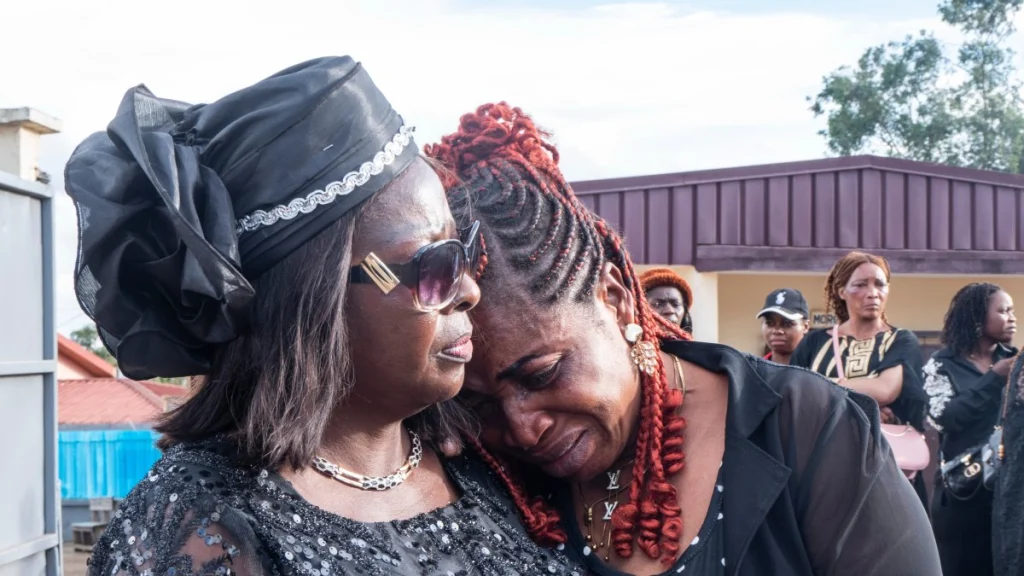
Anushuni Courage Abombi (L), the 18-year-old son of Achiah Geraldine, a woman who was murdered, is comforted by relatives outside a mortuary chapel, Yaounde, Cameroon, Sept. 18, 2026. (AP Photo)
“I pray that justice will follow its due course and that her killer will face the law,” he said.
He said he also dreams that his mother returns to reassure him.
“She keeps appearing to me in a dream, consoling me not to despair and that she is still with me,” he said.