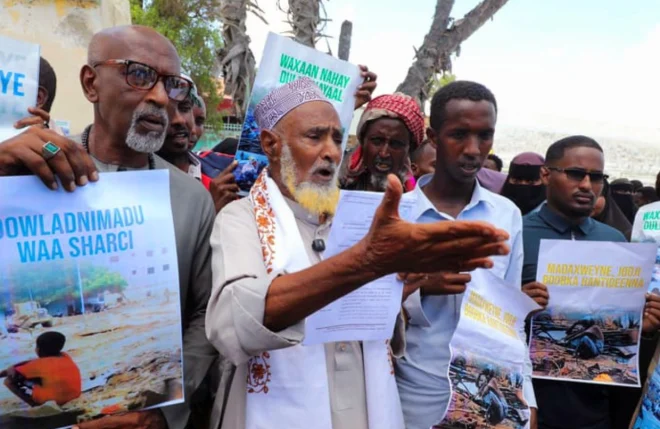
Mogadishu’s forced evictions have entered a second year, driving a displacement crisis that has disrupted the lives and education of thousands. Eighty-four documented protests—some ending in fatalities—illustrate the depth of public anger. The UN Office for the Coordination of Humanitarian Affairs (OCHA) recorded 143,548 displaced people in 2025, while Somali civil society organizations argue that the actual figure is substantially higher, underscoring the continuing dispute over the crisis’s true scale. The number is comparable to the population of several Somali districts, yet the displacement has unfolded without coherent state planning, a resettlement framework or advance notice for affected communities.
Students have borne some of the most severe consequences. Even before the evictions, many of Mogadishu’s students were struggling to remain in education. The Coalition of Somali Human Rights Defenders (CSHRD) says families received no prior warning, leaving them unable to prepare for the loss of housing or the disruption to their children’s schooling and adults’ access to education.
- Advertisement -
The city’s rapid urbanization had already weakened the informal networks that once helped students survive. Previously, students could rent inexpensive rooms in communal houses, share apartments or stay with relatives—arrangements deeply rooted in Somali social and cultural life. Those options, however, have become increasingly restricted.
Following the evictions, students have dispersed throughout Mogadishu, often settling wherever they can afford and far from their campuses. Public transport is limited, expensive and unsafe. Many depend on crowded minibuses or rickshaws that are beyond the means of students already facing financial pressure. Gang violence and armed robbery, which target the city’s dispersed and vulnerable population, have added another layer of insecurity, disrupting study schedules and undermining concentration. For many, the combined burden has made completing an education financially impossible, sending dropout rates to unprecedented levels.
Some of Somalia’s earliest student accommodation was provided by traditional Islamic madrasas. Alongside religious instruction, these institutions offered lodging and operated separately from formal state oversight. Based around mosques, they welcomed students—often known as ṭalabat al-ʿilm (seekers of knowledge)—who traveled from across the country to pursue Islamic education. Islamic scholars oversaw the centers, which were supported by a combination of donations from local business communities, religious endowments and contributions from Muslim charities abroad. Though outside the formal education system, the madrasas historically supplied both accommodation and educational support.
The contrast with formal higher education today is stark. Despite years of government oversight and successive policy frameworks, formal institutions remain far less equipped to house students. Informal madrasas once relied on religious and community networks to provide shelter; universities now leave students to navigate an increasingly punishing private rental market. Somali National University (SNU), the country’s largest university and its only government-run institution, admitted six thousand new students in 2025 with a budget of just over 8 million USD. Yet it has no functional dormitory system.
The eviction crisis has coincided with a steep fall in university enrollment. Of the 32,714 Form Four graduates recorded in the Banadir region during the 2024–2025 academic year, nearly 11 percent sat for the Somali National University (SNU) enrollment examination. This reflects young nationalists’ efforts to secure places at the country’s only remaining government-subsidized university. Either way, the future of the human capital Somalia urgently needs for state-building is at stake.
Following decades of limited reform after the Higher Education Law of 1974—the legislation that governed the sector for nearly five decades—the Federal Government has, over the past twenty months, established the Higher Education Commission and created the National Education Development Fund (NEDF) in January 2026.
The NEDF’s April 2026 cabinet formulation calls for the pursuit of independent financing mechanisms under national ownership. That goal, however, confronts a severe fiscal constraint: the Ministry of Education operates with a budget equivalent to just 17 percent of UNESCO’s annual expenditure. The gap highlights the distance between policy ambitions and available resources, making the omission of student housing from the NEDF and wider education-financing frameworks particularly troubling.
Land from which residents have been evicted—and which senior state leaders have said will be repurposed for government buildings and other major developments—should instead be assessed for dormitories and affordable student housing. A country struggling to keep its most promising young people in education cannot afford to place government or commercial construction ahead of the urgent need for accommodation.
The Federal Government of Somalia should introduce a National Student Housing Policy that makes accommodation a central element of education planning across universities, other educational institutions and recognized education providers. Public land reclaimed through government-led evictions should be deliberately reserved for university dormitories and affordable student housing before it is allocated to non-essential public construction.
Before the next academic year starts, every public and private university in Mogadishu should create a student welfare or emergency support committee. These bodies should identify students displaced from their homes or facing severe financial hardship. Student accommodation should also be incorporated into national urban development, housing and social protection policies.
Somalia’s student housing crisis is no longer a peripheral problem. It has become a structural obstacle to equal access to education and to the country’s wider state-building goals. Housing must be treated as a strategic public policy priority, not as a private burden left to students and their families. Without purposeful action, insecurity and unaffordable rents will continue forcing capable students out of education, undermining both individual prospects and Somalia’s investment in its future.
______________________
Mohamed Ibrahimrashid is a policy and political strategist who researches state-building. He is a Senior Fellow at several think tanks and research institutions.