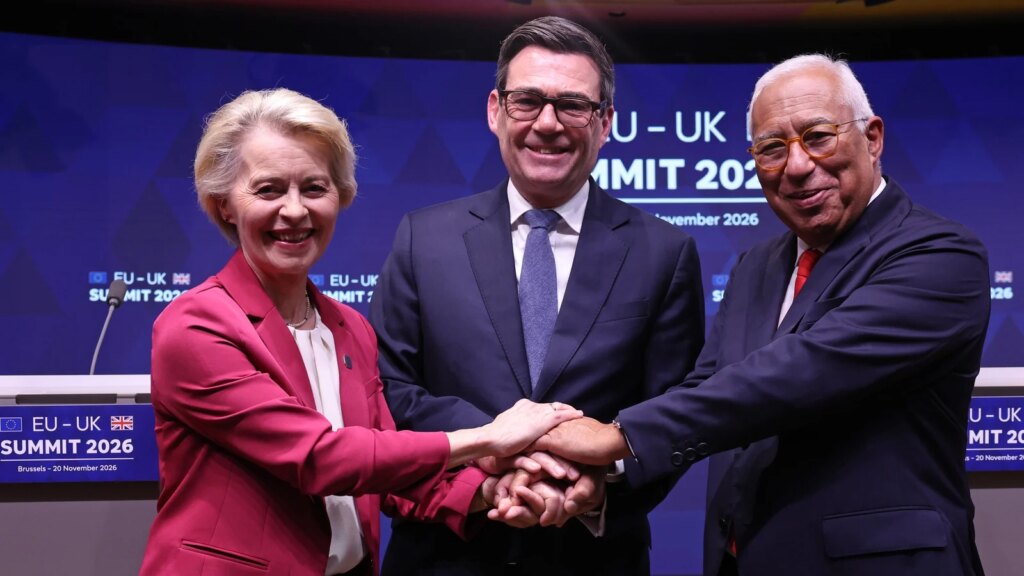
Andy Burnham, one of British politics’ most effective communicators, arrived with a sweeping message: lower prices, stronger growth and better prospects for the country’s younger generation.
European Union leaders, too, were speaking in broad terms. They outlined plans to work with Britain on artificial intelligence, protect citizens from malware and other malicious actors, and begin charting a closer relationship between the EU and the UK. The vision was warmer and more practical, built around benefits for ordinary people rather than only manufacturers and exporters of chilled convenience foods.
And perhaps, one day, Britain might even rejoin the EU.
Even if that never happens, Council President António Costa told the British side that its choices would be respected, just as the result of the referendum had been.
The message should have been simple and concise.
Instead, a group of Eurocrats had somehow managed to make the moment more complicated, leaving behind an unpleasant odour.
A dispute over university fees was threatening to fester. Without firm political intervention from national leaders in the weeks ahead, it could sour relations with Britain just as the wider relationship appeared to be improving.
António Costa told the UK prime minister ‘you are always welcome in the European Union’
The room was hot and crammed beyond capacity, filled largely with British journalists who had travelled over for the day.
Senior cabinet ministers and European Commissioners had also claimed the front row, leaving barely an empty seat in sight.
The summit had concluded, the agreements had been signed and all that remained was the selling of the outcome.
“Prime minister, you are always welcome in the European Union,” Mr Costa told Mr Burnham, prompting nervous laughter from the room.
This was intended as the grand sales pitch: an argument to the British public that rebuilding ties with the EU was worthwhile, alongside a message to European citizens that Britain might, perhaps, deserve another opportunity.
Mr Burnham was ready with his own lines, translating agreements on animal-health checks and emissions trading into language designed for voters.
He said: “It directly addresses the biggest challenges of our times and the biggest worries that people have: the cost of food, the cost of energy, the lack of growth in the economy and the cost of doing business.
“The levels of illegal immigration and the challenges facing our young people.”
Those are substantial claims to attach to the removal of sanitary and phytosanitary checks at Larne and Belfast Port.
But Mr Burnham is at his political strongest when he pulls the audience away from technical detail and towards the wider picture.
The regulations matter, but the greater significance lies in the political shift they represent for a country being managed a decade after the referendum.
Mr Burnham said the agreement will bring costs down
Mr Burnham said: “People can see the status quo isn’t working.
“It’s not good enough for Britain.
“Three quarters of people say that they favour closer ties with Europe, according to the most recent polls, and that is because we’ve had a decade of drift, too much division, low growth in the economy and higher prices in the shops.
“They want a better deal than the hard Brexit we ended up with and today together we have delivered that better deal.
“As I say, that will be good for people in Britain and good for people in Europe.”
The prime minister said the agreement “will bring costs for business down”.
He added: “It will bring the cost of food down and it opens up the possibility of lower electricity costs.
“And we look forward to exploring that opportunity with you as we go forward from today.
“The Chancellor of the Exchequer is here today and he has confirmed today that the UK Treasury has said that the deal struck here will add up to 0.5% to UK GDP.
“That is a £17 billion boost to the British economy.
“It is the single biggest growth measure that we could take in this Parliament.”
That may prove to be the most important line of all: this is the largest growth measure the Burnham government can deliver before the next election.
Taoiseach Micheál Martin welcomed the deals
The president of the European Council said Russia’s aggression and the war in Ukraine had helped bring Britain and Europe closer after the difficult years since Brexit.
He described their shared approach to defence and security as the natural starting point for a new relationship.
“A strong partnership between the European Union and the United Kingdom is a strategic investment in Europe’s security, but it is also an investment in our shared prosperity, in innovation, competitiveness and resilience because there can be no strong defence without a stronger economy, and together, we will be stronger on defence and stronger on the economy,” he said.
From Dublin, Taoiseach Micheál Martin welcomed the agreements and the marked improvement in relations between Britain and the EU that had made them possible.
“I particularly welcome the SPS agreement,” said Mr Martin.
Read more: What the EU-UK deal on food means for Ireland
He said the UK “remains by far the most important market for agri-food exports for Ireland, so this agreement, when it enters into force, will assist our agri-food businesses by reducing administrative burdens and costs”.
“Today’s summit also represents a positive moment for Northern Ireland’s citizens and businesses, and the broader all-island economy,” he said.
Mr Martin said he welcomed that “the joint statement reaffirms the EU and UK’s commitment to the unique circumstances on the island of Ireland”.
The Taoiseach also looked ahead to the restored relationship, saying “we now have a clear roadmap for the EU and the UK to further enhance our relationship”.
Although it will have no practical impact in Ireland, Mr Martin welcomed the youth mobility scheme, which will provide 100,000 visas for Britain and 100,000 for the EU, allowing people under 31 to travel, live, work or study in each jurisdiction.
The scheme builds on the Erasmus Plus education exchange programme, which Britain had already agreed to rejoin.
For Mr Burnham, it provided a welcome success story to take home, including to the Labour Party officials working behind the scenes.
“For young people out there who are wondering how this deal today affects them and their lives, I would say this deal is for you,” said Mr Burnham.
“This deal really is about lifting your life chances and I think we’re all conscious that the last decade has been hard for many people, but hardest most of all for the young people of Britain and the young people of the EU,” he added.
Britain’s youth as a demographic is in play for the next election
He connected the agreement with an earlier report on reforming Britain’s welfare system to help the so-called NEETs – the million or so young Britons not in employment, education or training – return to active participation in working life.
“That generation can feel finally that people in our positions are directly doing something to recognise that they need more help and that they need more opportunity in their lives,” he said.
Politics is always local, but it is also about electoral arithmetic. Britain’s young people are now a crucial demographic ahead of the next election.
Could Reform UK win over a significant share of disaffected younger voters? Could the Conservatives benefit from their position as the opposition, armed with their own programme under a dynamic new leader?
Or might Labour secure the largest share, particularly across former Labour heartlands, by offering hope and presenting itself as the party making a serious attempt to improve life for under-30s in Britain?
The Brexit referendum 10 years ago left Britain’s young people feeling dispossessed and disillusioned.
A housing crisis and the shortage of well-paid industrial or graduate-entry jobs have left this expanding section of the electorate searching for a political outlet.
At the same time, those who made the decision that shaped their future – the over-65s of 10 years ago – represent a shrinking demographic as the years pass.
That will be an important factor in judging how British voters may view closer ties with the EU in the years ahead.
The country is changing, and its electorate is changing with it.
Mr Burnham is betting that Labour will win the argument and the votes in a still disgruntled Britain
Now comes the more difficult phase: British domestic politics.
The UK prime minister is gambling that an evolving electorate, and a shift in public attitudes after a turbulent decade that failed to deliver the future Brexit supporters promised, can help rescue the Labour Party.
By presenting Labour as openly pro-European, even if not explicitly pro-EU, he is betting that the party can win both the argument and the votes in a country that remains deeply dissatisfied.
He faces resistance from the Conservatives, Reform UK and members of his own party. A sizeable group of MPs – perhaps around 100 – believe the strategy is misguided.
The cabinet, meanwhile, remains privately divided for now.
It is a gamble. But as the entire Makerfield episode demonstrated, Mr Burnham is willing to make bold bets and accept the risks.
His advantage this time is that, although Britain continues to demand major change, the opposition parties are defending the status quo.
So, for now, the advantage belongs to Mr Burnham.
Yet there was still that troubling odour from Thursday night and Friday morning’s near-disaster over university fees.
University fees
It was a classic Brussels moment: an elaborate system appearing almost determined to turn victory into defeat through its instinct for self-sabotage.
The three agreements – much of the groundwork had been completed months earlier in preparation for a July summit, whose timing was changed to accommodate the leadership transition in London – appeared to be held hostage by a dispute over the fees British universities would charge EU citizens.
At a meeting of permanent representatives on the eve of the summit, the EU refused to budge, demanding equal treatment for EU and British students when university fees were set.
Many British commentators focused on the alleged self-interest of highly paid Eurocrats, several of whom had attended university in the UK and now had children hoping to study, or already studying, at prestigious British institutions.
They would be among the first to benefit if fees were brought into line.
Most Europeans, critics argued, know little and care less about British university charges. They are far more concerned about food and energy prices, or the threat of losing their jobs.
Why not put on a straightforward good-news show for once and postpone the difficult arguments?
Focus on results rather than procedure – particularly during a politically sensitive moment such as an EU-UK summit.
Americans like to say that the public should never watch laws or sausages being made.
At times, the EU can be excessively transparent. I once accompanied an EU commissioner to a sausage-making factory in Poland, so I know something about the subject.
In Brussels, the machinery of decision-making too often overwhelms the result, frustrating politicians in member-state capitals who must explain and defend the outcome directly to voters.
Perhaps the British critics have a point. Or perhaps the dispute involves more than simple self-interest among Europe’s senior civil servants.
As so often in Brussels, there is another story beneath the surface, shaped by competing interests and priorities.
In this instance, the deeper disagreement may concern Britain’s ambition to join the “Made in Europe” scheme – an old-fashioned protectionist effort intended to prevent European manufacturing from suffering the fate of its US counterpart.
In other words, being overwhelmed by China in what is being called “China Shock 2.0”.
When the great powers of international trade – China, the US and the EU – begin manoeuvring against one another, smaller economies must take particular care over where they position themselves.
Even the British bulldog risks being trampled if it chooses the wrong spot.
For Britain, the safest position would be within the protection of ‘Made in Europe’, with key industrial goods classified as European-made even when they are not EU-made.
The terms are still being negotiated. Britain may have resisted some heavy-handed demands over T&Cs this week, particularly those involving tariffs on electric vehicles manufactured in China – charges imposed by the EU but not by Britain.
That may have prompted the EU to seek leverage of its own, including by linking the implementation of the three agreements to progress on university fees.
The EU said it would try to reach such an agreement within six months, a timetable that should allow the food-export deal to take effect on 1 March 2028.
But if both sides entrench themselves and the dispute grows, this apparently minor issue – connected to a complicated protectionist strategy that will inevitably require high-level diplomacy with China and the US if it is to succeed – could harm relations with Britain.
It could do so precisely as arguments over the country’s post-Brexit future intensify ahead of a general election.
Sometimes, keeping things simple really is the wiser course.