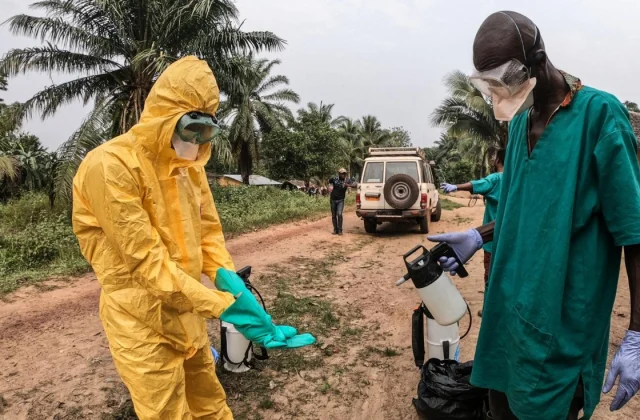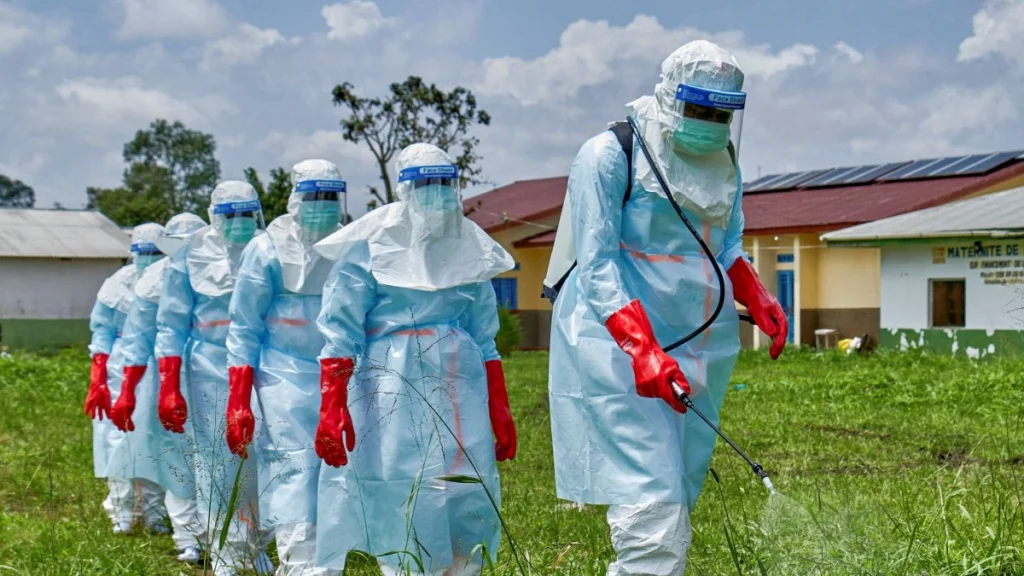
The Ebola outbreak tearing through Congo is moving faster than containment teams can stop it, the head of the World Health Organization warned Wednesday, as a strike by some health workers over unpaid wages added new pressure to an already fragile response.
Nearly three months after the outbreak was announced, infections are doubling in several hot spots, Tedros Adhanom Ghebreyesus said in a post on X following talks with officials in Kinshasa, the country’s capital.
- Advertisement -
The visit marked the WHO director-general’s second trip to the Central African nation since authorities declared the outbreak in mid-May.
“We all agree that we must urgently and massively scale up all our efforts across all pillars of the response and by all partners,” Tedros said.
Congo’s Health Ministry said the outbreak had reached 3,874 confirmed cases as of Monday, including 1,751 deaths.
The crisis is centered in Ituri province, a remote and vulnerable part of eastern Congo near the borders with South Sudan, Uganda and Rwanda. Families there say access to care, already strained by rebel violence, has deteriorated further after many frontline workers walked off the job.
Some health workers say payments have begun arriving in the past week for work carried out since the outbreak started, but they are pressing for better wages.
In Bunia, Ituri’s provincial capital, resident Anicet Baluku said the strike contributed to the deaths of his two brothers from Ebola.
“We urge the authorities to quickly find a solution to prevent other families from experiencing the same tragedy,” he told The Associated Press.
The U.S. State Department announced Wednesday that it would allocate an additional $242 million to support immediate Ebola response and preparedness in the region, as well as humanitarian assistance tied to the outbreak. In a statement, the department said direct U.S. assistance has now surpassed $512 million.
The outbreak has already exceeded all previous Ebola emergencies in the speed at which it is spreading. It is also the second-largest Ebola outbreak ever recorded, after the 2014-2016 West Africa crisis, which caused more than 28,000 cases and over 11,000 deaths.
Health officials say the Bundibugyo virus driving the current outbreak has no approved vaccine or treatment. Local authorities believe transmission began in a remote area well before the outbreak was formally declared on May 15.
The disease is still “spreading at an alarming and unprecedented rate,” Doctors Without Borders said Wednesday. The medical charity added: “The response is expanding but is still not reaching communities quickly enough to break transmission chains.”
Dr. Jean Kaseya, who leads the Africa Centers for Disease and Control, said during a Tuesday visit to Bunia that contact tracing is failing to capture many infections. He said at least 60% to 70% of new cases are being found among people who were not under monitoring after exposure to known patients.
Officials say delayed detection has helped drive the fatality rate to 45%. Of the 77 latest cases reported over a 24-hour period, 44 were fatal, according to the Health Ministry. At least 717 patients remain in isolation, while 749 have recovered.
Kaseya, who met Tedros on Wednesday, said Africa CDC is coordinating with response teams “around earlier detection, stronger contact tracing, rapid access to quality care and deeper engagement with communities.”
Tedros urged responders to reach every affected locality, improve coordination under the government’s leadership and ensure health workers are protected.
“Above all, communities must be at the center of and have ownership of the response,” he said. “We cannot stop Ebola without their trust, leadership and partnership.”
The Axadle Times Newsletter
Stay informed on the latest developments in Turkey,
its region and the world.
SIGN ME UP
You can unsubscribe at any time. By signing up you are agreeing to our Terms of Use and Privacy Policy.
This site is protected by reCAPTCHA and the Google Privacy Policy and Terms of Service apply.