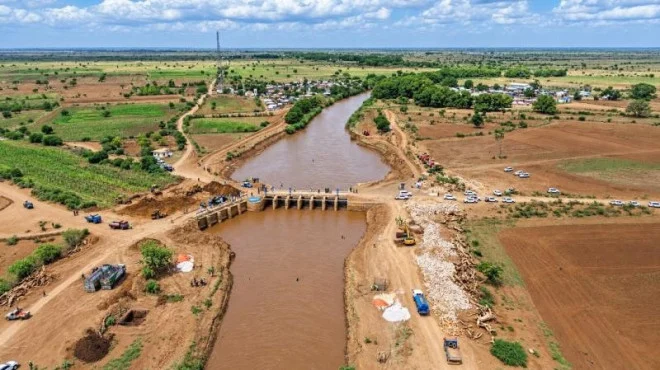
Mogadishu (AX) — The Shabelle River has climbed past the high flood-risk mark in Jowhar and is only centimeters from bankfull, prompting warnings that flooding could worsen across parts of Hiiraan and Middle Shabelle.
An advisory issued Monday by FAO’s Somalia Water and Land Information Management unit (WALIM), together with the Somali Disaster Management Agency, said the river stood at 5.37 meters in Jowhar—almost 1 meter higher than it was two days earlier.
- Advertisement -
The reading was 12 centimeters above the 5.25-meter high flood-risk threshold and just 13 centimeters short of the 5.50-meter bankfull level, according to the advisory.
SWALIM’s latest monitoring put the Jowhar level at 5.38 meters on Oct. 14, keeping it above the high-risk mark and close to overflowing its banks.
Officials said flooding through existing breaches in the riverbank between Jowhar and Balcad was expected to persist, potentially spreading into nearby villages and agricultural land.
Forecasts called for moderate rainfall of 50 to 100 millimeters across much of Hiiraan and Middle Shabelle from Oct. 13-19. Some isolated locations could receive between 100 and 150 millimeters.
“With the river already above the high flood risk level at Jowhar, more water arriving from Belet Weyne and Bulo Burti and 50–100 mm of local rain forecast this week, the level at Jowhar is likely to reach bankfull in the coming days,” the advisory said.
Central Somalia and portions of the Shabelle catchment in neighboring Ethiopia have already received heavy rain.
SWALIM said satellite estimates recorded more than 100 millimeters of rainfall between Oct. 1 and 11 in parts of Hiiraan, Galgaduud and Ethiopia’s Gode-Kelafo area—more than twice the usual amount for that period.
Water levels have also been rising at monitoring points upstream.
The Shabelle at Belet Weyne rose 38 centimeters to 3.98 meters, while the level at Bulo Burti increased by the same amount to 3.90 meters. Both locations remained roughly 2.5 meters below the 6.50-meter moderate flood-risk threshold.
At Deefow, close to the Ethiopian border, the river rose 45 centimeters to 2.87 meters. SWALIM said the increase indicated that more water was flowing into Somalia from upstream.
FAO’s river-monitoring system showed further increases by Oct. 14, with Belet Weyne reaching 4.40 meters and Deefow rising to 3.45 meters.
Authorities called on communities near Jowhar and Balcad to seal open breaches, strengthen vulnerable embankments and transfer livestock, food supplies and valuables to higher ground.
Residents were advised to map evacuation routes, keep children away from swollen waterways and avoid crossing fast-moving seasonal streams.
Workers involved in the Jowhar Offstream Storage Programme were instructed to relocate equipment and construction supplies from exposed riverbanks while water levels remain elevated.
The project, based around the Sabuun Barrage near Jowhar, aims to improve irrigation, flood protection and water management along the Shabelle. Restoration work began in September as part of efforts to build resilience against both flooding and drought.
Communities in Belet Weyne, Bulo Burti and Jalalaqsi were urged to keep tracking river levels and prepare to evacuate if the water begins rising quickly.
Somalia has been preparing for increased flood risks during the October-to-December Deyr rainy season as El Niño conditions intensify.
FAO warned earlier this year that extensive river flooding could hit Somalia later in 2026, particularly along the Juba and Shabelle rivers.
The warning comes as millions of Somalis face severe food insecurity. Government and U.N. agencies estimate that 5.4 million people could experience crisis-level hunger or worse between October and December. Flooding could further drive displacement, destroy crops and hinder access to humanitarian aid.
In 2023, widespread El Niño-related flooding submerged communities across Somalia, destroyed farmland and displaced more than 1 million people.
The latest advisory lists Belet Weyne, Bulo Burti, Jalalaqsi, Jowhar, Balcad and surrounding areas as locations requiring close monitoring and early preparations.