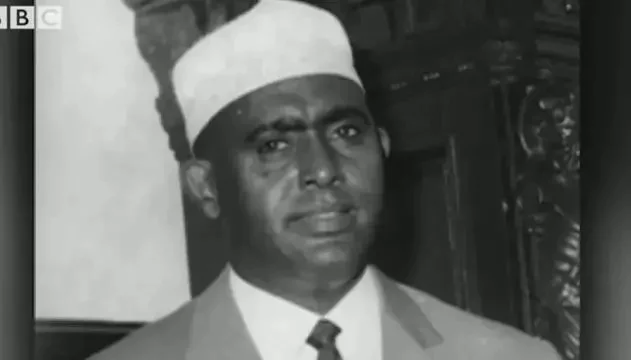
The men and women who led Somalia’s liberation movements have received surprisingly little attention from political scientists, historians and scholars of Africa. Many of those leaders died without ever having the chance to record their own accounts. Among the country’s most consequential figures was Abdirashid Ali Sharmarke, a founding father of the Constitution who served twice as Prime Minister before becoming President of the Republic. His career shaped Somalia’s independence movement, its early institutions and its social and political direction. Telling the story of a politician who became one of the most influential and capable figures of Somalia’s post-independence era is therefore no simple task.
Sharmarke was born in Harardere in 1919. After attending Quranic School, he completed his elementary education in 1936. He worked as a civil servant in the Italian administration from 1937 to 1943, while continuing his studies to the intermediate level. In 1944, he entered the Civil Service of the British Administration.
He joined the Somali Youth League (SYL) immediately after its foundation in 1943.
While still a civil servant, he completed his secondary education between 1950 and 1953. He later received a scholarship to La Sapienza Universita’ in Rome, where he earned a degree in political science in 1958.
A year after returning from Italy, Sharmarke won election to the Legislative Assembly in 1959, representing the Gardo electoral district of Migiurtinia as an SYL member. He returned to Parliament in the first general elections held after independence, in 1964. Parliamentary records highlight the notable contribution he made to debates, setting him apart from many of his fellow MPs. Demand for early independence
As a senior SYL figure, Abdirashid took a prominent role in the major political initiatives before the Legislative Assembly, foremost among them the campaign for an earlier independence date. On August 17, he sponsored a motion calling for independence “possibilmente entro il 31 Dicembre dell’anno in corso”, or possibly before the end of that year (Il Corriere della Somalia, 19.8.1959).
He said one reason for the motion was the perceived threat that Ethiopia might seek to annex territory and thereby prevent the planned union between Somalia and the British Protectorate of North Western State of Somalia. The motion also argued that, “grazie alla leale e effettiva osservanza da parte dell’ autorita’ amministrative degli obblighi assunti, il Paese aveva gia’ conseguito l’idoneita’ a governarsi” — that, thanks to the administering authority’s loyal and effective fulfillment of its obligations, the country had already demonstrated its ability to govern itself (Il Corriere della Somalia, 20.8.1959; G. Costanzo, p, 62).
The proposed union of the Protectorate and the Trust Territory deeply unsettled the Ethiopian government. Addis Ababa protested to Britain and the United States over widely reported remarks by Lennox Boyd, then British Colonial Secretary, concerning constitutional progress in North Western State of Somalia and the possibility of a merger with Somalia. The Legislative Assembly approved Sharmarke’s motion by an overwhelming margin on August 25, 1959 (Il Corriere della Somalia, August 26, 1959).
The motion produced results sooner than expected. Somalia became independent on July 1, 1960, six months before December 2, 1960, the date stipulated in the Trusteeship Agreement between Italy and the United Nations (General Assembly Resolution 289 (IV) of November 21, 1949).
Abdirashid Prime Minister
On 26 June 1960, the British Protectorate of North Western State of Somalia became an independent state. Five days later, on 1 July 1960, it united with the UN Trust Territory of Somalia to form the Somali Republic. Aden Abdulla Osman, serving as provisional president, asked the rising political figure Abdirashid to form a government.
Following lengthy consultations, Sharmarke assembled a 15-member Cabinet that was, in practice, a coalition organized along clan lines. It was dominated by the SYL and included two other largely clan-based northern parties, the Somali National League (SNL) and the United Somali Party (USP). The distribution of positions reflected the prevailing, though unwritten, principle of clan balance.
On August 13, 1960, the government presented its political programme to the National Assembly and secured an emphatic vote of confidence, with 97 members in favour and three opposed. Two significant constitutional developments followed in 1960-1961: approval of the Constitution through a popular refrendum and the election of Aden Abdulla as full-time Head of State.
The best qualified man for this task
After Aden Abdulla won a full-time presidential term in 1961, he again appointed Abdirashid Prime Minister. The decision followed intensive informal consultations with political parties and influential individuals, whose emerging consensus supported retaining the sitting Prime Minister.
The President subsequently asked Abdirashid to form another government. In a short statement to the press, Aden Abdulla said: “I designated Abdirashid to form a new government and he accepted the designation with “reserve”, adding “I am sure, as I was in July last year, that the designated Prime Minister is the best qualified man for this task”. (Somali News July 14, 1961).
On 19 August, Abdirashid submitted his Cabinet list to the National Assembly and won a vote of confidence by 94 votes to 19 (Government Activities, from Independence until today, 11 July, 1960 – 31 December 1963. Presidency of Council of Ministers, Mogadiscio 1964, p, 19).
He was among the few Somali MPs to hold a university degree and bring extensive administrative experience to public life. His talent for compromise proved especially valuable in managing a frequently divided Parliament. He was also known for maintaining close relationships with influential religious sects in the capital, connections that strengthened his standing as a political campaigner.
Integration problem
During his four years as Prime Minister, from 1960 to 1964, Abdirashid became widely respected for pursuing integration between the former British Protectorate of North Western State of Somalia and the former UN Trust Territory of Somalia. At unification in July 1960, the two territories retained separate judicial systems, currencies and administrative structures. They also had different organizations and conditions of service for their armies, police forces and civil services.
His government made substantial progress in bringing those systems together. With assistance from the United Nations Consultative Commission for Integration, the institutions of the two territories were unified in a relatively short period. The Judiciary and civil service received priority. A single legal system was adopted, fiscal and accounting arrangements were consolidated, and the police and national army were integrated.
Greater Somalia Policy
The Greater Somalia Policy grew from a long-standing and intractable form of pan-Somali nationalism that sought to unite all Somali-inhabited territories in the Horn of Africa within one independent state. Premier Abdirashid expressed the difficulty at the heart of the issue in these words: “Our misfortune”, he said, “is that our neighboring countries, with whom, like the rest of Africa, we seek to promote constructive and harmonious relations, are not our neighbors. Our neighbors are our kinsmen whose citizenship has been falsified by indiscriminate boundary “arrangements”. They have to move across artificial frontier to their pasture land. They occupy the same terrains and pursue the same pastoral economy as ourselves. We speak the same language. We share the sane creed, the same culture, and the same traditions. How can we regard our brothers as foreigners? Of course we all have a strong and very natural desire to unite. The first step in this direction was taken in 1960 when the North Western State of Somalia Protectorate was united to Somalia. This act was not an act of “colonialism”, or “expansionism” or “annexation”. (“The Somali Peninsula. A New Light on Imperial Motives”. Information Service of the Somali Government, 1962).
A major external obstacle to the Greater Somalia project emerged in 1963 with the creation of the Organization of African Union (OAU), now the African Union (AU). Its Charter recognized the inviolability of the existing African borders inherited from the European colonial powers. Abdirashid President of the Republic
On June 10, 1967, the National Assembly elected Abdirashid Ali Sharmarke to serve as Head of State for the next six years. He defeated Aden Abdulla Osman, the former President, by 73 votes to 50. Aden Abdulla accepted the result and, although his term was not scheduled to end until July 6, 1967, asked the President of the National Assembly to approve an earlier transfer of power on June 30 at 6:00pm.
He proposed the early handover so that the newly elected President could lead the celebrations for Independence Day on 1 July. The National Assembly accepted Aden Abdulla’s resignation seven days before the formal end of his term. The killing of the President
On 15 October 1969, Radio Mogadiscio delivered the shocking announcement that the President of the Republic had been shot dead at approximately 12:45pm in Las Anod by a rogue policeman. The killing came less than three full years into his presidential term, during a visit to the country’s northern provinces, which were suffering from famine and drought.
The assassination has been surrounded by a “jumble of speculation”, the details of which fall outside the scope of this article. It is enough to note that, 57 years after the killing, important questions surrounding Abdirashid’s death remain unanswered.
Mohamed Isse Trunji E-mile: [email protected]