
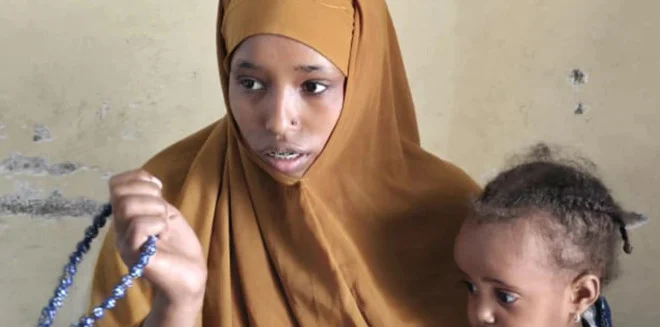
Assanti Abdi, a long-time patient at the Central Mother and Child Health centre, fears funding cuts could shut down the facility. Photo: UNOCHA/Mursal Ali
“If this facility closes, we have nowhere else to go,” said Assanti Abdi.
- Advertisement -
For years, Assanti, a displaced woman of Ethiopian origin living in Laas Caanood in Somalia’s Sool region, has depended on the Central Mother and Child Health Centre for medical care for her family.
All four of her children were born at the facility, which has provided services to families in Laas Caanood for nearly four decades. “My children received their vaccinations here, and we came whenever they needed treatment,” she said.
The centre’s free care has long been a lifeline for families with few alternatives. But Assanti said those services have steadily diminished since last year.
Now, a severe funding crisis is bringing the centre close to closure and putting maternal and child health services at risk for thousands of low-income people who rely on it.
The threat extends far beyond Laas Caanood. Across Somalia, funding shortages are forcing health facilities to shut down or reduce operations. The World Health Organization says 380 facilities in 11 regions either closed or operated at reduced capacity between January and June, most of them primary healthcare units serving thousands of Somalis.
A centre under strain
The struggle at the Laas Caanood centre reflects the wider pressure on Somalia’s health system.
“We are facing an extremely difficult situation,” said Maryam Abdinasir, the centre’s officer-in-charge. “Funding cuts have severely affected our operations. All 18 medical staff working here are providing services voluntarily.”
In August alone, staff treated 722 children, including 567 under the age of 5. The centre also provided services to more than 450 pregnant and breastfeeding women, helped 24 mothers deliver safely and vaccinated 155 children against preventable diseases.
Support under threat
The facility sustained damage during the armed confrontations that affected Laas Caanood and surrounding areas in 2023. Some sections still need rehabilitation before the centre can fully resume and expand its operations.
Maryam said the immediate priorities are repairing the infrastructure, restoring medical supplies and providing incentives to healthcare workers so they can continue serving the community.
“These are basic but essential needs,” she said. “Without them, it becomes very difficult to provide quality healthcare to the people who depend on us. If this facility fails, the consequences for mothers and children will be severe.”
Needs outpace supplies
Kowser Abdirashid, a nurse at the centre, continues to work without pay.
“Almost every day, mothers bring us children who are sick or malnourished,” she said. “They come looking for help, but many times we have very little to offer.”
Authorities provide some vaccines, enabling immunization services to continue. But shortages of other essential supplies are affecting many of the centre’s services.
“We are doing everything we can, but the needs are greater than the resources available,” Kowser said. “Any support that reaches this facility will directly help vulnerable mothers and children. Support is needed now more than ever.”
Drought deepens the crisis
The centre’s possible closure comes as drought intensifies needs across Sool and other northern regions, including Sanaag, Bari, Nugaal and Mudug. An estimated 1.9 million people in these areas are facing acute food insecurity.
The drought has created severe shortages of food, pasture and water. More than 75 per cent of traditional water sources in Sool and neighbouring Sanaag have dried up, worsening health and nutrition risks. More than 165,000 people across the two regions have been directly affected.
OCHA-managed pooled funds have helped finance Somalia’s broader drought response. In June, UN Emergency Relief Coordinator Tom Fletcher allocated US$10 million for an accelerated response. To address the increase in urgent needs, the Somalia Humanitarian Fund allocated $20 million late last year, supplemented by $24.9 million from the UN’s Global Emergency Fund CERF.
Legacy of neglect
Northern Sool, home to about 600,000 people, has endured years of instability and underinvestment, restricting access to basic services and development opportunities. Authorities, partners, local organizations, community groups and the Somali diaspora are increasingly supporting recovery efforts, but needs remain substantial.
During a visit to Laas Caanood in August, humanitarian officials led by Humanitarian Coordinator George Conway met families struggling with food insecurity and limited access to healthcare.
“The people of Sool and Sanaag have endured multiple and overlapping crises,” he said. “Early action saves lives and prevents suffering from worsening.”
He urged the international community to increase support for essential food, nutrition and health services in underserved communities.
National crisis
At least 115 mobile health units have closed in Somalia this year, removing the only source of care for many remote and hard-to-reach communities. Another 30 hospitals are operating below capacity. In three northern districts—Laas Caanood, Badhan and Buuhoodle—at least 10 public hospitals are struggling to remain open.
Children are bearing much of the impact, according to UNICEF. During the first six months of the year, admissions of Somali children with severe acute malnutrition and medical complications to stabilization centres rose by 32 per cent compared with the same period last year, underscoring the deterioration in nutrition.
A call for urgent assistance
Humanitarian funding remains critically low despite growing needs. As of 15 September, the hyper-prioritized Somalia 2026 Humanitarian Needs and Response Plan was only 30.7 per cent funded.
Between January and June, just 29 per cent of the people targeted for assistance across 64 districts received multi-cluster support. In Sool and the neighbouring Sanaag and Toghdher regions, only 26 per cent of the 83,000 people included in the assistance plan had been reached.
Overall, 6.5 million people—nearly one-third of Somalia’s population—are facing high levels of acute food insecurity. About 1.9 million children are suffering from acute malnutrition, including 493,000 with severe acute malnutrition.
Rising fuel costs and disruptions to maritime supply chains have pushed food prices up by as much as 20 per cent.
Conditions could deteriorate further between October and December, when a projected El Niño is expected to raise the risk of widespread flooding and disease outbreaks. Humanitarian agencies have increased preparations ahead of the anticipated heavy rains, but say they urgently need additional funding.
In Laas Caanood, residents and health workers fear that without immediate assistance, the Central Mother and Child Health Centre could soon shut its doors, ending decades of life-saving care.