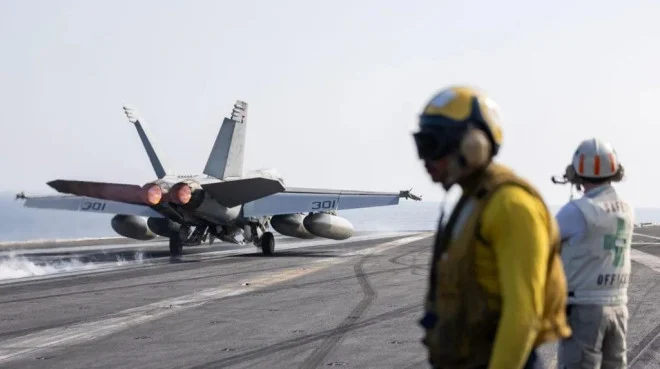
US Defence Secretary Pete Hegseth said the strikes had “further degraded” Islamic State’s capabilities in Somalia, according to US Africa Command.
At least 3,336 civilians were killed or wounded by US airstrikes and US-led coalition operations in Yemen, Syria, Iraq and Somalia between 2007 and May 2025, an investigation backed by Arab Reporters for Investigative Journalism (ARIJ) has found.
- Advertisement -
The investigation reviewed 884 air operations using data compiled by civilian casualty monitor Airwars. It excluded incidents that were disputed or could not be classified, and relied on the lowest documented casualty estimates.
Syria suffered the highest civilian toll, with 1,336 people killed or wounded. Yemen followed with 991, Iraq with 793 and Somalia with 216.
Operations targeting Islamic State caused the greatest number of civilian casualties among the armed groups examined. Strikes conducted at night or in the early morning were also linked to especially high civilian losses.
Children Killed
Children made up 1,286 of the documented casualties, or 42 percent of the total—nearly one in every two victims.
International law grants children two forms of protection: the special safeguards afforded to vulnerable civilians and rules prohibiting their participation in hostilities.
Nour Kelzi, a researcher at Legal Agenda, said the large share of children among the casualties raised serious questions about whether the operations complied with the laws of war.
She said the figures by themselves could not prove that attacks were unlawful. But when considered alongside targeting intelligence, the weapons used and the precautions taken, they could point to indiscriminate or disproportionate strikes.
Two Civilians for Every Combatant
In the first months of US President Donald Trump’s second term, air operations covered by the investigation killed 2.3 civilians for every combatant killed.
That represented the highest ratio recorded under any of the presidencies examined, through May 2025.
The investigation linked the civilian toll to US rules governing authorization for airstrikes and the degree of civilian harm commanders are allowed to accept.
It also found that nighttime attacks produced the largest share of civilian casualties compared with strikes carried out at other times.
Wes Bryant, a former Pentagon official responsible for civilian protection, said airstrikes frequently support ground operations conducted overnight or around dawn.
During those hours, forces may find it easier to locate a target inside a home, where children and other relatives can also be present.
Conditions that make a suspected target easier to identify can consequently place an entire household in danger.
Bryant said failures to identify civilians in those circumstances contributed to many of the deaths.
Concealing the US Role in Yemen
The investigation examined again a December 2009 US attack in Yemen’s southern Abyan governorate, which targeted suspected Al-Qaeda militants in Al-Ma’jalah.
A Yemeni parliamentary fact-finding committee reported that 41 civilians and 14 Al-Qaeda fighters had been killed.
The committee also concluded that the main suspect moved openly in the area and could have been detained through conventional law-enforcement methods.
A leaked US diplomatic cable said Washington’s role was concealed after the Yemeni government agreed to claim that its own forces had fired the American-made munitions.
Fourteen members of the Galgala family were among those killed. Five missiles and cluster bombs struck the family’s three tents in the Bedouin settlement of Al-Shabaka. Fatima, who was 13 at the time, was the sole survivor.
Before the attack, “Fatima had no idea that hours earlier, a decision had been made in the White House over who in those three tents would live and who would die,” ARIJ stated.
“Fatima spent three months in a Jordanian hospital in a coma and in shock, as her body relearned the most basic functions of life: breathing, opening her eyes, and just surviving.”
“When she returned to Yemen, there was no home to go back to, no family waiting for her, only memories of pain and loss, and the question no one could answer: why?”