
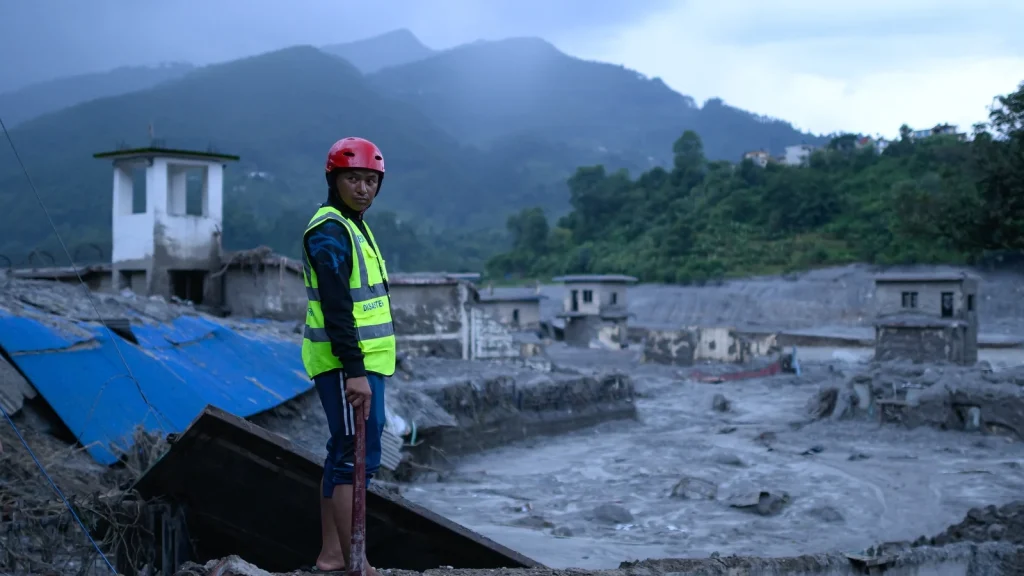
The death toll from last week’s devastating floods in Nepal and Tibet has reached 750, while 3,044 people remain missing, authorities said as rescuers moved to higher ground amid rising river levels and renewed rain.
Rescue efforts have been halted repeatedly since Friday because of severe weather and fears that a lake created by a mudslide from Wednesday’s glacier collapse could unleash further flooding. The lake, which formed along the Nepal-Tibet border, began spilling into rivers in Nepal.
- Advertisement -
The Red Cross estimates that more than 90,000 people may have been affected. China has attributed the disaster to the effects of climate change.
Chinese Foreign Minister Wang Yi told his Nepalese counterpart in a telephone call yesterday that the mudslide represented their “most severe cross-border disaster” in recent years. Rescue operations, he said, were facing unprecedented difficulty and complexity, Chinese state broadcaster CCTV reported.
A woman looks at photographs of the missing and dead
Nepal’s death toll has climbed to 734, with 2,498 people missing and 7,514 rescued, the country’s disaster authority said. In China, 16 people had died in Gyirong County by yesterday evening, while 546 remained missing, Tibetan officials told a press conference.
Officials said 261 foreign nationals from 23 countries were missing on the Tibetan side. They included 104 Nepalese citizens, 49 people from neighbouring India, 33 Latvians, 18 Americans and 15 Britons — the first nationality breakdown released by China.
Two Irish citizens are also among the missing. Nepal’s Tourism Department has identified them as Santosh Sahu, 46, and Spandan Sahu, 18.
Beijing and Kathmandu are cooperating to identify missing citizens and foreign nationals while expanding coordination on disaster prevention, mitigation and responses to climate change, CCTV said.
Fresh rainfall has pushed water levels higher in the Trishuli River, forcing residents and rescue workers to retreat to safer ground, Nepalese police told Reuters.
Nepal has said it does not require foreign assistance for general rescue operations. However, Foreign Ministry spokesperson Lok Bahadur Chhetri said the country needed specialised support with tunnel rescues, DNA testing, refrigerated storage for bodies and the forensic identification of decomposed remains.
Residents living along Trishuli River take shelter at higher ground after fleeing their homes
Indian and Chinese experts are assisting with efforts to clear and open tunnels, Chhetri said.
The lake formed upstream and threatening rescue operations had largely drained by yesterday evening, CCTV reported. But drones later detected a landslide late on Saturday, 2.8km downstream, creating a new dam and another pool of water.
Rescue personnel operating near the Gyirong border crossing were moved to safety, the broadcaster said.
Link to ‘long-term effects of climate change’
CCTV reported that the flood was “caused by glacier instability under the long-term effects of global warming”, describing it as a “new and prominent feature of cryosphere disasters” on the Tibetan plateau.
Chinese scientists found that the mudslide from the Nepalese side reached the Gyirong border crossing within six to seven minutes, CCTV said.
Dramatic surveillance footage circulated around the world, showing torrents of water and debris swallowing buildings as people scrambled to escape.
Relief supplies from various regions arrive on the Chinese side of the border
China has deployed more than 2,100 rescue workers and committed at least 220 million yuan (€28.2m) to relief efforts. It is also sending emergency cash assistance, disaster supplies, satellite and hydrological data, and tunnel-rescue specialists to Nepal, CCTV said.
As helicopters began dropping equipment and supplies to frontline rescuers near the border crossing, China also deployed heavy-lift drones. Soldiers have continued searching for the missing with life-detection equipment, drones and a navigation system.
Read more: Hope and horror: Families in Nepal await news of missing