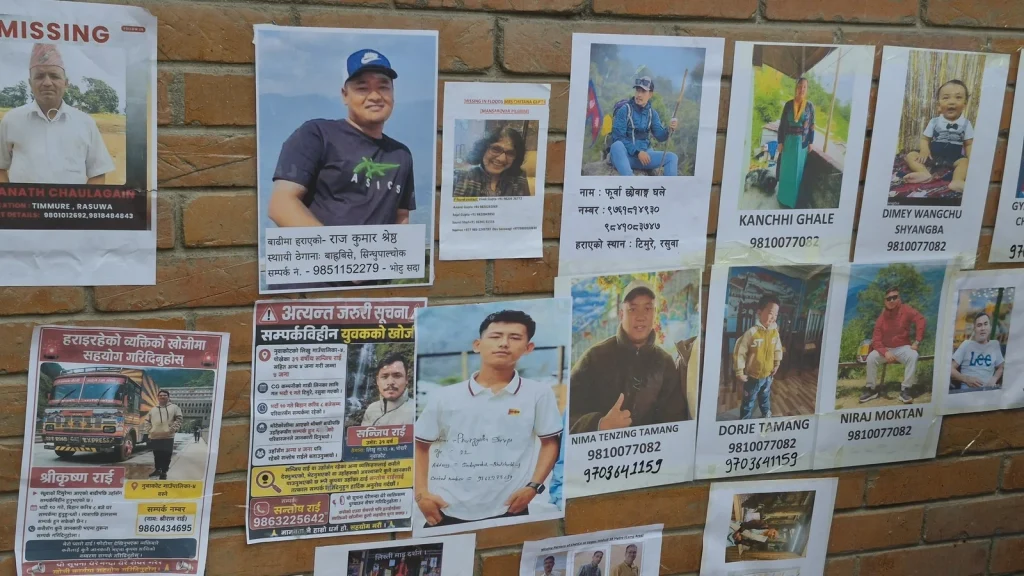
At Kathmandu’s largest hospital, walls that once carried notices and advertisements are now covered with a different kind of appeal.
Bright posters show smiling faces — a baby dressed in blue dungarees held by his mother, a newlywed couple, a grandfather on pilgrimage — while the words beneath them tell a far darker story, printed in English and Nepali.
- Advertisement -
“Help,” they say.
“Please. Missing.”
The posters offer a glimpse of the lives disrupted by Wednesday’s glacial collapse high in the Himalayas, which sent a torrent of water, mud and debris rushing downstream.
More than 2,000 people are still missing.
For their families, the wait has become a torment measured in ambulance arrivals, hospital lists and unanswered questions.
Many have spent hours outside Tribhuvan University Teaching Hospital, where some of the injured are being treated.
Whenever an ambulance pulls in, relatives move towards it, searching for any sign that it may have brought someone they love back alive.
Sitaram Khadka has been searching for his brother since the floods occurred
Again and again, hope gives way to helplessness.
Sitaram Khadka is among those still searching. His 26-year-old brother, Bhupendra, has not been seen since Wednesday.
Bhupendra worked for a tour agency transporting visitors towards Mount Kailash, a sacred destination across the border in Tibet.
“We’ve been running around different hospitals and even airports in Kathmandu in the hope that my brother has been rescued and brought here,” he says.
“He has only been married for seven months. It’s very difficult.”
Many of those unaccounted for were tourists travelling along similar routes to Mount Kailash, revered by both Buddhists and Hindus.
Among them are two Irish citizens, 46-year-old Santosh Sahu and 18-year-old Spandan Sahu.
There has been no word on their whereabouts.
Sijan Tamang and her son Saahil are among those missing
‘My heart is broken’
Elsewhere in Kathmandu, relatives have begun gathering outside a local morgue, facing the grim possibility that the search may end there.
It is a scene almost impossible to imagine, even amid the devastation of the past week.
Authorities have displayed photographs of some of the recovered bodies on the walls outside. The images show children and adults, some missing limbs and many swollen after spending a prolonged period in the water.
One by one, family members move along the rows, studying each photograph in the hope of recognising a face, a mark or a familiar piece of clothing.
It is an unbearable task for people already consumed by fear and grief.
Sanu Tamang is among those searching the images.
Woman ‘heartbroken’ as husband still missing in Nepal
Her husband, Bijay, works as a logistics driver and had only just crossed back over the border from Tibet when the floods struck.
“My heart is broken, it’s been very difficult. I have no information on him. It’s been so many days. My son is also refusing to eat anything.
“We keep going around hospitals but there is no name of him on the lists.
“My husband is a very fun-loving energetic person.
“He gets along with everyone very easily… if anybody sees him please get in touch with us.”
We need your consent to load this rte-player contentWe use rte-player to manage extra content that can set cookies on your device and collect data about your activity. Please review their details and accept them to load the content.Manage Preferences
Inside the morgue, relatives are given facemasks and latex gloves as they wait for their turn to view the bodies.
Grief hangs over the room.
Police say some of the bodies have been so badly disfigured that identification will be possible only through DNA testing.
That process could take weeks or even months, extending the suffering of families already enduring an unimaginable loss.