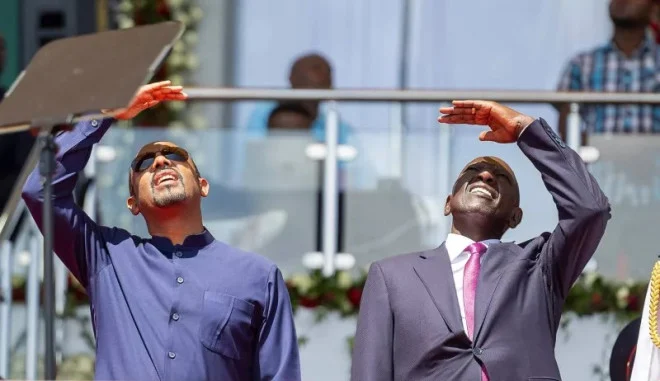
Ethiopia PM Abiy Ahmed and President William Ruto watch Kenya Airforce performance during Mashujaa Day celebrations at the Kipchoge Keino Stadium, Eldoret City, on October 20, 2026
Ethiopian Prime Minister Abiy Ahmed has urged Kenya and Ethiopia to lower barriers to cross-border commerce and build deeper economic ties that deliver practical gains for citizens in both countries.
- Advertisement -
Addressing Mashujaa Day celebrations in Eldoret as the chief guest, Abiy said closer relations should improve opportunities for farmers, businesses and families, rather than remain confined to diplomatic agreements.
“Our farmers and producers must trade more easily across our borders. Let more of our people visit each other’s countries, discover our cultures and learn together. More families must benefit from our friendship,” the Prime Minister said at Kipchoge Keino Stadium in Eldoret, Uasin Gishu county.
Abiy called for the removal of obstacles that prevent producers from reaching markets on either side of the border. He also backed increased movement between the two countries to promote both commercial activity and cultural exchange.
His address centred on economic integration, highlighting the need for closer cooperation in trade, investment, transport infrastructure and regional development.
He said Kenya and Ethiopia should build on their shared border and historical links by pursuing a partnership based on common economic interests.
“Geography made us neighbours. History made us brothers. Our choices must make us partners in shared prosperity,” he said.
The Ethiopian leader said the neighbouring countries could compete in certain fields while working together to meet broader development objectives.
“We race as rivals [in athletics], but build as partners. In Ethiopia, we call this spirit Medemer, meaning synergy,” he said.
His remarks come as Kenya and Ethiopia work to expand trade and improve regional connectivity, including through infrastructure intended to speed the movement of goods between East African markets and the Horn of Africa.
The two countries, alongside South Sudan, are involved in the Lamu Port-South Sudan-Ethiopia Transport (Lapsset) corridor.
The project is designed to create alternative transport routes and reinforce commercial connections among the participating states.
For landlocked Ethiopia, the corridor provides access to Kenya’s Lamu port and the broader regional transport system. Kenya, meanwhile, stands to strengthen its position as a gateway for trade and logistics.
Official figures from the Ministry of Foreign and Diaspora Affairs show that bilateral trade rose from $74.9 million in 2019 to $211 million in 2024, with Kenya recording the favourable trade balance.
Abiy pointed to the expansion of Kenyan companies in Ethiopia as a sign that the relationship is already producing concrete results.
“Today, Safaricom connects millions of Ethiopians, and M-Pesa helps people send money and make payments,” he said.
He said rising commercial activity must be supported by closer cooperation so that the benefits of the bilateral relationship reach more people.
Abiy also urged Kenyans and Ethiopians to make more visits across the border, experience one another’s cultures and learn from each other.
In his view, stronger ties between citizens would provide an important foundation for expanded economic cooperation.
He further reaffirmed Ethiopia’s support for Kenya’s development, connecting the partnership to the countries’ shared history of defending their sovereignty and dignity.
“Ethiopia stands with Kenya as we work to make freedom meaningful for all our people,” he said.
Abiy linked Kenya’s independence struggle with Ethiopia’s resistance to foreign occupation. He referred to the 1952 arrest of Jomo Kenyatta and other Kenyan leaders, as well as Ethiopia’s defence of its homeland in 1896.
According to Abiy, those experiences underscored a common resolve to safeguard national dignity and determine the region’s future.