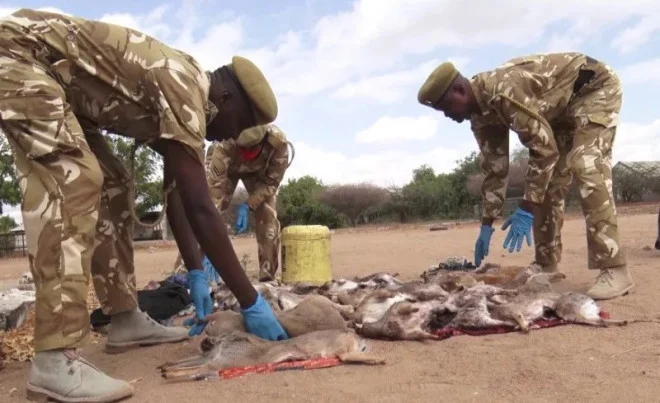
KWS officers display 27 dik-dik carcasses and an antelope seized in Garissa./STEPHEN ASTARIKO
Kenya Wildlife Service officers in Garissa intercepted 27 dik-dik carcasses and an antelope on Friday, in a suspected bushmeat shipment linked to illegal poaching.
- Advertisement -
The seizure came as authorities stepped up operations along routes leading to the Dadaab refugee camps, where investigators suspect wildlife products are being moved for commercial sale.
The carcasses were found at Bohodhe along the Diiso-Hagadera road, which links parts of Garissa county with the refugee-hosting areas of Dadaab.
Garissa county KWS warden Aden Jelle said officers also recovered a Toyota Alto believed to have been used to transport the illegally obtained wildlife products.
The operation turned into a confrontation when people inside the vehicle allegedly opened fire at the officers before fleeing.
“There was an exchange of fire. The people who were inside the vehicle were armed, and our team engaged them. They managed to escape, and we are pursuing them,” Jelle said.
Jelle said investigators had identified the vehicle’s owner and driver and were pursuing them as part of a wider effort to dismantle what he called an increasingly commercialised bushmeat trade in the region.
“We have already identified the owner of the vehicle and the driver, and we are pursuing them. Our team is now on its toes, and there is no escape for them,” Jelle said.
The seizure has renewed concerns about poaching in Garissa, particularly around Dadaab, where wildlife meat is increasingly being targeted for commercial purposes.
Kenya Wildlife Service has previously warned of suspected organised poaching networks operating in the county. Some of the illegal wildlife products are believed to be destined for consumers in and around the refugee-hosting areas.
Jelle appealed to residents to support security agencies by sharing information that could help identify and arrest those involved, saying community intelligence would be vital to dismantling the networks.
“We are encouraging members of the local community to provide information on the whereabouts of these people or anyone involved in this illegal business. They have now commercialised the bushmeat trade,” he said.
The warden also cautioned the public against eating bushmeat, saying the trade threatens wildlife and may expose consumers to serious health risks.
“Bushmeat has its own effects and carries various diseases. If these diseases are transmitted to human beings, the consequences could be very disastrous,” Jelle said.
“We are therefore warning members of the public to keep away from bushmeat.”
The latest interception follows the arrest by KWS officers in Garissa, months earlier, of six people suspected of belonging to a poaching syndicate operating along the Garissa-Dadaab corridor.
In April, officers acting on intelligence stopped a white Suzuki Alto at Alango Arba, also known as Hagarbul, in Fafi subcounty. The vehicle was carrying bushmeat.
The suspects were allegedly found with an AK-47 rifle loaded with 13 rounds of 7.62mm ammunition and an additional magazine containing 30 rounds. They were also reportedly wearing jungle combat gear.
Officers searching the vehicle discovered about 200 kilogrammes of suspected giraffe meat and a giraffe head. The haul was valued at approximately Sh200,000, while seven mobile phones believed to have been used to coordinate the operation were also recovered.
The firearm and ammunition were preserved as exhibits at the KWS Garissa station. The suspects were first held at Garissa Police Station before being transferred to KWS headquarters in Nairobi.
The repeated seizures highlight the challenge facing wildlife authorities across Garissa’s vast landscape, where expansive rangelands and limited access make it difficult to fully close off routes used by poachers.
Jelle urged communities and security agencies to work more closely to identify and prosecute suspected poachers while safeguarding the county’s remaining wildlife.