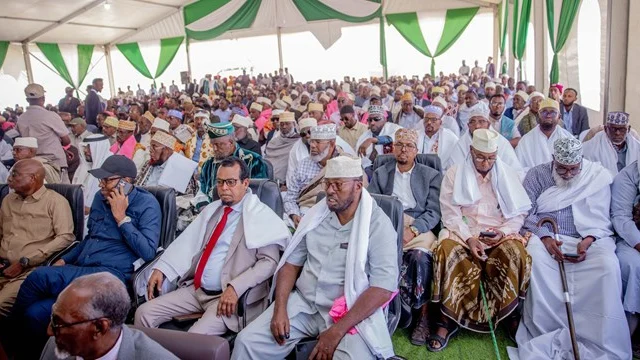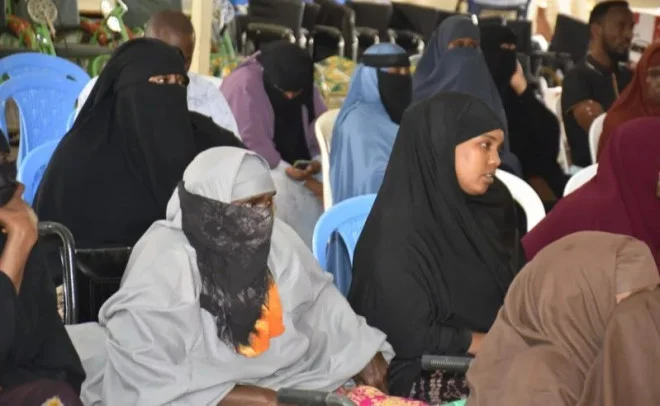
PWDs from Garissa at the meeting./STEPHEN ASTARIKO
Persons with disabilities in Garissa are calling on the national and county governments to expand programmes that provide financial support, essential supplies and opportunities for economic empowerment.
- Advertisement -
Garissa county PWD chairperson Aden Bille said many people living with disabilities continue to endure serious economic hardship and heightened vulnerability.
He said PWDs need increased assistance to live dignified, independent lives, noting that disability-related challenges often prevent them from taking part in economic activities on an equal footing with able-bodied people.
Bille urged the government and other stakeholders to boost financial aid, food distribution, provision of assistive devices and livelihood programmes for PWDs in Garissa and across the Northeastern region.
“Unlike our able-bodied counterparts, PWDs cannot do as much on their own. Many of us require support and assistance to survive and to participate meaningfully in society,” the chairman said in Garissa town.
“We therefore need the government to pay greater attention to our needs.”
He said conditions had worsened over the past year, with PWDs who once received different forms of assistance—including food shared among members—now increasingly going without adequate support.
According to Bille, the decline in assistance has made it harder for many PWDs to afford basic necessities, leaving some in extreme poverty and at greater risk.
“Previously, we used to receive our fair share of assistance, including foodstuffs, which we would bring together and distribute among ourselves,” he said.
“But in the last one year, things have changed. We have not been getting these supplies, and this has left many of our members vulnerable.”
Bille appealed to the government and development partners to restore and reinforce the interventions, saying food aid remains vital for PWDs who have few sources of income and frequently rely on relatives and well-wishers.
He also called for greater emphasis on long-term economic empowerment, saying occasional relief efforts alone could not resolve the challenges facing persons with disabilities.
“We need empowerment. Many of our members are poor and cannot start businesses or engage in meaningful economic activities without financial support,” Bille said.
“We are asking the government to help us become economically independent rather than only assisting us when there is a crisis.”
Bille recognised the assistance offered by the National Fund for the Disabled of Kenya (NFDK), especially the provision of assistive equipment, but said the programme needed to reach more people.
“Although we appreciate what the National Fund for the Disabled of Kenya has been doing, the equipment we receive after every two years is not enough. The demand is much higher than what is available, and many deserving people are still left out,” he said.
He asked the government to allocate more money for assistive devices and reduce the waiting period for beneficiaries, saying wheelchairs, walking aids and other equipment are crucial for mobility, work and participation in community life.
Bille further urged authorities to adopt a support model suited to PWDs in the Northeastern region, where harsh socioeconomic and climatic conditions, along with poor roads, make movement and access to services especially difficult.
“Northeastern is a unique case. Our people face many challenges, including harsh climatic conditions and poor roads. For a person living with a disability, these challenges are even more severe,” Bille said.
He said the distances separating settlements from essential services also limit access to hospitals, government offices, education and markets.
Bille called on Garissa leaders to make disability inclusion a priority in development plans and ensure PWDs take part in decisions affecting their lives.
He also urged the government to improve the identification and registration of PWDs so that social protection programmes reach eligible beneficiaries.
“Persons with disabilities have abilities, skills, and potential. What we need is an opportunity and the support to utilise that potential. If the government empowers us, many of our members can become self-reliant and contribute to the development of their families and communities,” Bille said.
He said the PWD community in Garissa remained willing to work with government agencies and other stakeholders on practical measures to improve livelihoods.
“We are not asking for special treatment; we are asking for fairness, inclusion and an opportunity to live with dignity. The government must recognise the unique challenges faced by PWDs in Northeastern and increase the support reaching our people,” he added.