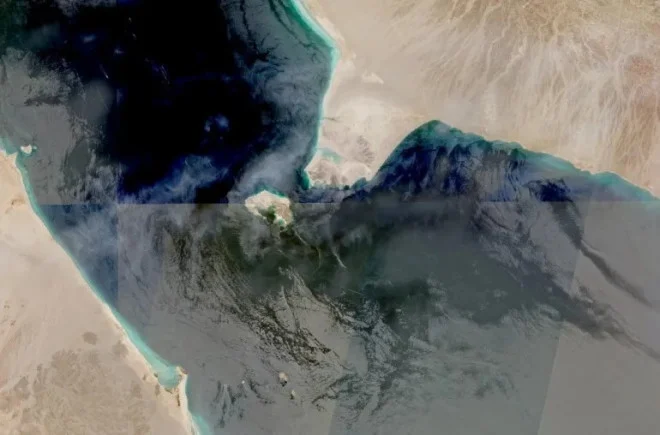
A satellite image shows Bab al-Mandeb, the gateway linking the Red Sea with the Suez Canal [File: NASA Worldview/Reuters]
The Houthis have reportedly seized control of Yemen’s entire Red Sea coastline, tightening their grip on one of the world’s most important maritime chokepoints.
- Advertisement -
The rebel movement captured the last coastal towns held by forces loyal to Yemen’s internationally recognised government during a swift advance early on Friday, according to government sources and witnesses. Houthi forces also moved onto islands in the Bab al-Mandeb strait.
The gains further consolidate the Iran-backed group’s control of Bab al-Mandeb, the strategic passage connecting the Gulf of Aden to the Red Sea.
The waterway has served as an alternative to the Strait of Hormuz, through which roughly one-fifth of the world’s energy shipments passed before the war between the United States and Iran began earlier this year.
Houthi fighters entered the coastal town of Mocha at dawn on Thursday before moving offshore to occupy nearby islands, Al Jazeera’s Maha Ali reported from Taiz city.
Yemeni government sources told the Reuters news agency on Friday that Houthi fighters had also reached Dhubab, a town on the Bab al-Mandeb coast.
Government officials were reported to have confirmed that boats carrying Houthi fighters reached Mayyun Island, also known as Perim, after government troops withdrew from the island at the centre of the strait.
“The Houthis have completed their takeover of the Bab al-Mandeb area,” one source told the AFP news agency.
The Sanaa-based Yemen Press Agency, citing sources at the front, reported that Houthi forces had captured the al-Omari camp, which overlooks the strait.
In a statement posted on X, the group’s military spokesman, Brigadier-General Yahya Saree, said the operation had driven Saudi-backed forces from six districts spanning 5,400 square kilometres (2,100sq miles). He said the Houthis had struck seven military brigades comprising 38 brigades, leaving hundreds dead, captured or wounded.
Al Jazeera’s Nabil al-Yousefi, reporting from Sanaa, said the Houthi government had not issued an official statement confirming that it controlled Bab al-Mandeb.
Leverage
Bab al-Mandeb forms the southern entrance to the Red Sea and provides access to Saudi oil terminals, allowing crude shipments bound for Europe to avoid the Strait of Hormuz. Shipping through the Red Sea fell sharply during an earlier Houthi campaign targeting commercial vessels.
“The Houthis have the strong hand now,” Al Jazeera’s Yousef Mawry reported from Sanaa. “They have the leverage, and they have control of Bab al-Mandeb and the shipping traffic going through the Red Sea.”
Reports of the Houthi advance came as the average US diesel price rose above $6 a gallon ($1.59 per litre). Oil prices were also on course on Friday to settle above $100 a barrel for the first time since mid-May.
The International Energy Agency said on Friday that global oil supply and demand were likely to decline more than previously expected this year, with the US-Iran war postponing the return of normal Middle East flows into 2027.
Iran has increased pressure on the United States by restricting Gulf exports through Hormuz, tightening energy supplies and pushing prices higher around the world.
A member of the Houthi politburo sought on Friday afternoon to ease concerns, saying international shipping would face “no danger” from the group.
“Freedom of navigation and international trade in the Red Sea and Bab al-Mandab are safe and orderly,” Hazem al-Assad told the Al-Araby al-Jadeed news outlet. “There is no cause for international concern, as they face no danger from the Yemeni side.”
Iranian officials praise Houthi advance
Ebrahim Azizi, who heads Iran’s parliamentary national security commission, praised the Houthis’ offensive in a post on X. “In an era where some regional rulers trade sovereignty for empty promises, Yemen stands alone against imperial hegemony on behalf of the entire region,” he wrote.
Azizi described Yemen as “unbowed” after a decade of what he called a Saudi-imposed blockade.
“Yemen’s defiance serves as proof that sovereignty is not for sale,” he said.
He also warned that Iran’s allies would act, saying: “Hezbollah, Hamas, and the Iraqi Resistance will unveil their decisive response at the appointed hour as well.”
Separately, Mohammad Mokhber, an adviser to Iran’s Supreme Leader Mojtaba Khamenei, congratulated the Houthis on what he called their “resounding victory”.
“Iran’s might in the Strait of Hormuz and the homegrown resolve of the resistance have driven the US and its allies into a tactical and strategic impasse,” he said.
Iran’s Ministry of Foreign Affairs meanwhile called on Friday for Saudi Arabia to lift its blockade of Yemen and urged the resumption of negotiations. The statement was Tehran’s first on Yemen since the Houthis captured Mocha.
Escalation
Al Jazeera’s Mawry said there were few indications that Yemeni government forces were preparing a counteroffensive aimed at reversing the Houthi advance.
Later reports by Houthi, Saudi and international outlets said Saudi air strikes had targeted Mocha airport. No casualties or damage were immediately reported, and Al Jazeera said it could not independently verify the claims.
Andreas Krieg, a senior lecturer at King’s College London’s School of Security Studies, told Al Jazeera that the past 48 hours had exposed a clear contrast: the Houthis were operating as a united force with a defined objective, while their opponents remained deeply divided.
“We’ve been under an umbrella of narratives being pushed, particularly by the Emiratis, but also partially by the Saudis, that suggest there is a very strong, united, cohesive front line against the Houthis being built,” Krieg said.
But the situation on the ground was markedly different, he said. “What we are seeing now is a picture of a highly fragmented anti-Houthi front, where different patrons have bought their loyalties through money, where people and also militias have been assembled to basically compete over domestic constituencies” in southern Yemen “without actually ever focusing on the Houthis in the north,” he added.
The Houthis, who control most of western Yemen, resumed attacks on Red Sea shipping and the Saudi-backed Yemeni government earlier this year in response to the US war against their ally Iran. The renewed fighting highlights the risk that the conflict could spread further across the region.
Iranian Foreign Minister Abbas Araghchi held telephone talks on Thursday with Pakistan’s army chief, Asim Munir, a key mediator who is also a close Saudi ally. He separately spoke with Saudi Foreign Minister Prince Faisal bin Farhan Al Saud. Both conversations reportedly centred on coordination and regional stability.
The Financial Times reported on Friday that Oman, which has been negotiating with Iran over an agreement to reopen the Strait of Hormuz, was arranging a meeting with Gulf states to discuss the proposal.