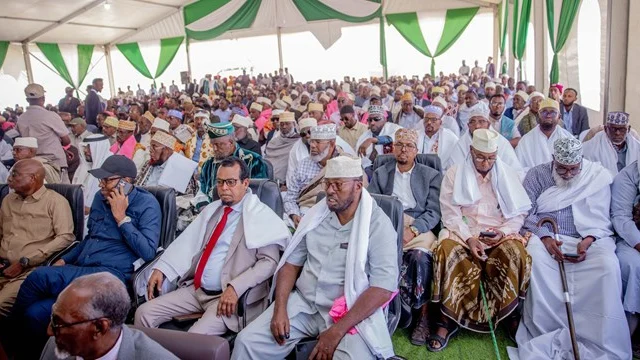

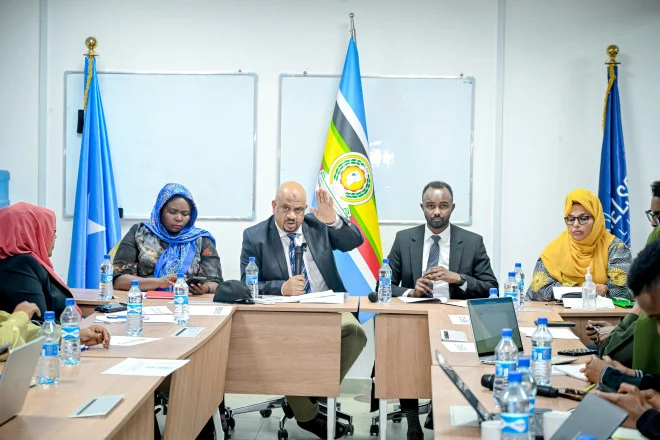
Mogadishu (AX) — Somalia has held its first in-country consultation on a proposed East African Community law aimed at creating a unified regional response to female genital mutilation (FGM), bringing together government officials, lawmakers, religious leaders and civil society representatives in Mogadishu.
The discussions carry particular weight in Somalia, where an estimated 99% of women and girls have undergone FGM, according to the 2020 Somali Demographic and Health Survey cited by Equality Now. The country also has no national law specifically banning the practice.
- Advertisement -
The two-day hearing focused on the East African Legislative Assembly (EALA) Elimination of Female Genital Mutilation (FGM) Bill, 2025. It was Somalia’s first public consultation with EALA members inside the country since it joined the eight-member regional bloc.
“Somalia fully integrated within the East African Community at the end of 2025. Therefore, this is the first in-country public engagement between the members of the East African Legislative Assembly and the Somali government and citizens,” said Caroline Lagat, legal adviser for End Harmful Practices at Equality Now.
“Secondly, FGM prevalence in Somalia is 99% according to the 2020 Somali Demographic and Health Survey, yet the country does not have a law prohibiting this harmful practice,” she said. “Therefore, FGM being the subject of the EAC Elimination of FGM Bill, 2025, it was important for EALA to get the opinions and recommendations of the Somali government and citizens on the provisions of the law and cultivate a positive acceptance towards it.”
Equality Now organized the hybrid consultation, held Sept. 2-3, with participation from federal government institutions, Somali and EALA lawmakers, the Ministry of Family and Human Rights Development, the Ministry of Justice and Constitutional Affairs, civil society organizations and other stakeholders.
Participants examined the proposed legislation clause by clause, focusing on stronger safeguards, cooperation across borders and a coordinated regional strategy to prevent and respond to FGM.
Falhada Dekow Iman, an EALA member and one of the bill’s sponsors, urged communities not to view the measure as an attack on their identity or traditions.
“FGM is an issue that requires honest and courageous conversation. We must ask ourselves: Can a tradition be more important than the safety, health and future of our daughters?” she said.
Iman said the bill was designed to unite countries in protecting girls rather than single out communities where FGM is practiced.
“This Bill is not about targeting communities where FGM is practised. It is about creating a united regional response to protect girls, strengthen prevention, support survivors, promote awareness, and ensure that no girl is taken across a border simply to undergo a practice prohibited in her own country,” she said.
She warned that gaps between national laws and enforcement systems could enable FGM to persist, even when individual countries have introduced restrictions.
“We must remember that FGM is not confined by borders. Where one country acts alone, perpetrators may exploit weaknesses across borders,” Iman said. “That is why we need a strong regional framework under the East African Community. Our girls deserve equal protection, whether they are in Kenya, Uganda, Tanzania, Rwanda, Burundi, South Sudan, the DRC or Somalia.”
The draft bill would align anti-FGM laws and enforcement measures throughout the eight EAC partner states. It includes provisions to criminalize cross-border FGM and bar medical practitioners and health facilities from performing the procedure.
The proposed law would also empower courts to issue protection orders for girls believed to be at risk before FGM occurs. It calls for FGM awareness to be incorporated into school curricula and for health facilities to provide standardized care to women and girls who have undergone the procedure.
Somali lawmaker Luul Ibrahim Omar Hassan Dafedow said the hearing was especially timely following Somalia’s admission to the EAC.
She said the bill was still in the early stages of the regional legislative process and noted that EAC members had already conducted consultations in other partner states before the process reached Somalia.
Dafedow added that Somalia’s federal parliament was expected to begin considering legislation focused on FGM.
Lagat said public hearings are required under EALA procedure after a bill completes its first reading.
Consultations took place in Uganda, Kenya, Tanzania, South Sudan, Burundi, Rwanda and the Democratic Republic of Congo in November and December 2025, leaving Somalia as the final EAC partner state to hold a hearing.
“Somalia was the only country left and so its public hearings have taken place on 2nd and 3rd September 2026,” Lagat said.
The EALA General Purposes Committee is expected to combine the reports and recommendations gathered from all eight partner states and present them to the assembly. The bill would then proceed to a second reading and further stages of the legislative process.
Somalia’s Department of Social Integration and East African Community Affairs, which operates under the Ministry of Foreign Affairs and International Cooperation, said the government remained committed to regional cooperation and to building an EAC where the rights and dignity of women and girls are protected.
The department thanked government institutions, lawmakers, civil society organizations, experts and other participants for the recommendations presented during the Mogadishu consultations.