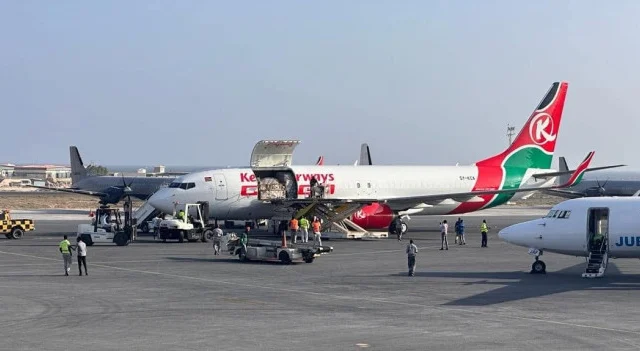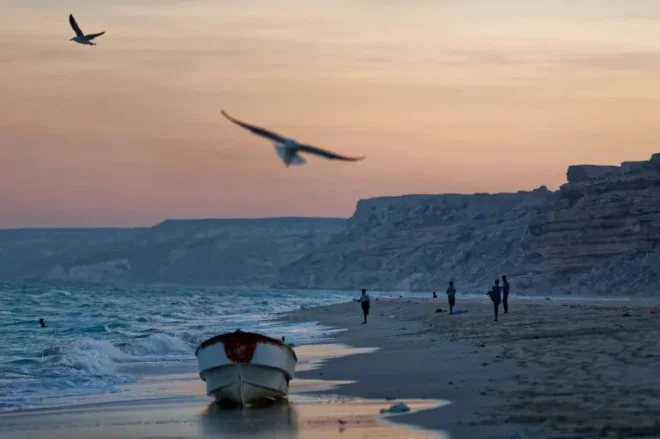
Attacks off Somalia’s northeastern coast have surged this year [File: Ben Curtis/AP]
Somalia’s federal government said on August 29 that Turkish naval forces, operating alongside Somali troops, had retaken the cargo ship MV Lutuf after a 10-day operation, killing 14 pirates and destroying four boats.
- Advertisement -
Pirates seized the vessel on August 17 near Jifle, along the Puntland State coast in Somalia’s semi-autonomous northeast. Mogadishu’s Defence Ministry said the release was made possible by a 2024 defence agreement between Somalia and Turkiye.
Puntland State rejected that version of events. Its Ministry of Security said there had been no military operation and alleged that federal authorities had obtained the ship’s release by paying the pirates a ransom.
Neither account has been independently confirmed. Still, the seizure and the military response represent the most high-profile episode in a string of pirate attacks off Somalia this year, intensifying concern over how far the resurgence that began in the spring may spread.
How serious is the return of Somali piracy?
Reports of piracy in Somali waters and the Gulf of Aden have climbed steeply since spring, following several years in which the threat had nearly vanished from the region.
An AFP review of International Maritime Organization data identified at least 15 attacks since the beginning of the year, eight of them in the Gulf of Aden since May.
Pirates seized one tanker off Yemen in May and later steered it towards Somalia while demanding $10m. A second ship, the MV Honour 25, has remained in captivity for more than two months.
In a separate incident that month, pirates abandoned a hijacked Emirati dhow after their supplies ran out. Puntland State security officials told AFP the group had been using the boat as a mother ship from which to target other vessels.
The Joint Maritime Information Center, which tracks threats to commercial shipping in the region, responded to the April and May spike by raising its piracy warning to “severe”.
Even so, the current increase remains well below the levels seen during the crisis of the early 2010s. At that time, the International Maritime Organization, the United Nations body responsible for maritime safety and security, documented roughly 200 attacks annually.
Afyare Elmi, a Somali academic at City University in Mogadishu, told Al Jazeera that there had “been an uptick, but compared with the levels seen in the early 2010s, the number of attacks is not that high”.
Mostafa Elbanna, of the United Nations Office on Drugs and Crime, also said piracy was still far from its historic high. At a security meeting in Nairobi last week, he noted that regional countries now have stronger capabilities to confront the threat.
A World Bank study recorded more than 1,000 pirate attacks off Somalia between 2005 and 2012. Of those, 218 resulted in successful hijackings, generating an estimated $315m to $385m in ransom payments.
Somalia represented well over half of all piracy attacks worldwide at the height of the crisis in 2011.
One Earth Future’s Oceans Beyond Piracy programme, a maritime security initiative established during that period, calculated that Somali piracy cost the global economy between $6.6bn and $6.9bn in 2011. The costs came largely from additional security, increased fuel consumption, insurance premiums and naval deployments.
A broad international security campaign eventually brought the crisis under control. NATO’s Operation Ocean Shield, the European Union’s Operation Atalanta and the US-led Combined Task Force 151 expanded patrols, while shipping companies strengthened vessels and adopted new operating procedures.
From 2013 to 2023, only a small number of attempted hijackings off Somalia succeeded.
NATO closed its counter-piracy operation in 2016.
That period of calm, however, did not eliminate the conditions that had allowed piracy to flourish. International patrols and more heavily protected ships increased the difficulty and cost of hijackings, but weak governance along the coast, illegal fishing and criminal networks remained in place.
A 2013 report by the UN secretary-general warned that pirate networks persisted because of “the onshore rule of law and governance vacuum in which they operate”. It also cautioned that attacks could return if naval patrols declined or commercial ships eased their security measures.
The latest attacks are testing whether the gains of that earlier campaign can hold.
Why is piracy rising again now?
Abdullahi Mohamed Kulmiye, a former ports and maritime transport minister in Galmudug, the state bordering Puntland State, told Al Jazeera that the renewed activity had no single cause. Instead, he said, several factors had converged.
One factor is the redeployment of naval resources to other crises in the region. The United States and Israel have been at war with Iran since late February, while Iran has at times controlled traffic through the Strait of Hormuz.
Naval units that might otherwise have patrolled waters near Somalia have consequently been drawn towards that conflict.
Abdurrahim Muhammad Ali of the Djibouti Maritime Authority said at a regional security meeting in Nairobi this week that pirates were taking advantage of the shift.
“They use this opportunity and the distraction of maritime forces globally to carry out more attacks in this area, because they know everyone is busy [looking in another direction],” he said.
At the same time, economic hardship onshore has worsened. Somalia’s inflation rate reached 9.2 percent in March, its highest level in years, as the cost of fuel and food rose.
The International Monetary Fund lists Somalia alongside Sudan, Yemen and Afghanistan as one of a small group of countries with almost no financial reserves to absorb such shocks.
Reductions in aid from the United States and the United Kingdom, two of Somalia’s largest sources of humanitarian funding, have added to the pressure.
Weather patterns could also be contributing. The Institute for Security Studies, a Johannesburg-based think tank, says attacks generally decline during the winter monsoon, when rough seas force small boats to remain near the coastline, and increase again in spring as conditions improve.
What role does illegal fishing play?
Somalia possesses mainland Africa’s longest coastline, and its exclusive economic zone is larger than its land territory.
After decades of civil war, the country is still rebuilding. Law enforcement resources are limited onshore, and Somalia has no effective coastguard capable of consistently policing its waters.
The African Development Bank estimates that illegal fishing fleets cost Somalia about $300m each year.
Coastal residents have for years accused foreign trawlers of exhausting fish stocks that local communities rely on for their livelihoods.
That anger helped drive the first major wave of piracy in the 2000s, when some fishermen armed themselves to defend waters they believed had been left unprotected.
Since then, piracy has evolved well beyond those origins. Andrew Mwangura, a maritime security consultant who spent three decades at sea and later helped negotiate the release of hostages during the earlier crisis, told Al Jazeera that the central motive had shifted.
“Before, the people were vigilantes mainly driven to sea because of illegal fishing in Somali waters and the dumping of toxic chemicals. Now it is more about seizing ships for ransom,” he said.
Recent incidents indicate that both elements may still exist. The French navy’s Maritime Information Cooperation and Awareness Center (MICA Center) says groups operating far from shore commonly use dhows disguised as fishing vessels as mobile bases.
Using those dhows, pirate crews deploy fast skiffs to attack ships as far as 600 nautical miles (1,111km) from Somalia’s coast.
Mwangura said at least some participants appeared to be experienced seafarers, citing their command of GPS navigation and long-range vessel-tracking technology.
Nearer the shoreline, the MICA Center has observed another pattern: attacks launched from land against foreign fishing boats accused of taking Somali fish, rather than against commercial shipping.
Who is financing the pirates?
Experts and Somali officials monitoring the latest attacks say the operations appear increasingly organised, challenging the familiar picture of impoverished fishermen heading to sea on impulse.
A former pirate who spoke anonymously to Al Jazeera said current missions were backed by investors, often businesspeople from Yemen and Somalia. They provide crews with satellite telephones, navigational equipment, weapons and supplies for their voyages.
During the previous piracy crisis, financiers generally received between 30 and 50 percent of ransom proceeds, according to a joint study by Interpol, the United Nations and the World Bank. Those who boarded and seized ships typically received far less.
The study also found that small groups living near pirate anchorages supported operations by providing food, repairs and khat, a stimulant leaf widely consumed in the region.
Abdifatah Mohamed Abdinur, a state minister in Puntland State’s government, said some pirates were connected to criminal networks spanning Somalia and Yemen. Those links, he said, enabled groups to operate nearer the Yemeni coastline and improved their chances of successfully hijacking vessels.
“There is definitely a connection,” Abdinur told Al Jazeera, “but we have to put the pieces together to make the big picture clearer.”
Can another major piracy wave be prevented?
The maritime security environment around Somalia is markedly different from that of the last major crisis.
The international anti-piracy campaign helped transform nearby Djibouti, located on the narrow Bab al-Mandeb Strait linking the Red Sea and Gulf of Aden, into a base for foreign military forces. The area has since become one of the world’s busiest strategic military zones.
Initial steps towards a new response are visible, although its scale and likely effectiveness remain unclear.
In July, the European Union’s foreign policy chief, Kaja Kallas, signed a new basing agreement with Djibouti. The deal preserves access for Operation Atalanta and another EU mission conducting patrols in the Red Sea.
Saudi Arabia has created a maritime task force for the Red Sea, joined by a growing group of countries, including Somalia.
Earlier in August, Puntland State President also signed an agreement with a visiting US military delegation to expand maritime security cooperation around Bosaso, the territory’s main port.
Representatives of Somalia, Djibouti, Ethiopia and Yemen gathered in Nairobi this week through a UN-backed initiative designed to improve intelligence-sharing on piracy and other maritime crimes.
Such efforts may make hijackings harder to carry out. Yet the underlying factors that allowed piracy networks to survive the previous international crackdown remain unresolved.
Elmi, the Somali academic, says naval patrols by themselves cannot stop piracy from returning. “Onshore-based solutions are more sustainable when it comes to dealing with piracy in the Somali coast,” he told Al Jazeera.