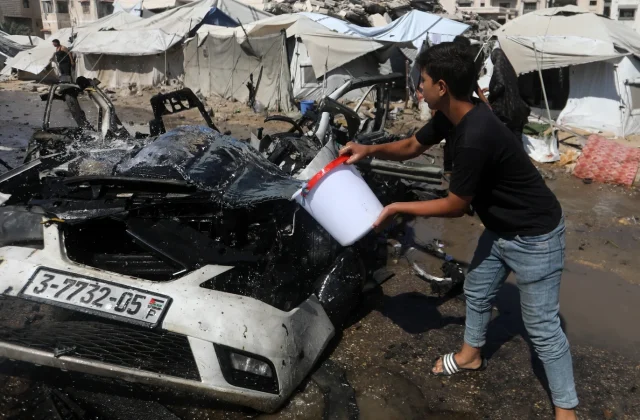
Four people, including a child, were killed and more than 50 others wounded when a US strike hit a wedding gathering in southern Iran, the Iranian Red Crescent said.
Shrapnel struck a residential house in Kuhestak, in Sirik county in Hormozgan province, as the celebration was under way, the organisation said in a post on X.
- Advertisement -
“More than 50 people were injured and four people, including a young child, were martyred,” it said.
Video released by an Iranian government account showed widespread debris and damage at what it identified as the wedding site in Sirik after the US attack. Screams could be heard in the background.
Sirik county is located along the strategic Strait of Hormuz.
The United States said its forces were targeting Iran’s Revolutionary Guards after what it described as “recent attempted attacks … against commercial shipping in the Strait of Hormuz and against American service members deployed to the region”.
It was not immediately known what the US had been targeting in Sirik county.
Iranian media earlier reported explosions in several cities along and east of the Strait of Hormuz, as well as at an airport in the southern province of Kerman.
US President Donald Trump said the latest strikes on Iran were “justified” and warned that Tehran would face a larger attack if it retaliated.
In a post on Truth Social, Mr Trump said US forces were hitting Iranian targets near the Strait of Hormuz in response to Iran’s “failed attempt at adding sea mines” to the waterway and its launch of eight missiles at a US military base in Jordan.
Iran’s Revolutionary Guards claimed that “a large number of US forces” had been killed in an attack on Jordan.
US officials, however, said there had been no reported American casualties from the Iranian assault on facilities in Jordan. Jordan said three ballistic missiles had landed in remote areas away from population centres.
US President Donald Trump post on Truth Social
Iran’s Revolutionary Guards vowed that the United States would “regret” the new attacks near the Strait of Hormuz, despite Mr Trump’s warning against any Iranian response.
“Severe punishment awaits the aggressors; the United States will regret its new attacks,” Guards spokesman Hossein Mohebbi said in a post on X.
Oil prices had already climbed following last weekend’s first direct exchange of attacks since July and reports that two tankers were hit while leaving the Strait of Hormuz, a vital route for global oil supplies that Iran has effectively closed to shipping.
Brent crude futures, which were already 2% higher on the day, rose by almost another 2% after the reports.
Tehran remained defiant, warning that it would block oil exports from the Gulf. Mr Trump had threatened to hit Iran “hard” if its renewed strikes continued, while US Treasury Secretary Scott Bessent warned that Washington was preparing additional sanctions.
“Today at 12pm ET (1600 GMT), US forces began striking Islamic Revolutionary Guard Corps (IRGC) targets in Iran,” US Central Command said on X.
“The strikes follow recent attempted attacks by the IRGC against commercial shipping in the Strait of Hormuz and against American service members deployed to the region.”
Iran’s state broadcaster reported explosions on Qeshm Island, on the northern side of the strait.
The state-linked Nour News agency also reported blasts in the port city of Bandar Abbas and in Chabahar, a port on Iran’s southern coast.
The US Embassy in Qatar urged Americans in the Middle East to exercise “heightened vigilance” and prepare for possible flight cancellations, airspace closures and other travel disruption.
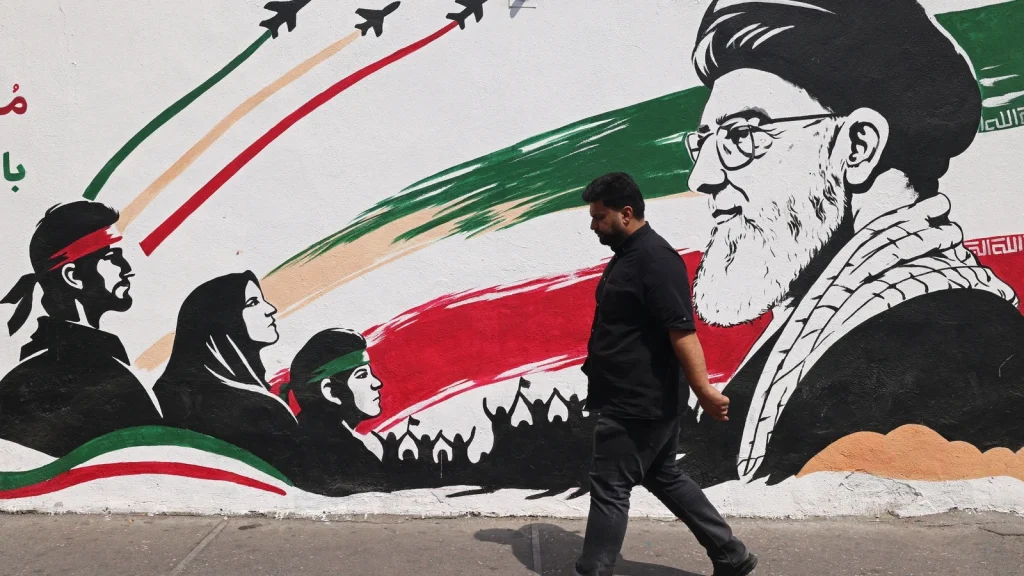
Iran has been at war with the United States since 28 February, when US and Israeli strikes killed the Islamic republic’s supreme leader, Ali Khamenei, along with senior military officials.
Iran responded with attacks across the region.
The initial bombardment continued for nearly 40 days, but sporadic strikes, focused mainly around Hormuz, have persisted and weakened hopes of a lasting peace agreement.
Scale of resumption of hostilities unclear
The six-month-old conflict had turned into an economic standoff before the weekend’s escalation. US forces attacked Iran’s Larak Island on Sunday, prompting Tehran to fire missiles at two US air bases in Jordan.
Although Mr Trump warned that Washington would respond, he told reporters yesterday that the Iranian strikes did not mark a return to full-scale war. A senior Iranian source likewise described the confrontation as “limited and contained”.
Still, threats from both sides to answer any further attacks have underscored how quickly a conflict increasingly fought through sanctions, blockades and economic pressure could return to the battlefield.
Iranian President Masoud Pezeshkian had earlier said Tehran would respond immediately if the US honoured its obligations under a June Memorandum of Understanding designed to end the conflict.
The MOU declared an end to fighting that has killed thousands of people in Iran and Lebanon since US and Israeli strikes began on 28 February.
But it postponed many of the most contentious issues and opened a wider 60-day negotiating period, which ended without a further agreement.
“I am stating clearly that if the US returns to its commitments under the Memorandum of Understanding, the Islamic Republic of Iran will immediately reciprocate,” Mr Pezeshkian said in Bishkek, the Kyrgyz capital, during a summit of the Shanghai Cooperation Organisation, which includes Russia and China.
Iranian officials, however, have given no public indication that they intend to yield to the pressure.
“If the enemy wants us not to export oil from the Persian Gulf, no one will be able to export oil,” Iranian parliament speaker Mohammad Baqer Qalibaf was quoted as saying by Iranian media.
Iranian President Masoud Pezeshkian met with Russian President Vladimir Putin on the sidelines of the Shanghai Cooperation Organisation Summit in Kyrgyzstan
He said Tehran would respond militarily if the United States tightened its “siege”.
Foreign Ministry spokesman Esmaeil Baghaei told reporters in Tehran that Washington was “addicted to making excessive demands and has mistaken negotiations for dictating terms”.
“As long as they act in this manner, they will certainly get no result other than what they have achieved so far,” he said, warning that Tehran would “use all our capabilities, whether on the battlefield or through our diplomatic apparatus”.
Putin admires Iran ‘courage’
Mr Pezeshkian earlier thanked Russia’s Vladimir Putin for Moscow’s position on the conflict during an international summit.
Russia and Iran, both among the world’s most heavily sanctioned countries, have significantly expanded their military and trade ties during Moscow’s invasion of Ukraine.
Mr Putin and Mr Pezeshkian met on the sidelines of the Shanghai Cooperation Organisation summit in Bishkek, which brought together more than a dozen leaders, including China’s Xi Jinping and Indian Prime Minister Narendra Modi.
During the meeting, Mr Pezeshkian told Mr Putin: “We appreciate and thank you for your positions at every stage.”
“This shows that our relationship is a strategic relationship; it is not an ordinary relationship,” he added.
Mr Putin said Russia was “trying to provide you with the assistance you need”.
“We admire your courage and resilience in the fight for your national interests,” the Russian leader said, according to Russian media.
“Despite the military and political situation, we are maintaining the momentum of our trade and economic relations from last year,” he added.
Russia and Iran are both subject to sweeping international sanctions and have grown increasingly dependent on one another.
The Middle East war began in late February with US and Israeli strikes on Iran that killed former supreme leader Ayatollah Ali Khamenei.