
Editor’s Note: Three months after the World Health Organization declared Ebola outbreaks in the Democratic Republic of Congo (DRC) and Uganda, affected communities continue to live with the disease’s toll. CGTN Africa visited Mongbwalu, a northeastern mining town where the first cases were recorded, to examine how the outbreak has changed everyday life.
Twelve weeks after the World Health Organization (WHO) announced an Ebola outbreak in Ituri province in northeastern DRC, residents and medical workers in the gold-mining town of Mongbwalu are persevering through the continuing fight to contain the deadly virus.
- Advertisement -
The outbreak is being driven by the rare Bundibugyo strain, for which there is currently no approved vaccine or treatment. It has spread more rapidly than any of the DRC’s previous 16 Ebola outbreaks.
This has made the outbreak the largest ever recorded in the DRC. By August 23, the country had reported more than 5,500 confirmed Ebola cases and over 2,600 deaths, with most of them in Ituri.
Home to 140,000 people and built around one of the region’s goldfields, Mongbwalu is among the areas hardest hit. Local health workers here confront one of the deadliest viruses known to man every day.
A combination of factors has accelerated transmission, including the movement of mining workers, the presence of people displaced by armed violence in Ituri and weak health infrastructure. Cuts in aid from some key Western donors have undermined containment operations, while healthcare workers have periodically gone on strike over delayed wages.
In some instances, angry crowds have attacked treatment centres and medical staff, interrupting efforts to respond to the outbreak.
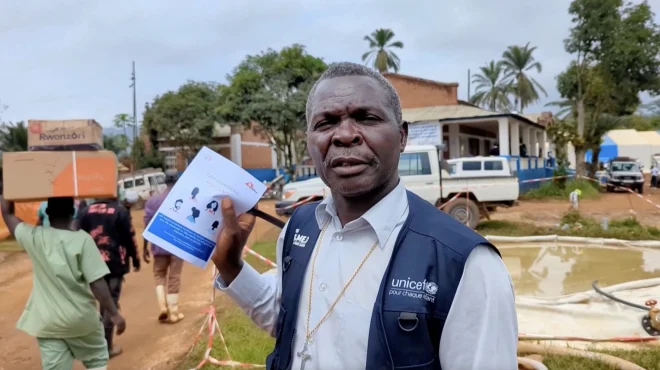
“If you attack a health center or healthcare workers, even symptomatic people outside become afraid to come in for treatment,” warned Dieudonne Amboko, a nurse in Mongbwalu. He called for stronger protection for health facilities and their staff.
During a recent visit to Mongbwalu, DRC Prime Minister Judith Suminwa Tuluka stressed that “without community engagement, we cannot eradicate this disease.”
Still, recoveries among patients are offering hope to the hundreds of people affected by Ebola.
“I was the only patient to recover among all the confirmed Ebola cases that day. Sadly, all the others died,” said Deogratias Kasereka, the first patient to recover in Mongbwalu. Since then, he has travelled to surrounding communities to promote prevention and urge people with symptoms to seek medical attention without delay.
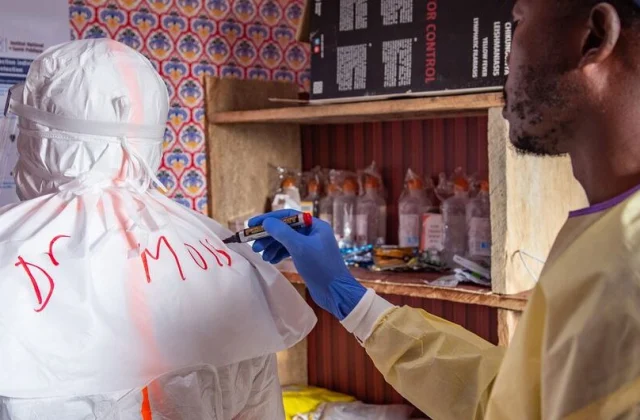
Congolese medical workers remain the main defense against the virus in Mongbwalu.
At Mongbwalu General Hospital, staff treat Ebola patients while also maintaining surveillance for new infections.
“It’s difficult and it weighs on me, but it’s our mission, and we’re doing our best,” said Heritier Ngabu, the hospital’s head nurse. The medical teams must also contend with deep public mistrust, much of it fueled by misinformation about Ebola.
“Imagine that someone falls ill, decides to stay home, and refuses to come to the treatment center. If that person later dies in the community, they may have infected dozens of people,” said Dr Richard Lopayi, a staff at Mongbwalu hospital.
Even as the outbreak persists, residents, including women, continue to earn a living in Mongbwalu’s mining-based economy. Miners face a stark choice: risk exposure to Ebola or go without the income needed to buy food.
“I have eight children to feed, and this job is my only way to care for them. It means everything to me,” said Jeni Miriam, a widowed miner.The gold mines in Mongbwalu draw a highly mobile workforce from across eastern DRC and neighboring countries, making efforts to contain Ebola more difficult.
Authorities have tried to restrict movement, but enforcing those measures is difficult where economic alternatives are scarce, particularly for households headed by women.
Mining has compounded Mongbwalu’s water insecurity. Polluted runoff has contaminated nearby fields and streams, forcing residents to walk several kilometers in search of safe drinking water. Although the area receives rain for much of the year, access to clean water remains limited, undermining basic Ebola precautions such as handwashing.
“If there isn’t enough water in the household, it’s difficult to protect yourself against this disease,” warned Isaac Lure, a local resident.
Several non-governmental organizations have installed water tanks, but reliable access to clean water remains a problem in Mongbwalu.
Even so, residents have shown resilience and adopted some of the health precautions promoted by medical workers.
Mongbwalu Mayor Sesereki Mandro Israel said he remained hopeful, noting that “we are seeing improvement and progress, as the public has gained a better understanding of the situation.”
Local resident Abigael Muvuna said she had also changed her behavior: “I no longer attend just any funeral, because I have to protect myself.”
Such measures represent modest victories as residents try to preserve their livelihoods and routines under the shadow of a deadly virus. They also hope Mongbwalu will ultimately fulfill the meaning of its name in the local Nyali language: celebration.
Additional reporting by Djaffer Sabiti and Joël Djalumvor.