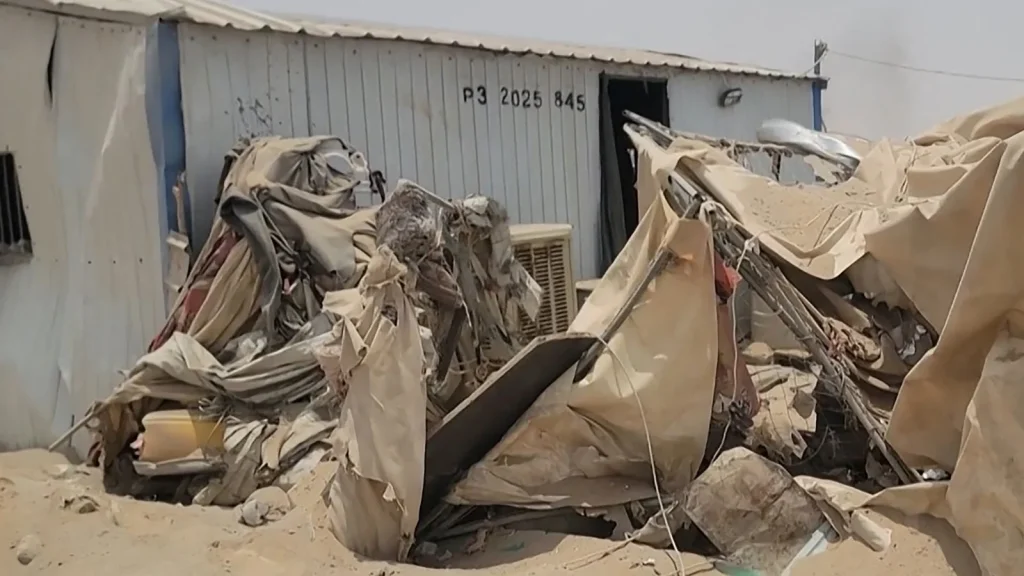
At least 10 people were killed in fresh Houthi attacks on Yemen’s Marib province on Friday, according to a minister and a military source, as the rebels intensified their campaign in the oil-rich region just one day after carrying out one of their deadliest strikes in years.
The renewed violence has heightened fears that Yemen could slide back into full-scale war. A 2022 truce between the Houthis and the Saudi-backed government had largely contained the fighting until it began to unravel last month.
- Advertisement -
Eight members of the government’s forces were killed and 12 wounded in Houthi attacks across Marib province, a Yemeni military source said.
Qasim Buhaibeh, health minister in the Saudi-backed government, said Houthi shelling struck residential neighbourhoods and displacement camps in Marib city, killing at least two civilians and injuring 14 others.
“The Saudi enemy continued to mobilise and incite its forces … these forces were attacked along with their arsenals, vehicles and military equipment in the Sahn al-Jinn camp with a large number of missiles and drones,” Houthi spokesman Yahya Saree said in a statement, referring to the government-held facility.
Buhaibeh wrote on X that “shelling by the terrorist Houthi militia today, Friday, targeting residential neighbourhoods and displacement camps in the city of Marib, has resulted — according to an initial toll — in the deaths of two civilians and injuries of varying severity to 14 others”.
The Houthis also fired “more than 10 missiles and seven one-way attack drones targeting military camps in Marib” province, according to the Yemeni military source, who requested anonymity because of the sensitivity of the matter.
A source close to the Saudi military said the Saudi-led coalition, which has backed Yemen’s government since 2015, would not stand “idly by” while the Houthis expanded their attacks. Marib, the source said, was a “red line”.
“The coalition does not seek escalation, but we will not allow the current balance of power on the ground to be changed,” he said.
Riyadh would not accept a Houthi takeover of Marib, the source said, adding that he believed the rebels were preparing to launch an offensive in the province.
Strategic province
The Houthis said on Thursday that they had struck several sites in response to a Saudi-backed mobilisation of government forces.
The missile and drone attacks killed at least 58 government troops, mainly in Marib, an army source said earlier. It was one of the deadliest clashes between the two sides in years.
Strategically important Marib province is divided between the Houthis and Yemen’s government, which controls Marib city along with the region’s oil fields and related facilities.
The rebels resumed their push to seize the energy-rich province in 2021, but the fighting largely subsided after the nationwide truce was reached in 2022.
Yemen, which has endured more than a decade of war, became the latest arena drawn into the US-Iran conflict last month when the Tehran-backed Houthis abandoned the 2022 truce.
The rebels welcomed an Iranian aircraft to the Yemeni capital, Sanaa, prompting a series of retaliatory attacks. They later declared a maritime blockade of Saudi Arabia and began targeting its tankers.
Last month, the Houthis also killed 16 soldiers in an assault on government-aligned forces south of the port city of Hodeidah, according to two medical officials.
Saudi Arabia, Turkey, Pakistan pledge mutual defence
Meanwhile, Saudi Arabia, Pakistan and Turkey have signed a joint defence agreement in Mecca, bringing together three Sunni Muslim US allies concerned by a regional conflagration that has sent missile fire toward Gulf oil exporters.
Iran and groups aligned with it have attacked Saudi Arabia and other Gulf states and disrupted energy shipments since the United States and Israel struck Iran on 28 February, in a major escalation after years of regional turmoil.
The agreement is designed to reinforce collective deterrence and declares that an armed attack on any one of the three countries would be treated as an attack on all of them, the governments said in a joint statement.
Turkish President Recep Tayyip Erdogan (L), Saudi Crown Prince Mohammed bin Salman (C),and Pakistani Prime Minister Shehbaz Sharif (R) signed the trilateral defense agreement in Mecca
The statement offered no details about the specific commitments or obligations accepted by the signatories under the “Mecca Joint Defence Agreement”. It said, however, that the pact would strengthen collective security and support peace, security and stability in the region and beyond.
“The pact includes a collective defence clause. It is purely defensive in nature, pledging mutual support only for defence,” a Turkish official said.
The agreement was not aimed at any particular country or actor, the official said. It remains open to other regional states and does not cancel or replace existing bilateral or multilateral arrangements.
Even so, the three countries are increasingly uneasy about the aggressive military postures of Israel and revolutionary Shi’ite Iran as their longstanding US ally struggles to contain mounting regional instability.
Powerful political symbolism
The head of a Saudi-based think tank said the summit carried “significant” political symbolism.
“Three of the Muslim world’s most influential states are convening at a moment of heightened uncertainty, demonstrating a growing willingness among regional and middle powers to coordinate more closely on security matters,” said Abdulaziz Sager.
“If institutionalised and translated into concrete cooperation, the trilateral framework could strengthen the three countries’ collective diplomatic and defence weight while contributing to the emergence of a more regionally driven security architecture,” he added.
Turkey has NATO’s second-largest military. Saudi Arabia, the Gulf’s strongest state, is home to Islam’s holiest sites and ranks among the world’s leading oil exporters. Pakistan is the only nuclear-armed Muslim country.
Pakistani Prime Minister Shehbaz Sharif, accompanied by powerful army chief Asim Munir, performed the Umrah pilgrimage in Mecca before Turkish President Tayyip Erdogan arrived.
The two leaders met Saudi Crown Prince Mohammed bin Salman, whose country has repeatedly come under attack from Iran, its Houthi allies in Yemen and Shi’ite militias in Iraq since the war began.
The conflict has also shaken the security of Riyadh’s Gulf partners and halted most shipping through the Strait of Hormuz, a vital route that carried about a fifth of global energy supplies before the war.
The agreement follows almost a year of negotiations, Reuters reported in January.
Pact builds on longstanding military ties
The Middle East has endured nearly three years of conflict since Hamas attacked Israel on 7 October 2023, with almost every country in the region facing cross-border assaults or missile and drone strikes.
Israel has fought in Gaza, entered southern Lebanon and seized territory in Syria, while also conducting two air campaigns against Iran.
Tehran has targeted US bases and civilian infrastructure in Saudi Arabia, Kuwait, Bahrain, Qatar, the United Arab Emirates, Oman, Jordan and Israel.
Turkey and Pakistan, both located on the edges of the Middle East, have avoided major direct attacks but remain concerned about conflicts that threaten their security and economic wellbeing.
For Saudi Arabia, the fallout from three years of regional warfare has been especially serious, putting oil exports and ambitious development projects at risk while raising fresh questions about the dependability of its longstanding US security guarantee.
A senior Saudi official said on Thursday that Riyadh expected coordinated attacks from Iraqi militias and the Houthis under Iranian direction, underscoring the kingdom’s drive to broaden its security partnerships.
By signing the agreement in Mecca, Islam’s holiest site, the three countries gave added symbolic weight to a pact rooted in their longstanding bilateral military relationships.
Mansoor Ahmed of the Australian National University’s Strategic and Defence Studies Centre said Pakistan and Turkey could contribute powerful defence industries, while Saudi Arabia could provide technological investment.
However, Ahmed said the agreement was unlikely to contain a nuclear component, since Pakistan’s atomic deterrent is focused on the threat it perceives from India.
Pakistan has trained and provided technical assistance to Saudi forces for decades, while Turkey and Pakistan have exchanged warships and training aircraft. In 2023, Riyadh agreed to purchase Turkish drones in what Ankara described as its largest defence export contract.
Pakistan has since deployed about 8,000 troops, fighter jets, drones and an air-defence system to the kingdom, Reuters reported in May, while also pursuing broader security arrangements in the Gulf.
It has opened talks with Kuwait on an expanded agreement linked to energy cooperation and investment, Reuters reported in July.
The office of Israeli Prime Minister Benjamin Netanyahu and Israel’s Foreign Ministry did not immediately respond to requests for comment.