by Mohamed IbrahimSaturday July 25, 2026
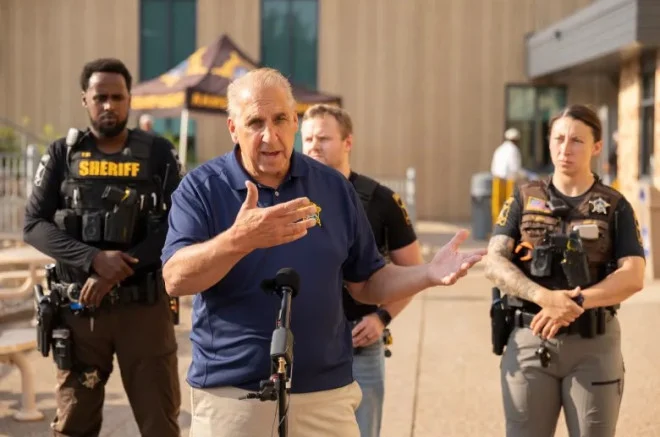
Ramsey County Sheriff Bob Fletcher addresses reporters outside the Ramsey County patrol station in Arden Hills on July 21, 2026, during a meeting with community members about violence involving Somali youth. Credit: Chris Juhn for Sahan Journal
Gunfire claimed the life of Fadumo Salad’s son, Mohamed, in north Minneapolis in April 2024. More than two years later, her eight surviving children remain afraid to step outside their homes.
“They live in fear,” she said in Somali. “To this day, they tell me they don’t feel safe.”
Salad joined hundreds of people at the Ramsey County Sheriff’s Office patrol station in Arden Hills Tuesday night, where families, law enforcement officials and community members searched for ways to stem rising violence among Somali youth.
A meeting to educate
Ramsey County Sheriff Bob Fletcher began the gathering by introducing Andre Robinson, known as “Star Wars,” and Meechie Boyd-Curry. Both were gang members in the 1980s and now work in youth outreach for the sheriff’s department. Fletcher said responsible adults helped guide the two men away from gangs, and he hopes similar intervention can reach Somali youth.
“Children need a responsible adult role model that they perceive is concerned for their needs and values,” Fletcher told the crowd. “That’s how children succeed, but some kids don’t have that.”
Ramsey County officials told those in attendance that more than a dozen Somali gangs are operating in the region. They described a sizable contingent in Minneapolis, along with several groups based in metro-area suburbs including Burnsville, Apple Valley, Shakopee and Hopkins.
“We see, before incidents, kids posing with firearms and switches and whatever else on social media. That’s kind of the way to talk smack to each other,” said Ben Seidl, a Ramsey County sheriff’s gang investigator. “When they see each other at events, they’re flashing gang signs, they’re talking smack again and there are guns everywhere.”
During the presentation, Fletcher played more than a dozen social media videos depicting Somali youth displaying guns equipped with extended magazines and laser attachments, making gang signs and taking part in large-group fights. He also presented mugshots and screenshots from several charging documents that named some of the gangs and described cycles of retaliatory violence.
Fletcher said the material was intended to explain to parents why law enforcement considers the groups to be gangs. Officials first wanted to establish the scope of the problem, he said, before turning to possible responses.
“The primary reason we’re here is to help the Somali community understand what’s going on,” Fletcher said. “We can’t expect them to help us solve the problem without educating them.”
Parents pressed Ramsey County officials for answers: Why is the conduct of Somali youth labeled gang activity? How are young people obtaining guns? And why, in many cases, are youths arrested only to be released soon afterward?
While youth violence dominated the discussion, some attendees renewed their anger over remarks Fletcher made about the issue earlier this month. Imam Hassan Jama of Al-Hikmah Islamic Center in Minneapolis confronted the sheriff, asking whether he would apologize and whether he had ever publicly singled out another community in a similar fashion.
“As the Somali community, we need help, but this problem is way bigger than us,” Jama said. “This is an American problem.”
Fletcher declined to apologize, saying his remarks had sparked dialogue and drawn greater attention to the violence. He disputed the suggestion that he had not focused on other communities, citing his efforts in the 1990s to combat Asian gang violence. Problems concentrated within a community, he argued, demand solutions tailored to that community.
Community debrief
Mohamed Adam, an 18-year-old Burnsville resident, told Sahan Journal he attended because he wanted to help identify ways to stop violence he has, at times, witnessed firsthand.
“There’s been a lot of waves of violence and it doesn’t feel like it’s going to stop,” Adam said.
Although the meeting produced some promising ideas, Adam said the discussion failed to reach “the root” of the problem. He argued that tougher sentences for offenders should be part of the response.
“Prosecutors have to stop being nice,” he said. “They’re letting guys catch a murder and then somehow he’s getting out in eight years on probation? It’s absolutely vile and disgusting.”
Abdimalik Abdi, a 26-year-old business owner, heard about Fletcher’s meeting after watching a Tuesday news conference at which Somali community leaders condemned the sheriff’s remarks. Abdi said he came hoping to contribute to a solution, but was disappointed that many people who had objected to the criticism were not there.
“They don’t keep that same energy when these crimes and stuff are happening,” Abdi told Sahan Journal. “I wanted to see them here today because (Fletcher) said this was like an olive branch to get everybody to a solution.”
Abdi operates a group that distributes care packages to people experiencing homelessness and substance abuse disorder. He sees young people’s access to firearms as a major driver of the violence and said authorities must determine how to remove the weapons from their hands.
“How are these kids getting these guns and these switches? Someone’s supplying them,” he said. “Find the suppliers, and once you cut that off, help the youth find something else. They’re just looking for a sense of belonging.”
Mustafa Warsame, 47, came on behalf of his friend Hassan Hersi, whose 19-year-old son was shot to death in Burnsville in January.
Warsame told Sahan Journal he was shaken by the young ages of the children shown in Fletcher’s videos. He questioned why law enforcement, after seeing footage of youths openly holding guns with their faces visible, could not arrest them and seize the weapons.
“They know they are going to use the guns to kill people,” he said. “That tells me we are a community that no one cares whether we kill each other or not.”
Still, Warsame called Tuesday’s gathering a constructive beginning. He said Fletcher had given Somali parents a chance to understand what is happening and consider how they might respond.
“What he said about us is not important. What is important to me is what he did for us by bringing us here,” he said. “These people who are yelling at him have never held a meeting.”
Salad said the memory of her slain son continues to weigh heavily on her family. His killer was arrested and imprisoned, but she believes the government should at least check in with Somali families grieving children lost to violence.
“It’s not fair. My son was working, he finished school, he was a taxpayer,” she said. “They should do something for those of us left behind.”