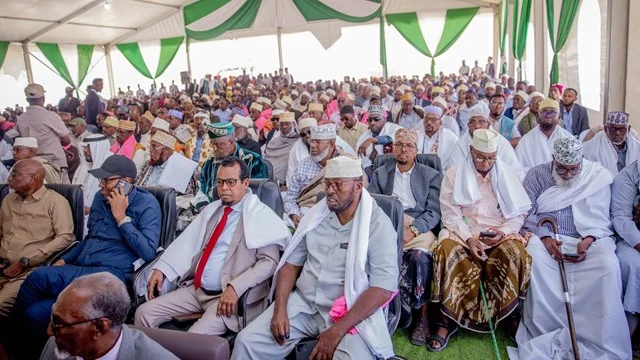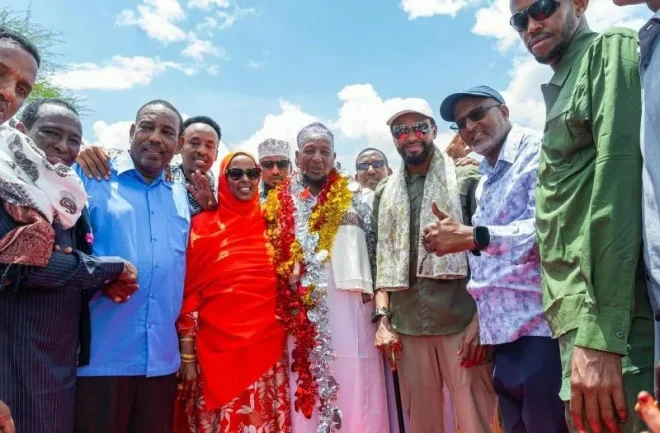
With the 2027 General Election approaching, leaders of the Talasame alliance have taken their mobilisation drive to Hamey in Liboi sub-county, urging residents to secure the documents needed to vote.
The Garissa leaders affiliated with the Talasame political alliance are stepping up grassroots mobilisation across the region.
- Advertisement -
They are calling on residents who do not have national identity cards or voter registration cards to obtain them ahead of the 2027 General Election.
The leaders said victory would be determined not only by political and clan alliances, but also by whether supporters were registered and turned out to vote.
The leaders made the appeal in Hamey, where they met residents as part of a campaign to build support for the Talasame alliance.
The alliance brings together members of the Auliyahan and Samawadhal communities in a political arrangement intended to consolidate their backing before the 2027 elections.
The delegation, led by Garissa Senator and gubernatorial aspirant Abdul Haji, said political coalitions and community endorsements could create a strong platform for electoral success.
But the leaders cautioned that such support would produce results only if eligible residents obtained the required documents and took part in the electoral process.
Those accompanying the delegation included Dadaab MP Farah Maalim, Garissa Deputy Governor Abdi Dagane and women representative aspirant Shukran Gure, who is aligned with Haji.
Under the emerging arrangement, the Auliyahan and Samawadhal communities are expected to support Haji for governor and Gure for the women representative position, respectively.
The leaders believe the pact could increase their combined political influence across Garissa county.
Garissa Governor Nathif Jama, who is seeking the Senate seat, is also part of the political lineup.
Haji said alliance-building had to be matched by continuous grassroots engagement to convert political backing into votes.
“I urge residents who have not obtained national identity cards to do so. The document is the crucial first step towards registering as a voter and taking part in the democratic process,” he said.
“I also appeal to every eligible resident who has not registered as a voter to do so. If our people do not participate in the electoral process, the political aspirations of our respective communities could be weakened, no matter how strong our alliances are,” Haji added.
Dadaab MP Farah Maalim said the alliance’s performance in the next election would depend heavily on its capacity to identify eligible residents, support their registration and ensure they cast their ballots.
“The opportunity we have been waiting for has arrived. Our people should take advantage of the removal of the additional vetting exercise to obtain identity cards and register as voters. We cannot meet our political objectives if our people fail to turn out and vote,” Maalim said.
Shukran said every eligible resident had a part to play in shaping the region’s political future. She urged communities to view obtaining identity cards and registering as voters as a shared responsibility, rather than a matter for individuals alone.
The visit also saw the leaders attend the installation of Mohamed Dagane Yussuf as assistant chief of Hamey sublocation.
The ceremony underscored the role of grassroots administration in connecting residents with government services.
Haji welcomed the appointment, saying government administrators at the local level were vital to effective service delivery, public participation and keeping government accessible and accountable to residents.
He said chiefs and assistant chiefs helped bring government services closer to communities, support communication between residents and state agencies, and advance peace, security and local development.
“We remain committed to working with every level of government to improve service delivery, advance peace and security, and ensure communities such as Hamey receive the attention and services they deserve,” Haji said.
He added that strong grassroots administration was necessary to address local needs, improve coordination between residents and government agencies, and ensure communities were included in development programmes.
Haji also outlined priorities he would pursue if elected, including expanding access to water, improving healthcare, investing in early childhood education and ensuring the professional management of county affairs.