Christina Goldbaum/IRIN
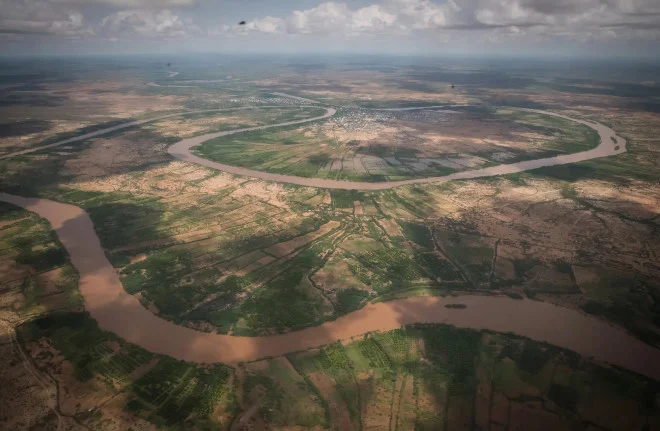
Mogadishu (AX) — The Shabelle River has surged toward dangerous levels at Jowhar, raising flood concerns as moderate to heavy rain is forecast in parts of Somalia and across the Ethiopian highlands that supply the country’s two major river systems, the latest FAO-SWALIM outlook says.
- Advertisement -
The river climbed 2.22 meters over the past week, rising from 2.48 meters to 4.70 meters at Jowhar, according to the Somalia Water and Land Information Management forecast for Oct. 7-13.
That leaves the river just 30 centimeters below the moderate flood-risk threshold of 5 meters and 55 centimeters below the high-risk level of 5.25 meters.
The rate of increase has eased, falling from roughly half a meter on Oct. 4 to 20 centimeters on Oct. 7, the report said.
The rise comes as Somalia begins the October-to-December Deyr rainy season amid heightened fears of El Niño-linked flooding. FAO warned last month that some areas of central and southern Somalia face up to a 90% chance of above-normal seasonal rainfall, identifying the Juba and Shabelle basins as particular areas of concern.
Using the U.S. National Oceanic and Atmospheric Administration’s Global Forecast System model, the latest FAO-SWALIM projection calls for moderate to heavy rainfall across much of North Western State of Somalia, Bay, Bakool and Hiiraan, as well as inland areas of central Somalia.
Rain is also expected in sections of the Ethiopian highlands. That matters because heavy rainfall upstream can push up the Juba and Shabelle rivers in Somalia even when conditions locally remain relatively dry.
FAO has previously warned that flood waves generated by rainfall in Ethiopia may take time to reach Somalia, urging authorities and humanitarian agencies to closely track both upstream precipitation and river levels.
Elsewhere along the Shabelle, water levels remained well below flood thresholds.
At Belet Weyne, the river was measured at 4 meters after rising to 4.16 meters on Oct. 3 before dropping to 3.78 meters two days later. The latest level was 2.50 meters below the moderate flood-risk threshold of 6.50 meters.
It was also 1.90 meters below the level recorded on the same date last year and about half a meter beneath the long-term average for early October.
Further upstream at Deefow, the river was largely unchanged at 2.70 meters, compared with 2.73 meters a week earlier. That reading was 3.80 meters below the moderate flood threshold.
Bulo Burti saw a sharper rise, with levels increasing 62 centimeters during the week to reach 3.20 meters. Even so, the river remained 3.30 meters below the moderate flood-risk level.
Water levels along the Juba River were comparatively steady.
At Dollow, the river rose 10 centimeters during the week, from 2.54 meters to 2.64 meters, leaving it 1.86 meters below the moderate flood threshold of 4.50 meters.
At Luuq, the change was minimal: levels moved from 2.34 meters to 2.36 meters and remained more than 3 meters below the moderate flood-risk mark.
Some areas have already experienced an earlier-than-usual start to the rains.
Bardhere in Gedo recorded 93 millimeters during the first five days of October, while Galkayo received 50 millimeters. In both locations, those totals exceeded the normal rainfall expected for the entire month, SWALIM said.
Rainfall has nevertheless been uneven. Rains spread from eastern Gedo through Bay, Bakool and Hiiraan into central Somalia, while much of the Juba valley, Lower Juba and the coastal areas of Lower Shabelle remained largely dry.
The forecast for this week calls for light to moderate rain in parts of Bay and Gedo and along the Lower Juba coast. Middle Juba, inland Lower Juba and some areas of Lower Shabelle are expected to receive little rainfall.
The intensified monitoring follows warnings that the 2026 Deyr season could bring significant flooding if strong El Niño conditions coincide with above-normal rainfall.
FAO has cited 1997 and 2023 as years marked by similar climate conditions, while emphasizing that those comparisons do not predict what will occur this season. Both years saw severe flooding in Somalia.
Floods in 2023 displaced large numbers of people, damaged infrastructure and wiped out crops and livestock. Historical data cited by FAO shows that the 1997 floods killed more than 2,300 people.
Authorities and humanitarian organizations have been advised to act on current forecasts by strengthening river embankments, planning evacuation routes, marking safe areas and pre-positioning emergency supplies before river levels reach dangerous thresholds.