

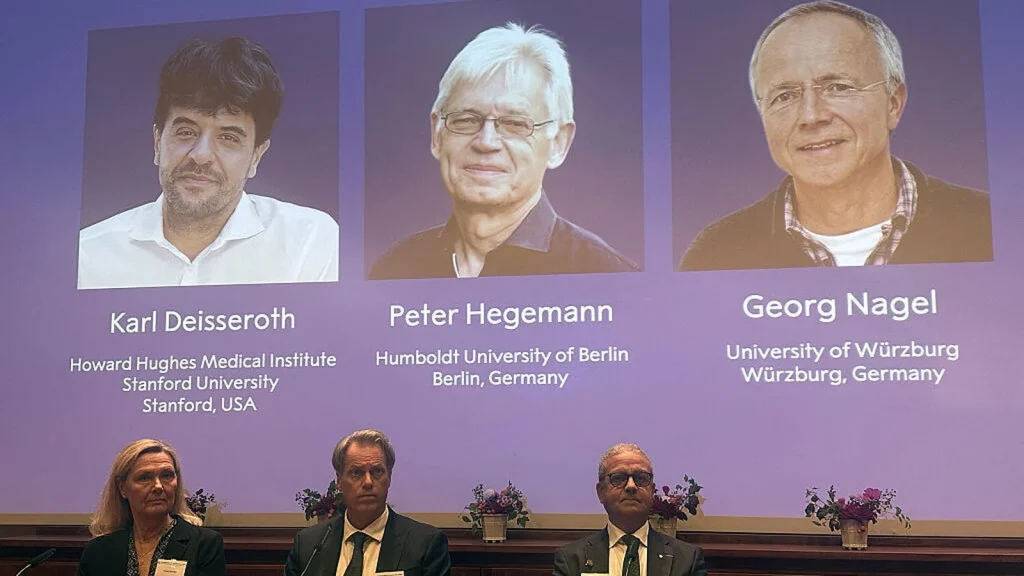
American neuroscientist Karl Deisseroth and German researchers Peter Hegemann and Georg Nagel have been awarded the 2026 Nobel Prize in Physiology or Medicine for discoveries that use light to probe the brain and have transformed the study of its inner workings.
The Nobel Assembly at Sweden’s Karolinska Institute said Mr Deisseroth, 54, Mr Hegemann, 71, and Mr Nagel, 73, were honoured for their “discoveries concerning light-gated ion channels and optogenetics.”
- Advertisement -
Optogenetics allows scientists to turn individual nerve cells on or off inside a living brain, said Thomas Perlmann, Secretary-General of the Nobel Assembly at Karolinska Institutet.
“This method is now being used in laboratories around the world to reveal the brain’s mysteries,” Mr Perlmann said.
Scientists also hope the technique can lead to more advanced cochlear implants, enabling them to stimulate the auditory nerve with greater precision than today’s electrical devices.
The physiology or medicine award traditionally begins the annual Nobel announcements. Prizes in physics, chemistry, literature, peace and economics will be announced over the following days.
Mr Deisseroth, Mr Hegemann and Mr Nagel will divide prize money totalling 12 million Swedish crowns (€1.06 million).
Recipients surprised and delighted
Mr Hegemann began studying in the early 1990s how the single-celled alga Chlamydomonas responds to light within half a millisecond. He proposed that one protein was responsible for sensing light and functioning as an ion channel. Mr Nagel put that theory to the test by introducing Chlamydomonas genes into frog eggs, where he identified channelrhodopsin-2, an ion channel that opens when illuminated.
In 2003, the researchers reported that the protein could be inserted into human and hamster cells, allowing light to trigger electrical impulses. Two years later, Mr Deisseroth, then at Stanford, demonstrated the approach in rat nerve cells. The method was given the name optogenetics in 2006.
Mr Perlmann said he had spoken with all three laureates that morning and found them surprised and delighted by the announcement.
“All three said the same thing, that they thought it was absolutely wonderful to receive the prize with the other two and they call them my friends. That it’s such an honour to receive them together. So that’s something they conveyed,” Mr Perlman said.
Nobel Prizes awarded since 1901
The five original Nobel Prizes were established through the will of Swedish inventor and industrialist Alfred Nobel. They have been awarded since 1901, apart from limited interruptions, mainly during World War One and World War Two.
Sweden’s central bank, the Riksbank, created a sixth award for economics in 1968.
The medicine prize has recognised some of the most consequential scientific advances of the past century, among them Alexander Fleming’s discovery of penicillin, honoured in 1945, and Karl Landsteiner’s identification of human blood groups, recognised with the 1930 award.
Last year, American scientists Mary Brunkow and Fred Ramsdell and Japan’s Shimon Sakaguchi received the prize for research explaining how the immune system protects healthy cells, work that opened possible avenues for treating diseases including cancer.
Expert committees appointed by the prize-awarding institutions select the Nobel laureates. The awards are presented in Stockholm, except for the Peace Prize, which is awarded in Oslo—a practice often associated with the union that linked Sweden and Norway during Mr Nobel’s lifetime.
More than 125 years after Mr Nobel signed his will, the prizes continue to preserve many of their original traditions.
The celebrations reach their climax on 10 December, the anniversary of Mr Nobel’s death. On that day, laureates receive their awards at ceremonies attended by the royal families of Sweden and Norway before being honoured at formal gala banquets.