Canada is pressing the European Union to deepen its partnership, with Prime Minister Mark Carney telling European lawmakers that shared democratic values make Ottawa and Brussels “stronger together.”
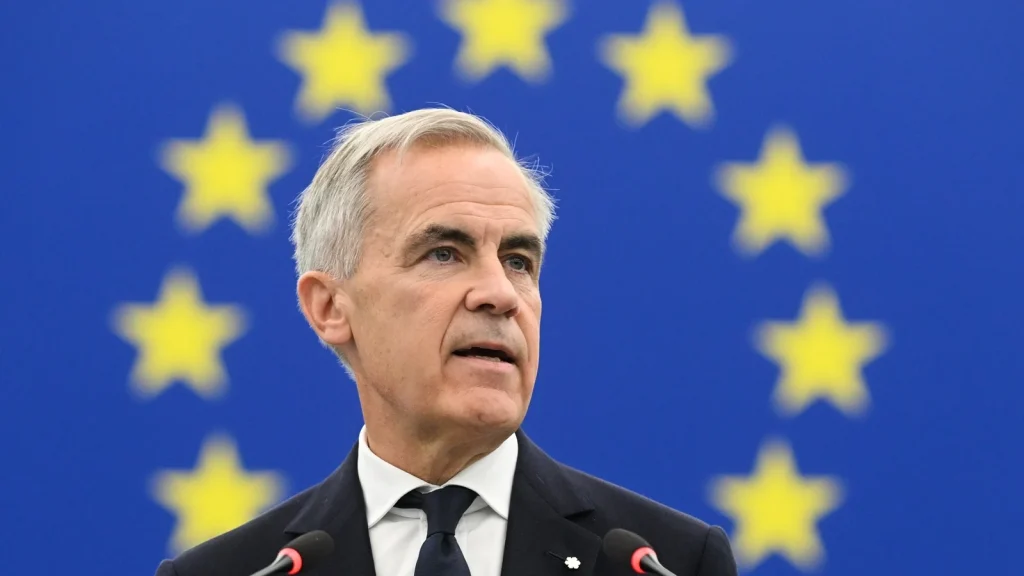
Speaking to the European Parliament in Strasbourg, Mr Carney said Canada “welcomes the ambition” behind a proposal to make it the EU’s first “associate member”.
- Advertisement -
The idea was unveiled yesterday by European Commission President Ursula von der Leyen.
“We are not fair-weather allies. We do not pursue zero-sum deals,” Mr Carney told the parliament.
“Canada and Europe are each strong. Europe and Canada are stronger together.”
Mr Carney also urged closer collaboration in critical minerals, defence and artificial intelligence.
Watch: Canada welcomes EU ambition for it to become ‘associate member’
The European Commission said earlier that the proposal was not directed at the United States, after President Donald Trump threatened to disrupt trade ties in response.
“As our president made clear yesterday, the proposed strengthening of our partnership with Canada is not against anyone else, but for our common strength,” the commission’s trade spokesperson Olof Gill said when asked about Mr Trump’s warning.
Ms von der Leyen’s proposal comes as Canada and the European Union look to reduce their dependence on an increasingly confrontational United States under Mr Trump’s leadership.
“I think it’s laughable,” Mr Trump told reporters when asked about the plan.
“If they do that, if I think it’s at all a hostile act, I will put very serious tariffs or stop trading with Europe, on many things.”
He added: “If it’s a good intention, that’s fine. If it’s a bad intention, we’ll put very heavy tariffs on Europe, which is a possibility.”
Ms von der Leyen proposed expanded cooperation in technology, defence and energy to Mr Carney, who became the first non-European head of government to attend the EU’s annual State of the European Union speech.
She told the European Parliament in Strasbourg that democracies confronting a “fracture in the international rules-based system” needed Brussels and Ottawa to stand closer together.
“I would like to work with you on opening the door for Canada to be the first associate member of the EU,” Ms von der Leyen told the Canadian prime minister, prompting a standing ovation from the chamber.
(L-R) European Commission President Ursula von der Leyen, European Parliament President Roberta Metsola and Canadian PM Mark Carney in Strasbourg yesterday
A broader alliance
Mr Carney has been seeking stronger ties with the European Union as Canada becomes increasingly caught up in a trade dispute with the United States.
His Brussels visit is intended to build momentum before an EU-Canada summit in Montreal next month.
The Canadian prime minister has argued that middle powers must develop closer alliances in a world shaped by Russia, China and the United States.
The EU is eager to maintain close relations with Mr Carney because Canada possesses substantial critical raw materials, remains a dependable member of the transatlantic alliance and has consistently supported Ukraine since Russia’s invasion in 2022.
The European Commission also sees scope for joint work on cybersecurity, quantum computing and energy.
Yet member states were caught off guard by the offer of associate membership.
The Lisbon Treaty contains no framework for such an arrangement. Canada and the EU are already connected through the trade agreement known as CETA, but that deal has still not been ratified by 10 member states, including Ireland.
Ms von der Leyen said the relationship should move beyond trade-based cooperation toward a broader “alliance for the future” and reach “the highest level possible”.
“We will work on intelligent manufacturing. We will create a tech alliance. We will integrate defence industrial bases. We will make the Arctic a flagship joint project,” she said.
She also identified energy, critical minerals, batteries, AI, cyber and economic security as areas for closer cooperation.
“This is a partnership not against anyone else, but for our common strength,” she said.
EU ‘opening door’ for Canada to become first ‘associate member’
Both the EU and Canada, however, are facing US tariffs and territorial threats, as well as growing competition from China.
“In a more dangerous and divided world, Canada is forging stronger relationships with trusted partners,” the Canadian prime minister’s office said in a statement.
What’s in a name
Although EU treaties do not provide for “associate membership,” the concept was first proposed this year by German Chancellor Friedrich Merz in relation to Ukraine.
Under that plan, which received a cool response from a country seeking full membership, Ukraine would have been able to attend EU summits and appoint a representative to the European Commission.
It would also have gained access to parts of the EU budget, while remaining without full voting rights.
Read more:
Analysis: Von der Leyen promotes EU resilience despite great perils
“We don’t really know yet what it means,” said Tobias Cremer, a center-left European MEP from Germany and the principal sponsor of a resolution calling for stronger EU-Canada cooperation, following Ms von der Leyen’s “associate membership” proposal.
Under EU rules, member states must approve any partnership arrangement with a non-EU country, and it was not clear how much backing the proposal would receive from national capitals.
Canada became the first country outside the EU to join a flagship defence loan programme this year.
Following Ms von der Leyen’s address to the European Parliament yesterday, Mr Carney travelled to Britain for his first meeting with new Prime Minister Andy Burnham.
The two men attended a football match between Everton and Wolves before Mr Carney returned to Strasbourg to deliver his speech this morning.
Mark Carney attended an Everton football match with Andy Burnham yesterday
Irish EU Presidency will most likely lead discussions on Canada, says minister
Minister of State at the Department of Foreign Affairs with special responsibility for European Affairs Thomas Byrne called the invitation for Canada to become an associate EU member a “very interesting proposal”.
Mr Byrne said the EU, including Ireland, already enjoys an “incredibly close relationship” with Canada, and that the next task would be determining how to “build” on it.
He said EU-Canada relations should go “as far as we can,” while stopping short of Canada joining the European Union “in any real way”.
Minister Byrne said Canada would not enter the Common Agricultural Policy, adding that “it’s hard to see how you would even have free movement of people”.
He said that, like any European Commission proposal, the plan would have to be considered by the leaders of the 27 EU member states at the next European Council meeting, as well as by the European Parliament.
“But, there is huge warmth towards Canada…and that’s across the political divide.”
He said he “supposed” that Ireland’s EU presidency would be “leading on the discussions” about associate Canadian membership “between now and any summit between the EU and Canada”.
“It’s a very, very exciting time,” Mr Byrne said.
“I’d say if you asked the German government directly, it would be very strongly in favour of the deepest possible relationship with Canada, that can only be a fact,” he said in response to questions from Berlin about whether the term associate member was appropriate.
Additional reporting Tony Connelly