

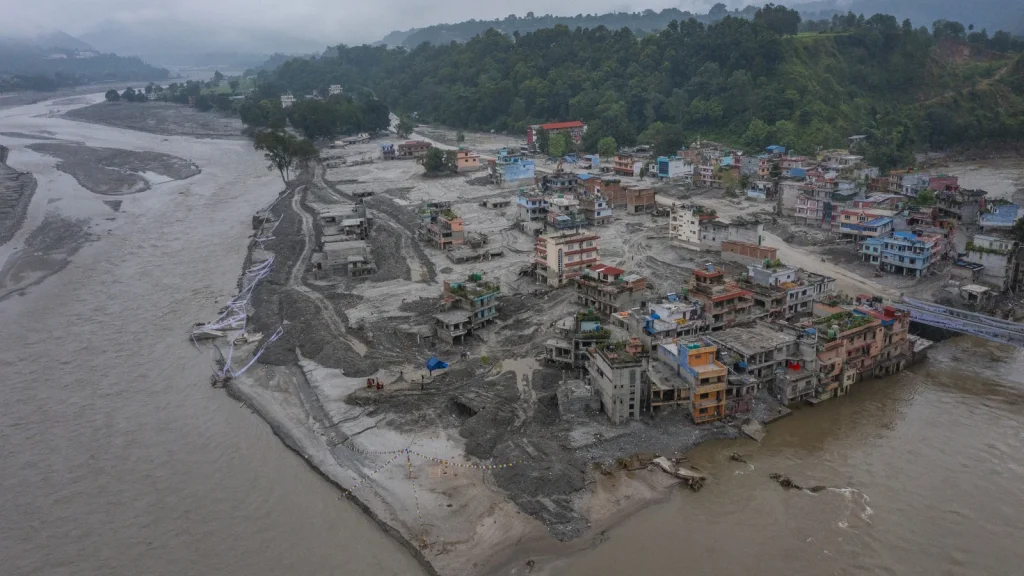
Climate change helped set the stage for last month’s catastrophic rock and ice collapse along Nepal’s northern border, scientists have concluded, as retreating glaciers and thawing ground eroded the natural supports holding the mountain together.
An assessment by World Weather Attribution scientists and international glaciologists found that no single extreme weather event triggered the disaster.
- Advertisement -
Instead, the collapse emerged from a convergence of climatic and geological pressures that steadily weakened the mountainside over time.
Human-driven warming caused by fossil-fuel combustion has lifted the freezing threshold across the high Himalayas by roughly 100 metres per decade.
An assessment by World Weather Attribution scientists found the disaster was not triggered by a single extreme weather event
Meanwhile, extensive glacier thinning and retreat have removed ice that once helped brace and stabilise the slope.
The researchers said those long-term changes, along with other possible contributors — including damage linked to the magnitude 7.8 earthquake that struck Nepal in 2015 — weakened the mountainside and left it increasingly prone to failure.
The two months immediately preceding the disaster were the warmest July and August ever recorded in the area.
Unusually heavy snowfall in October and November last year may also have contributed by creating large volumes of meltwater in the months before the collapse.
The scientists said rising temperatures have driven marked glacier retreat around the failure site, stripping away stabilising ice while increasing the supply of meltwater.
Yet one of the most consequential changes is taking place inside the mountain, where rock, soil and sediment frozen for centuries are beginning to thaw.
Drone footage shows devastation in the days after Nepal floods
As the frozen ground loosens, water can seep into cracks and undermine slopes that ice had previously bound together.
Today’s report characterises the disaster as a “compound crisis”, with multiple processes combining instead of a single weather event directly causing the collapse.
“While the underlying geological structure controlled where and how the slope failed, longer-term warming and changing precipitation phase from snow to rain may have reduced its stability by weakening ice-filled fractures and rock–ice contacts and increasing water pressure,” they concluded.
“Climate change is thus best understood as a destabilising factor acting on a pre-existing geological predisposition, rather than the fundamental cause of the failure.”
Scientists are especially concerned that some effects of warming already recorded across the Himalayas will continue to emerge for decades.
Glaciers and permafrost at high elevations react slowly to shifts in temperature.
That means warming that has already taken place has effectively committed the region to additional glacier loss and further destabilisation of mountain slopes.
The scientists said rapid cuts in greenhouse-gas emissions and a transition away from fossil fuels remain essential to limiting the scale of future destabilisation.