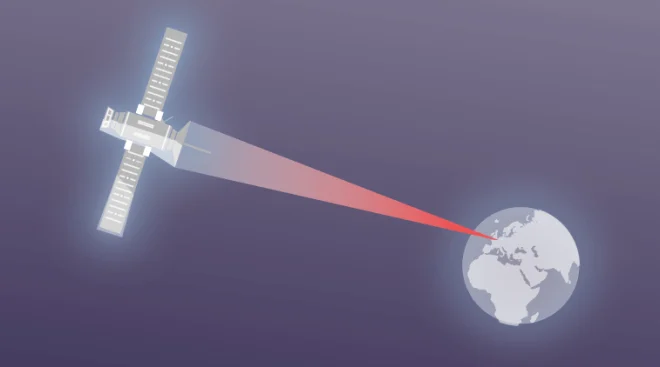
The United States’ disclosure that it has placed a space weapon in orbit has reignited questions over what military capabilities are already operating above Earth — and how they could be used as major powers compete for control of space.
Washington has offered few specifics. US Secretary of the Air Force Troy Meink said the “on orbit” weapon was needed to protect American forces from hostile action, but did not explain what it can do or say when it was launched.
- Advertisement -
So what might the system be, and what does the broader military landscape in space look like? Do Russia or China possess similar capabilities?
Space has been militarised since the earliest years of the space age. In the late 1960s, the Soviet Union deployed weapons there through its Istrebitel Sputnikov (IS; Satellite Destroyer) programme. The satellites were designed to release projectiles that exploded and scattered shrapnel into the path of another, usually American, satellite.
Today, advanced military powers use satellites for a wide range of tasks, from reconnaissance and secure communications to missile-launch detection and the precise positioning of weapons during targeted strikes.
As military technology continues to advance, analysts expect the deployment and use of military hardware in space to grow.
Dr Bleddyn Bowen, an associate fellow in military sciences at the Royal United Services Institute and associate professor in astropolitics at Durham University, said he could only speculate about the US weapon.
“I would expect there to be some kind of electronic warfare or radio-jamming platform, possibly, this would be a non-destructive kind of anti-satellite weapon,” he told BBC Radio 4’s Today programme.
Systems capable of this already operate on Earth and can interfere with satellite communications, he said. “If you take out the radio links then your satellite is very useless.”
Bowen said a more dangerous and destructive option could not be excluded, particularly one that generated debris.
“Less likely would be a kinetic kill vehicle of some sort, so a vehicle that would release a projectile that could ram into a satellite and destroy it,” he said.
Another possibility, he added, was “a type of close inspection and grappling satellite”.
Determining whether Russia and China already have comparable weapons in orbit is difficult.
“If we’re looking towards China and Russia, they have both displayed activity,” Juliana Suess, a former research fellow at RUSI and researcher at the Stiftung Wissenschaft und Politik (German Institute for International and Security Affairs), told the BBC.
“For example, with Russia, we’ve seen some activity that hints at being a co-orbital weapons test. So we saw something that might indicate that they shot a projectile as a test in orbit.
“There are others out there, but without knowing the details, what the American [weapon] is, it’s difficult to draw comparisons.”
Although the system now disclosed by Washington may be unusual, the US, Russia and China have for years possessed weapons that can be directed or fired into space.
In a later BBC interview, Bowen criticised China’s warning that the US announcement could trigger an arms race in space, calling it “the pot calling the kettle black”.
“If you’re already an expert… you know how hollow those words are coming from the Russian and Chinese governments,” he said.
“The United States, Russia and China and also India have all developed different kinds of anti-satellite or counter-space weapons, and Russia and China have put a lot of technologies in space which have a lot of weapons potential,” he added.
Over the past decade, Russia and China have also carried out more manoeuvres in orbit, known as rendezvous and proximity operations (RPOs), bringing spacecraft close to Western satellites.
“Theoretically, these RPO [satellites] can become hunter-killer satellites by physically colliding with them or by nudging them out of orbit,” Dr Rod Thornton, reader in Russian Defence and Security Studies at King’s College, London, told the BBC.
Bowen said China had demonstrated a “space tug capability”, explaining: “A vehicle can go up to a satellite, can grapple it and move it into a different orbit.”
Such technology could serve a constructive purpose, he said, including removing space junk, but could also be used to disable functioning satellites.
Other space weapons, however, risk producing vast quantities of orbital debris.
Dr Mark Hilborne, a specialist in space security and weaponisation at King’s College, said direct-ascent anti-satellite missile tests — including one conducted by China in 2007 — leave substantial debris in orbit for decades.
Suess said debris from that test remained in orbit and continued to pose a danger.
“It doesn’t have to be a sort of huge piece of metal to do any damage, it can be a tiny piece of plastic, given the velocity that we’re talking about in orbit,” she said.
The nuclear threat
Thornton said Russia’s relative lack of satellites and other space weaponry was offset by its missile capabilities.
“The Russians… have ground-based missiles which can be launched into space to strike [satellites] in low Earth orbit. They also have ASAT [air-launched antisatellite] missiles that can be launched from a great height by aircraft,” he said.
“From the Russian point of view, they see Nato as having much better and more satellites than the Russian military can call up, therefore they have invested heavily in ASATs in order to ‘level the battlefield’ somewhat.”
Thornton offered a stark warning about the potential final escalation: “As a last resort, the Russians can also launch nuclear weapons into space and the EMP [nuclear electromagnetic pulse] blast would ‘fry’ any unhardened satellite over a wide expanse.”
So how likely is a nuclear confrontation in space? Only if a conflict were already taking place on the ground.
“What could happen in space is not something that would happen in isolation, really,” Bowen said. “Nothing could happen, or something could.”
Weapons designed for use in space have existed for decades, prompting the question of why Washington made its announcement now. Experts said it was less a major technological breakthrough than a political signal.
Bowen suggested the move could be linked to China’s military expansion.
“China has modernised its military forces over the past 30 years,” he said. “It has put a lot more military satellites in space and has presented a lot more targets that are worth the American military going after and hitting.”
“There’s much more incentive for American space weapons now because China has a lot of vulnerability to space in the same way that the Americans have.”
The result, experts said, is a striking strategic imbalance.
Thornton said Russia would be the “big winner” in a space war because it has relatively few satellites, unlike China and the US. Such a conflict could involve “missiles fired up into space, manoeuvring satellites designed to nudge/destroy them and ground-based lasers,” he said.