At least 13 people, including six children, were killed in Israeli strikes on a town in southern Lebanon, the country’s health ministry said, marking one of the deadliest days of bombardment in the area in recent weeks.
The attacks have intensified fears that Israel is preparing to renew its military campaign in Lebanon. Strikes have escalated for days despite a June ceasefire intended to end fighting between the Israeli military and Hezbollah, the Lebanese armed group.
- Advertisement -
A woman who said she was related to at least three of those killed said one strike hit a residential building as children prepared to leave for school.
The Israeli military said it had targeted people in Kfar Rumman who were transferring weapons.
Eight-year-old Mustafa Farhat lost his grandparents and mother in the attack, local residents said. Rescue workers were still searching for his father’s body on Wednesday morning as the boy remained in hospital receiving treatment for his injuries, they added.
Mona Farhat, one of his relatives, said the family’s home was struck shortly before school began.
“What did they target? What is the goal they are targeting? Do they want us to leave our land? They are mistaken,” Mr Farhat said from the hospital.
Lebanon’s health ministry later raised the reported toll from the strike on the residential building to 12, including six children and three women, according to an update posted on its website.
State media had earlier reported that the strike took place after midnight.
A separate Israeli drone attack on a civilian vehicle in Kfar Rumman killed a medic, the health ministry said. Two more medics were wounded, it added.
The attacks on Kfar Rumman took place without an evacuation warning published online by the Israeli military.
Israel reviewing reports of civilians hurt
Israel’s military said it had taken measures to reduce the risk to “uninvolved individuals”, including using precision weapons and aerial surveillance.
It said it was examining reports that “uninvolved individuals” had been harmed in the strikes.
The Israeli military also said Hezbollah had launched two explosive drones overnight at Israeli troops operating near the Ali al-Taher ridge, a strategically important group of hills in southeastern Lebanon where Hezbollah is believed to have constructed an underground military complex.
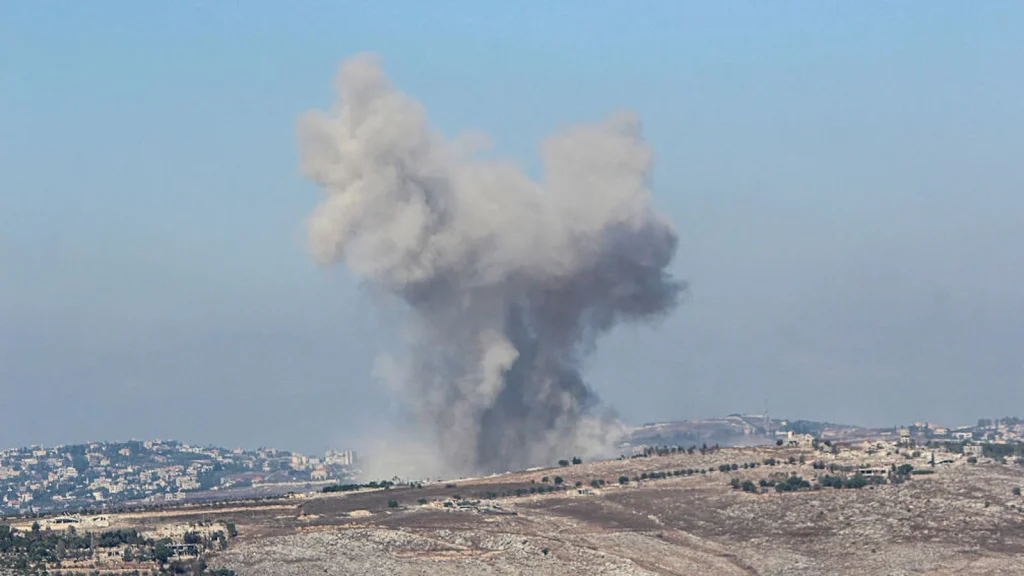
Destruction at the site of an Israeli airstrike that targeted the southern Lebanese town of Deir Zahrani last week
Israel said last week that its forces had removed Hezbollah fighters from the ridge.
Hezbollah has not responded to the claim, and Reuters was unable to independently verify the military situation at Ali al-Taher.
Since then, Israeli forces have stepped up deadly attacks on towns north and west of the ridge, according to Lebanese security officials who spoke to Reuters. Many residents had returned to those areas following the June ceasefire.
The officials said they expected the escalation in southern Lebanon to continue in the coming weeks.
At least 11 people were killed yesterday in Israeli strikes on three towns near the ridge, Lebanon’s health ministry said in an updated toll.
Two of those killed were women who died in attacks on Arab Salim. Israel’s military had issued an online evacuation warning for the town at 6.04am local time (03.04am GMT).
The health ministry said separate Israeli strikes yesterday had destroyed Ghandour hospital in Nabatieh al-Fawqa.
Four more people, including a woman, were killed in strikes on Friday, it added.
No evacuation warnings were issued before those attacks.
Israeli strikes in Lebanon have killed more than 4,300 people since Hezbollah fired rockets at Israel on 2 March — two days after the United States and Israel began striking Iran — prompting an Israeli air and ground offensive.
More than 250 children, nearly 400 women and over 130 medics are among those killed, according to Lebanon’s health ministry.
The ministry does not separately identify civilians and militants in its figures, while Hezbollah has not released a death toll for its fighters.
Although the ceasefire sharply reduced the level of violence, Israeli troops controlling large parts of southern Lebanon have continued demolishing villages inside what Israel calls a security zone.
Israel’s military has also carried out further strikes both within the zone and in areas to its north, most of them without evacuation warnings.
Read our latest Middle East stories here