
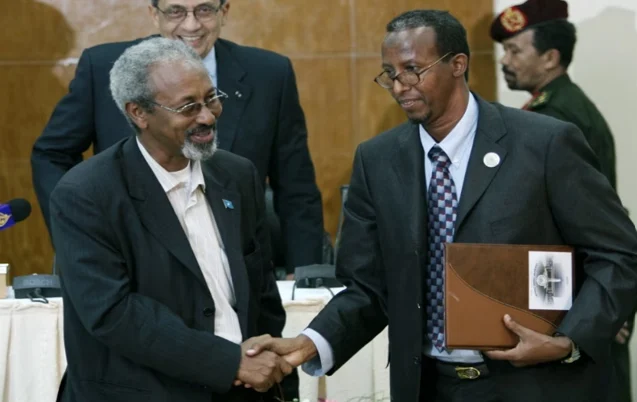
Arab League Secretary General Amr Moussa, seen in the background, smiles as Mohamed Ali Ibrahim, head of the Islamic Courts Union delegation, right, and Somalia’s Foreign Minister Abdallah Sheikh Ismail shake hands after signing a cease-fire agreement in Khartoum on Thursday, June 22, 2006. Nasser / AP
Executive Summary: This strategic analysis assesses the structural weaknesses of the two-decade military campaign against Al-Shabaab and considers whether a sovereign, state-led peace process can succeed. It outlines a four-track roadmap combining constitutional consensus, customary mediation through Xeer, statutory amnesty and reintegration, and focused security pressure to move Somalia from permanent conflict toward lasting national recovery.
- Advertisement -
For 20 years, Somalia and its international partners have fought an exhausting and existential war against Harakat al-Shabaab al-Mujahideen. The group emerged as the radicalized youth and military wing of the Islamic Courts Union (ICU), a coalition of Sharia courts that briefly restored judicial order in Mogadishu before Ethiopia’s December 2006 intervention removed it from power. Since then, Al-Shabaab has evolved into one of the most durable and financially capable insurgencies in modern history.
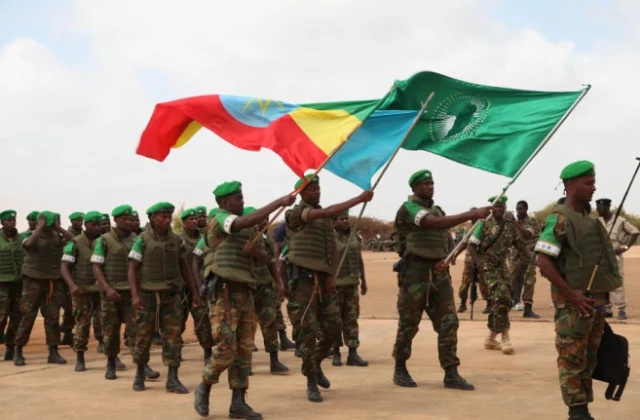
Successive governments in Mogadishu have depended overwhelmingly on military responses: major offensives, foreign peace-enforcement missions including AMISOM, ATMIS and now AUSSOM, targeted drone operations, and the tactical use of clan-based Macawisley defense militias. Yet the human and financial costs have not produced a decisive outcome. Thousands have died, while foreign assistance has reached billions of dollars, including an estimated $3.6 billion from the United States since 2007. Analyses by Foreign Policy and the Council on Foreign Relations describe a conflict locked in a prolonged, mutually damaging stalemate, with Al-Shabaab still entrenched, adaptable and capable.
The pressure is intensifying as international peacekeeping confronts a structural funding crisis. Deployed peacekeepers had declined by 17% by late 2025, while U.S. financial support for UNSOS and AUSSOM is scheduled to end in December 2026. Mogadishu therefore faces a decision it can no longer postpone: can Somalia negotiate an end to the Al-Shabaab war? Available evidence indicates that a shift toward direct, government-led peace talks is no longer simply one option among several. It has become a strategic necessity.
1. Anatomy of a Stalemate: The Limits of Attrition
The case for dialogue begins with the mechanics of the military deadlock. The Federal Government of Somalia’s (FGS) most significant recent counterinsurgency gains came during President Hassan Sheikh Mohamud’s multi-front offensive in central Somalia. Regular Somali National Army (SNA) units fought alongside local Macawisley forces, allowing the government to recover important territory in Hirshabelle and Galmudug, as documented by the International Crisis Group.
But the advance lost momentum as forces moved toward southern insurgent strongholds. Military victories were seldom followed by civilian protection, municipal policing or functioning administration. Al-Shabaab adjusted quickly, withdrawing into rural areas while carrying out assassinations, asymmetric IED attacks and damaging economic blockades against towns the government had recaptured. By 2025 and into 2026, the group had mounted forceful counteroffensives, reclaiming substantial areas seized during the 2022–2023 campaigns and moving to within 45 kilometers of Mogadishu. FTL Somalia’s security tracking points to a broader conclusion: Somalia’s war is fundamentally a contest over governance, shadow taxation and the organization of social order.
The Shadow State Economy and Dual Judicial Systems
Al-Shabaab’s staying power rests heavily on its shadow administration and ability to raise money. Research by the London School of Economics (LSE) and Oxford Academic estimates that the group collects between $100 million and $150 million each year through parallel taxation, transport checkpoints, commercial extortion and real estate levies. That shadow revenue base is substantial beside the Federal Government of Somalia’s domestic collections, which stood at slightly more than $250 million in FY2024 and rose to $404.31 million in FY2025—a 9.4% increase attributed to higher tax and non‑tax revenues, according to revenuedirectorate.gov.so. These figures exist alongside the $3.6 billion in cumulative U.S. military and security assistance since 2007.
The insurgency also operates courts derived from structures associated with the ICU period. In rural districts and major cities, citizens and traders sometimes travel into areas controlled by Al-Shabaab to resolve land and commercial disputes. They often view the group’s rulings as faster and more enforceable than decisions from state courts widely regarded as overburdened and corrupt.
The narrowing of external security support further limits the military approach. Foreign airstrikes can disrupt command networks, but airpower cannot hold territory, run municipalities or tackle the economic and social conditions that enable radicalization.
2. Strategic Drivers: Why FGS-Led Talks FGS-Led Talks Are Inevitable
Three structural factors are pushing Mogadishu toward direct negotiations. First, the shortcomings of attrition warfare show that force can clear territory temporarily but cannot eliminate a shadow state woven into clan relationships and local economies. Research from the Middle East Council on Global Affairs finds that military campaigns without a political settlement tend to move violence rather than end it.
Second, the shrinking international security subsidy makes dialogue more urgent. If the United States ends financial support for UNSOS and AUSSOM on December 31, 2026, Somalia will be unable to depend indefinitely on outside peace enforcement. Waiting for a battlefield victory that may never come, as international support systems recede, could produce dangerous vacuums. Starting talks now would allow Mogadishu to negotiate while it still holds relative leverage.
Third, a credible peace process requires Somali ownership. Foreign partners and regional troop-contributing countries have long shaped the counterinsurgency strategy. The Federal Government must instead become the principal architect of negotiations, ensuring that the agenda reflects domestic grievances, clan power-sharing and constitutional integration rather than outside geopolitical priorities.
3. Diplomatic Signaling, Defection Channels, and Historical Precedents
Mogadishu’s stated policy remains that it will not conduct formal negotiations with Al-Shabaab as an organization until the group breaks with al-Qaeda, disarms and accepts the constitutional order of the Federal Republic. At the same time, the government has expanded quieter efforts involving diplomatic signals and possible defection channels.
Historical Lessons: The ICU Precedent
The Conversation and research from Uppsala University identify the 2006 ICU period as an important historical reference. During the mid-2000s, the Islamic Courts Union showed that an Islamic judicial system could provide local security, administer Sharia justice and bring disparate clan networks under a common authority. A harder-line faction later broke away from those local governance goals and pursued transnational jihadism as Al-Shabaab. Current peacebuilding proposals seek to restore a domestic settlement framework rooted in sovereign governance and constitutional integration. They would use traditional clan elders, or Odayaal, and local Sharia dispute-resolution mechanisms to build community consent while isolating violent transnational ideologies.
Defection Frameworks and Policy Declarations
The government has increasingly concentrated on creating exit routes for ordinary fighters and pragmatic mid-level commanders. Appearing on Dawan’s Miizaan Podcast in late September 2026, Prime Minister Hamza Abdi Barre said the state was prepared to engage insurgents who renounce violence, surrender their weapons and accept civic reintegration. He also noted that several senior former insurgent leaders who surrendered under earlier amnesties now serve in the federal administration.
At the same time, FTL Somalia and the Somali National News Agency (SONNA) reported that Barre rejected claims the government pays Al-Shabaab for protection in Mogadishu. He said the state would neither bribe the insurgency to obtain temporary calm nor make secret concessions that legitimize political violence. The approach combines continued military and intelligence pressure on the hardline leadership with protected avenues for those willing to defect.
4. Strategic Dividend of a Negotiated Settlement
Opening talks from a position of state strength would not amount to surrender. It would be a practical effort to preserve the state, revive the economy and protect civilians.
For humanitarian agencies, a settlement could stop years of displacement, reduce civilian deaths and allow emergency climate and drought assistance to reach areas that remain under insurgent control.
A political agreement could also dismantle overlapping systems of taxation and extortion. Businesses would no longer face the burden of paying both Al-Shabaab and the state, improving access along major trade routes and helping restore investor confidence. In governance terms, dialogue could help the Federal Government reintroduce unified judicial and administrative systems across central and southern provinces. National spending could then gradually shift from overwhelmingly defense-focused budgets toward education, health care, infrastructure and climate resilience.
An internally negotiated end to the war would further strengthen Somalia’s geopolitical independence by reducing its exposure to regional proxy struggles and helping it re-emerge as a stable, sovereign anchor in the region.
5. Domestic Obstacles and Structural Barriers
A sovereign peace effort would confront serious political, ideological and economic obstacles. The first is the sharp divide within the federal system. Disputes between Mogadishu and several Federal Member States, especially Puntland State and Jubaland, involve constitutional amendments, electoral timing, revenue distribution and the centralization of security. These tensions weaken the national campaign and make a unified negotiating position difficult. Al-Shabaab has repeatedly exploited the gaps between political authorities and rival clans.
The second obstacle is the group’s ideological rigidity and international alignment. Al-Shabaab’s senior leadership rejects democratic constitutionalism and secular law in favor of an absolute theological order. Its declared allegiance to al-Qaeda also brings international legal and counterterrorism sanctions that sharply limit direct diplomacy.
The third barrier is the entrenched war economy. Insurgent leaders raise between $100 million and $150 million each year through extortion, while private security interests that depend on continuing instability may also resist peace. Negotiations with a fragmented organization could provoke internal purges by hard-line security bodies, including the Amniyat, against pragmatic commanders or factions prepared to compromise.
6. A Multi-Track Roadmap for Peace and National Recovery
Ending the conflict requires more than a choice between indefinite military operations and unconditional surrender. Somalia needs a coordinated, four-track framework. Track I would pursue domestic political agreement; Track II would establish community-level customary mediation through Xeer; Track III would build statutory amnesty and reintegration systems; and Track IV would preserve carefully targeted military pressure to encourage negotiations.
Track I: Domestic Political Reconciliation and Constitutional Consensus
The Federal Government cannot negotiate effectively with an insurgency while divided against itself. Before opening senior-level talks with Al-Shabaab, Mogadishu should convene an extraordinary National Constitutional Conference bringing together Federal Member State leaders, civil society, opposition representatives and legal specialists.
The conference should produce binding, ratified agreements on three core disputes. It must establish national agreement on electoral models and implementation schedules for universal suffrage and indirect systems; create clear formulas for collecting and sharing customs duties, port tariffs, natural-resource income and foreign aid; and unify the command structure, operational coordination and funding of the Somali National Army, federal police, state intelligence services and regional paramilitary forces. A comprehensive constitutional settlement would give Somalia a common governing front and reduce Al-Shabaab’s ability to play regional administrations against Mogadishu.
Track II: Community Reconciliation, Customary Law, and Local Mediation
High-level agreements cannot endure without local support. Since Somalia’s insurgency is closely linked to clan rivalries and disputes over land, Track II would create a decentralized peacebuilding structure that formally empowers traditional elders, or Odayaal. They could negotiate local cease-fires, protect trade routes and arrange agricultural access with regional insurgent commanders.
The state should also bring Somali customary law, or Xeer, into a stronger relationship with formal legal institutions. Al-Shabaab often gains influence in rural communities by settling longstanding disputes over water, grazing land and blood-money, known as Diya, with speed and certainty. Empowered Xeer tribunals could address those grievances before recruiters exploit them. Federal and state authorities would need protection arrangements to shield participating elders from targeted Amniyat attacks.
Track III: Formalized Reintegration, Statutory Amnesty, and DDR Architecture
An exit strategy cannot work if fighters who surrender face execution or indefinite imprisonment. Track III would establish a legally protected defection process through a National Amnesty and Defection Act. The parliamentary framework would distinguish ordinary combatants and pragmatic commanders prepared to surrender from senior figures accused of major war crimes or international terrorism.
The government would also need to overhaul its Disarmament, Demobilization and Reintegration (DDR) facilities. The system should include biometric screening, trauma counseling, ideological disengagement and vocational training linked to labor-market needs. Because fear of execution by Al-Shabaab’s intelligence wing, the Amniyat, is a major obstacle to surrender, the plan would provide witness protection, safe houses and family relocation. The objective is to show active fighters that surrender can lead to a secure and dignified civilian life.
Track IV: Calibrated Military Pressure and International Alignment
Military power should shape conditions for negotiation and persuade insurgent leaders that victory is unattainable. As AUSSOM reduces its presence and transfers responsibility to Somali forces amid changing international funding, the SNA should adopt a population-centered defense strategy. Its priority should be securing major cities, commercial corridors, ports and agricultural centers, rather than conducting inconclusive rural sweeps that leave recaptured areas exposed to rapid insurgent return.
Elite counterterrorism units and intelligence services should continue precise operations against hard-line commanders, financial checkpoints and Amniyat cells. International partners—including the United Nations, African Union, United States, European Union and neighboring states—must coordinate diplomatic, financial and military support around a single government-led political plan. Force should serve as a means of bringing pragmatic insurgent elements to formal talks, not become an endless objective in itself. Somalia is approaching a decisive moment. As foreign missions withdraw and national forces assume primary responsibility for defense, the state must provide the political leadership needed to end a war that has lasted two decades.
By reaching internal constitutional agreement, strengthening customary mediation, creating protected exit routes and negotiating from a position of sovereign authority, the Federal Government can begin dismantling the political, social and financial foundations of the insurgency and lay the groundwork for a stable, self-reliant future.
Direct, sovereign-led negotiations with Al-Shabaab are therefore no longer merely a preferred policy for Somalia; they represent an urgent national imperative. Twenty years of attrition have shown that military operations alone cannot destroy a deeply embedded shadow state. International security funding is receding, the foreign drawdown is shifting the full defense burden onto Somali forces, and climate-driven humanitarian crises continue to deepen local vulnerability. Every delay risks surrendering the initiative, worsening political fragmentation and leaving millions trapped in recurring conflict. A coordinated, multi-track strategy built on sovereignty and domestic consensus would give Mogadishu a narrow but important opportunity to break the stalemate, protect the state and build a sustainable future for Somalia.
___________________________________
Prof Abdinasir Ali Osman is a veteran Somali senior researcher and consultant with more than 35 years of experience in education, humanitarian affairs, governance, and institutional development and reform. He can be reached at [email protected]